Nearly sixty years have passed since I cooked my first rib eye steaks on a charcoal grill. I had bought them with money I earned from working at the local radio station, WHSM, as a treat for my family. I had taken my Christmas Ball date to the the Blue Heron supper club where we had both enjoyed our steaks, so my motive was perhaps not entirely altruistic.
Alas, my version of charcoal-grilled rib eye steak was not quite as appetizing as the chef’s medium rare steaks brought to our table by an envious waiter. They were so tender you could almost cut them with a table knife and bright pink on the inside with attractive criss-cross char marks on the outside. A pat of butter melting over each steak made it clear that we were having a gourmet dinner.
My first attempt at grilling rib eye steaks convinced me that I had much to learn. I had to fetch paring knives for cutting them. They were the same gray inside as my mother’s pot roast but with the texture of a leather-soled boot. Instead of criss-cross char marks, each steak was a uniform black on both sides. I did put a pat of butter on each one, but even with that elegant touch, the only reason the steaks got eaten was my father’s rule that “You eat what’s put in front of you.”
Except for an unfortunate attempt to grill some bear meat, I confined myself mostly to grilling less challenging meats like hot dogs, chicken legs and hamburgers until long after I was married.
Once married, we managed to dine quarterly or at least semi-annually at a supper club serving decent steaks, so my enthusiasm for a tender rib eye was regularly satisfied. We also were fortunate in having friends who knew how to grill steaks. Unfortunately we were all chronically short of funds, so “tube steaks” were more often served than meat chopped off the loin of a steer. However, Alan cooked some fine steaks in Virginia as did John in Kentucky and Earl in Wisconsin.
It was Earl who taught me the three really important things to remember when grilling a rib eye or other good steak. First, rub it with a judicious amount of seasoning you like; second, have a really hot fire; and third, adjust the cooking time according to the thickness of the steak. To those three I add a fourth: When you spread the charcoal, add a few pieces of apple, maple or cherry wood to give the meat a hint of smoke flavor.
Many of our guests compliment me on the steaks, so we must be doing something right. Of course, it might be that my inability to get dinner done on time is the explanation. As Socrates is supposed to have observed 2,500 years ago, “The best sauce for food is hunger.”
I think, however, that if you follow the guidelines listed above, you will wow your diners with some fine rib eye steaks.
INGREDIENTS:
As many steaks as you need, 3/4 to 1 inch in thickness
Your preferred steak rub or seasoning
PROCEDURE:
Remove the steaks from the refrigerator thirty minutes before starting the charcoal to let them come to room temperature. Make a mound of charcoal large enough to provide at least two inches of coals below the steaks. Light the charcoal.
Rub the steaks on both sides with your preferred rub.
When the mound of charcoal is eighty percent gray, spread the coals in a circle large enough to accommodate the steaks. Sprinkle the wood or wood chips around the coals. Put the grill over the charcoal. Use a damp paper towel to remove any foreign materials from the grill, then arrange the steaks over the charcoal.
If the steaks are three-quarters of an inch thick, turn the steaks after three minutes. Turn them again after three and a half minutes and remove them from the grill.
If the steaks are an inch thick, turn the steaks after four minutes. Turn them after four and a half minutes and remove them from the heat.
Your steaks should be medium-rare.
Serve with baked potatoes, kasha or pilaf.
NOTE: Be careful not to use too much seasoning. An eighth teaspoon is plenty for each side of a three quarter-inch thick steak and a bit more for the thicker steaks.
If you want your steak medium well done, add one minute to the cooking time for each side. Don’t even think about well-done.
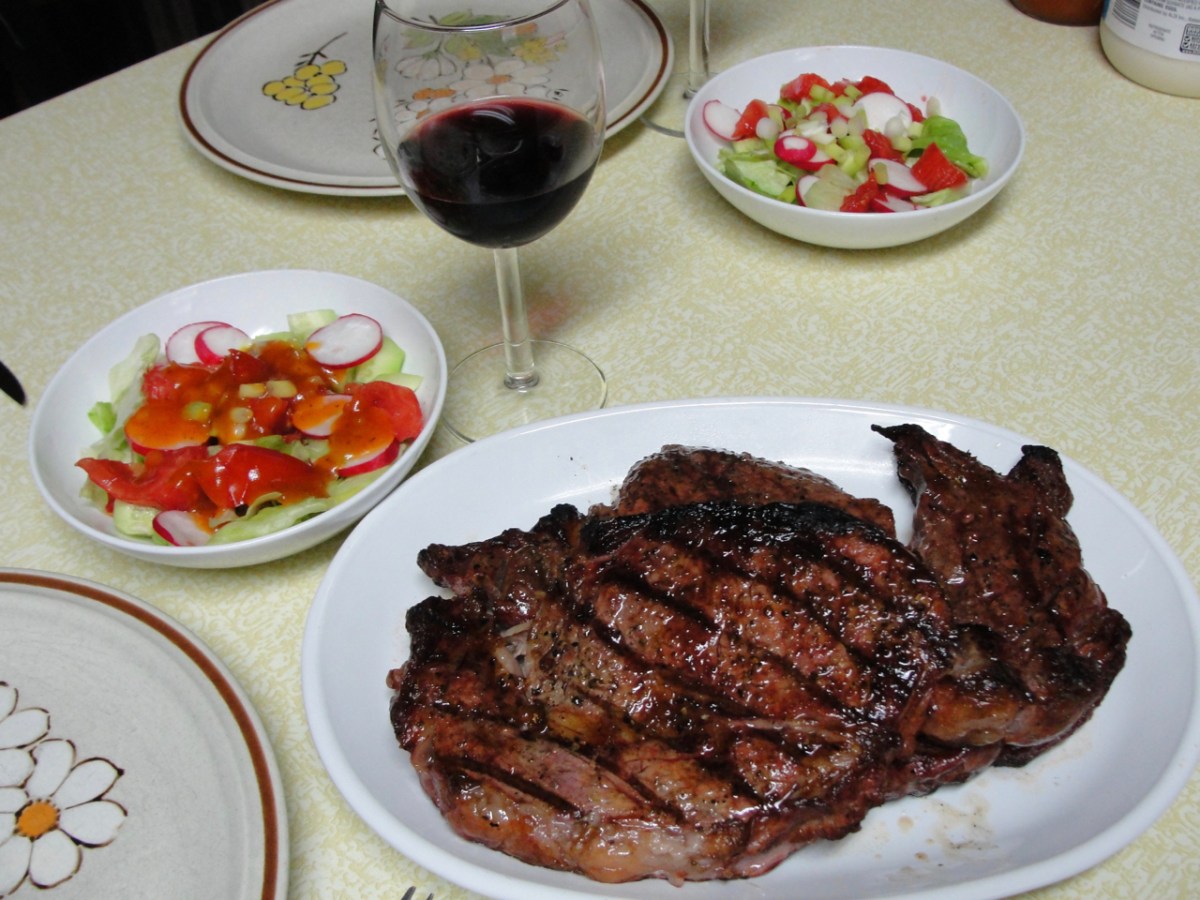
 Incidentally, here are the steaks before I grilled them. Note the light seasoning. The bottom one is the finished steak in the photo at the top of the post.

 Courage in the Kitchen