Patsy’s Buttermilk Biscuits

There are times when baking powder biscuits are indispensable. Sausage gravy, for instance, demands light, tender homemade biscuits hot from the oven.

Unfortunately, mine were neither light nor tender. Though some family members have disagreed, I still think that my biscuits were edible when hot from the oven and covered with gravy or spread generously with butter and jam. And once they had cooled, they could be used for coasters, hockey pucks or skeet practice.

It took courage to make them. Every few months I would try, with no noticeable improvement. Instead of floating down on the plate, they dropped, like ceramic coasters, with an annoying clinking sound. It also took courage to eat them. My victims/guests would ask for extra gravy or more jam.

A few weeks after I mentioned the problem to my sister Patsy, who is an excellent cook, I received the following email:

“Just thought I’d pass on this recipe for biscuits. It is from my Betty Crocker Cookbook and is my favorite for buttermilk biscuits. They always turn out well for me. Give them a try sometime.”

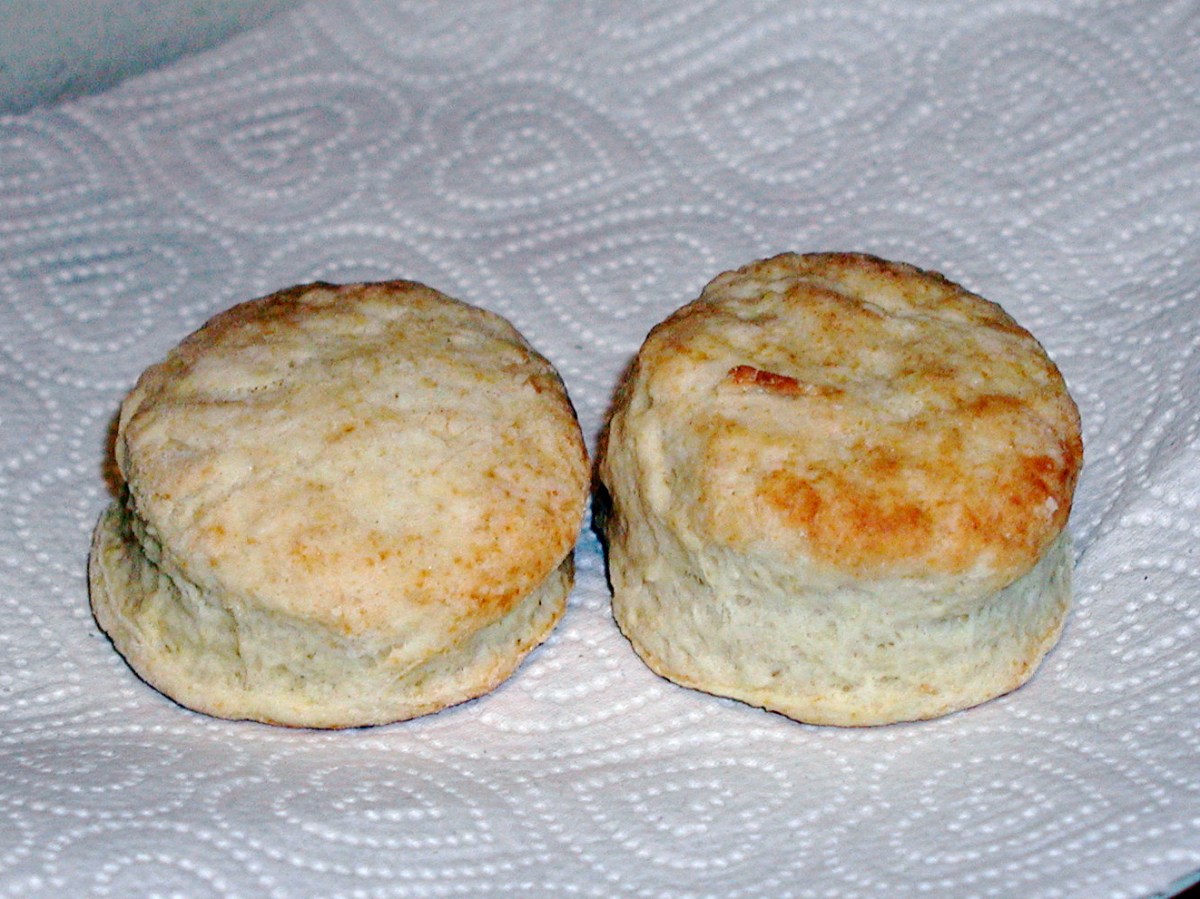
And so I did, and they were at least ten times better than any of my earlier efforts. Here is the recipe.

INGREDIENTS:

2 cups flour
2 tsp. sugar
2 tsp. baking powder
1 tsp. salt
1/2 tsp. baking soda
1/3 cup shortening
2/3 cup buttermilk
1 T milk

PROCEDURE:

Heat the oven to 400º F and bring the buttermilk to room temperature.

Sift the dry ingredients together in a mixing bowl. Cut in the shortening as you would for pie crust until it looks like cornmeal, and then add the buttermilk. Add a little more buttermilk if it looks too dry. Turn the dough out and knead it on a a floured board about fifteen turns, just until the dough forms a smooth ball.

Roll the dough to about a half inch thick and cut it with a water glass or doughnut cutter and place the biscuits an inch apart on an ungreased cookie sheet. Brush the tops with a little milk. Bake the biscuits for ten to twelve minutes or until they are lightly browned.

NOTES: Don’t knead the dough too long or the biscuits will be tough. You may have to make these biscuits a couple of times until you can recognize when you have kneaded the dough enough but not too much. Incidentally, a turn is rolling the dough over after you press it down and turning it a quarter turn.

The dough should be a half inch thick. A little thicker is better than too thin. You should end up with a dozen biscuits.

Jeff Smith’s Zwiebelkuchen (Onion Pie)

Since I grew up surrounded by German relatives, you might think that I learned about Zwiebelkuchen from a grandmother or aunt, but alas the truth is that it was The Frugal Gourmet who introduced me to this dish. Jerri gave me Jeff Smith’s book, The Frugal Gourmet On Our Immigrant Ancestors, in 1991, and we have enjoyed many of the recipes. Jeff’s version of Zwiebelkuchen is one of the best.

For most people in the United States the hardest thing about this recipe is mastering the correct pronunciation of the name. Zwiebelkuchen is pronounced Tsvee-bell-kook-en with the double “o” pronounced like the cooing sound doves make. A Zwiebel is an onion and a Kuchen is a cake or in this compound word, a pie.

Kuchen is the German word that became “quiche” in French, a word most of us know from the name of a wonderful custard pie, “Quiche Lorraine.” Besides the basic Quiche Lorraine, which consists of bacon and eggs baked in a crust, there are many variations. The most common version I have found is one in which Swiss or Gruyere cheese is added to the filling, but some recipes include spinach, mushrooms, broccoli, asparagus and cheddar cheese.

Like quiche, Zwiebelkuchen is an egg custard, but it differs in that there is more onion and bacon in the custard than you find in a quiche. This is a quiche with substance, a real meal for hungry people.

If you don’t have a pie crust on hand, you’ll find an easy recipe here.

INGREDIENTS:

4 slices of thick-sliced bacon (about 1/3 pound)
2 medium yellow onions (3 to 3 1/2 inches in diameter)
2 large eggs
1 cup sour cream
1 T flour
1/2 tsp. salt
1/4 tsp. fresh ground black pepper
1 unbaked 10-inch pie shell

PROCEDURE:

Preheat the oven to 400 degrees Fahrenheit. Take the sour cream and eggs out of the refrigerator. Cut the bacon into half inch pieces and fry it over medium heat until it begins to brown. The bacon should not become crisp.

While the bacon is frying, peel and chop the onions medium fine. You should have 2 to 2 1/2 cups of onions. If there is more than a tablespoon of grease in the skillet with the bacon, drain the excess before you add the onions. Continue cooking until the onions are translucent but not brown. Remove the pan from the heat and allow the onions and bacon to cool slightly while you make the custard.

Beat the eggs until lemon colored, then beat in the sour cream. Sprinkle the flour, salt and pepper over the liquid and beat them in thoroughly.

Prick the bottom of the pie crust a few times with a fork, then spread the onion and bacon mixture over the bottom. Pour the custard mixture evenly over the top, put the kuchen on the middle shelf of the oven and bake at 400 degrees for 15 minutes. Then turn down the heat to 350 degrees and bake for another 10 to 15 minutes or until a knife inserted near the center comes out clean and the top of the kuchen starts to brown.

With a salad and a glass of beer or wine, Zwiebelkuchen makes a wonderful lunch or light dinner.

NOTES: Jeff Smith’s recipe calls for a nine-inch pie crust, but I find that a ten-inch crust works better. With the larger crust I don’t slop custard on the bottom of the oven, and the kuchen bakes faster, so we can get down to the serious job of eating it sooner.