
A few years ago I bought a used cookbook published in 1962 by the Ladies Aid of the Eidskog Church in Ortonville, Minnesota. Ortonville is a small city in western Minnesota founded by Cornelius Knute Orton and incorporated in 1881. Four years later, Scandinavian immigrants in the area began worshipping together in their new church. Services were conducted in Norwegian until 1942.
Like many churches in rural areas, Eidskog experienced shrinking membership in the past few decades. Finally, after 130 years of serving their congregants and community, the church was forced to close. Hoping that the church furnishings could continue to be used by another congregation, Eidskog advertised in The Lutheran that it was closing and wanted to contribute items to any interested church.
The ad caught the eye of Dick Jackson, a member of a new congregation in River Falls, Wisconsin, that was planning a church building. Jackson and his wife met with people from Eidskog and recommended that Hope Lutheran Church accept the generous gift offered by the Eidskog congregation. The River Falls Journal published the story on November 11, 2015. Today, Hope Lutheran is a vibrant congregation with kitchen equipment and even the pews from the church built 130 years ago by those immigrants on the prairie.
I treasure the cookbook put together by the Ladies Aid of that old church. There are eighteen sections in the book, each headed by a verse from the Bible. The last two sections are not recipes but rather useful notes for housewives. “Stain Removal” includes a tip for removing cod liver oil stains, which brought back a memory of dodging the spoon when Mom dosed us with that nasty stuff from the brown bottle. “Household Hints” is organized as a series of “Did you know” questions, and I may test the one suggesting “That hamburger fried in ketchup gives it a barbecue flavor.”
Many of the recipes remind me of potlucks of long ago, and not all of the memories are pleasant. For example, there are seventeen recipes for salads made with Jello or gelatin including the infamous Jello Carrot Salad. However, even the salad section has lots of recipes I would like to try, and as might be expected in a Lutheran Ladies Aid cookbook, the hot dish section is loaded with intriguing possibilities.
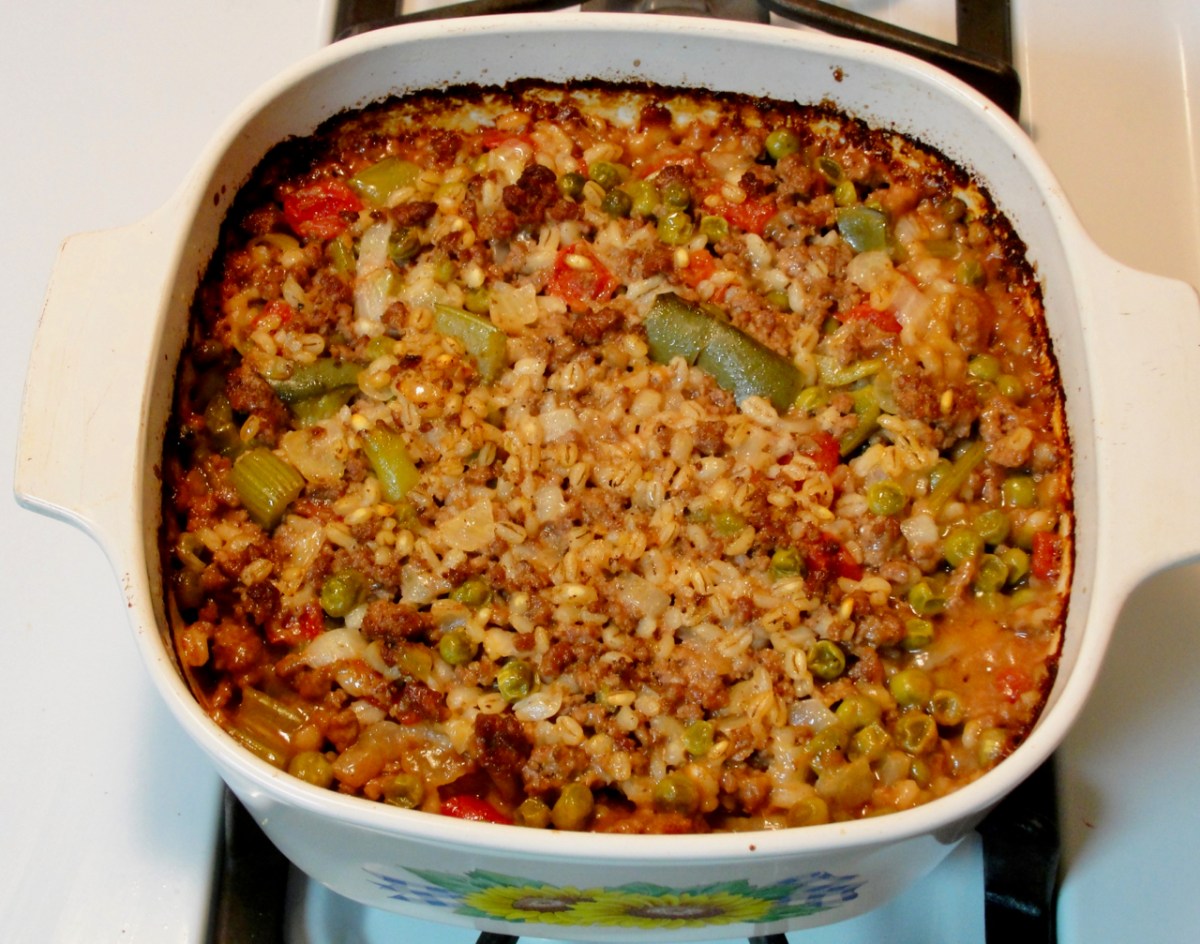
One that tempted me used barley instead of the noodles or rice so often found in potluck dishes. I hesitated to try it when I saw that one ingredient was a can of green peas, but I am glad I made it. The barley lends a satisfying texture missing from rice or noodles, and the combination of vegetables is delicious. You might want to make it for the next potluck you attend. If you think “hot dish” is too pedestrian, you could call it Beef and Vegetable Stew, since that is what it’s like.
INGREDIENTS:
2 tsp. shortening
1 1/2 lbs. lean ground beef (at least 85% lean)
1 small onion (2 to 2 1/2 inches in diameter)
1 large or 2 medium ribs of celery
3/4 cup pearl barley
1/4 tsp. salt
1/4 tsp. pepper
1 green bell pepper (about 3 inches in diameter)
1 can diced tomatoes
1 can green peas
1 can cream of mushroom soup
2 – 3 T water
PROCEDURE:
Coat a large skillet with the shortening and cook the ground beef over moderate heat until it is no longer pink. While the meat is cooking, clean and chop the onion into a quarter-inch dice and the celery into half-inch pieces.
Preheat the oven to 375º and lightly grease a three quart casserole.
Add the onion, celery and barley to the meat along with the salt and pepper and continue cooking for about five minutes. Wash the pepper, cut it into quarters and remove the seeds and white membrane. Chop the pepper into a half to three-quarter-inch dice.
If the skillet is large enough, add the pepper, tomatoes, peas and the can of mushroom soup to the meat mixture. If it is not, combine everything in a large mixing bowl. Rinse out the cans with two or three tablespoons of water, stir everything together and spoon the mixture into a three-quart casserole.
Cover and bake for 1 1/2 hours.
NOTES: This recipe is from a Lutheran cookbook. Feel free to add a little more salt and pepper or even a few drops of hot sauce if you prefer a spicier dish.
Do not drain the vegetables, as you want the flavor and liquid in the dish.
Finally, a sincere thank you to Mrs. Heins for her recipe and to all her friends who worked so hard at Eidskog and in so many other churches to share their favorite recipes with latecomers like me.

 Courage in the Kitchen