Buttermilk Wheat and Rye Bread

When my father built our house north of Hayward, he hired a carpenter to build the kitchen cabinets. My mother told him what she needed in her kitchen. Her specifications included a flour bin large enough to hold twenty-five pounds of flour, a scoop and flour sifter. The bin was wedge shaped and pivoted on the bottom so Mom could tip it forward, scoop out the flour she needed and then tip the bin back out of the way. It looked like the other cabinet doors, except that the pull was horizontal rather than vertical.

Flour bins were still common when I was growing up in the 1940’s and 50’s. Flour came in cotton sacks that held twenty-five pounds. Besides plain white sacks, the mills began using printed fabric in a wide variety of colors and patterns for flour sacks so thrifty housewives could turn them into clothes and other useful items.

Jerri remembers the flour sack dresses her mother made for her. Esther was a careful and talented seamstress, so Jerri’s dresses compared well with those worn by the other girls she played with. Once her mother made matching pink and white floral dresses for her and Jerri. My mother knitted and crocheted. She was not a seamstress, so she didn’t make dresses for my sisters. However, she did use her old Singer sewing machine to make flour sack aprons, dish towels, curtains and pillowcases.

Flour sack pillowcases were standard but they were not as nice as the smooth percale pillowcase my mother used when she wanted to keep her hair looking nice. Jerri still chuckles when she recalls the story of an exchange between her cousin Bruce and her Aunt Hilda.

Bruce began the conversation with a request. “Mom, could I have a pillowcase?”

Surprised, his mother asked, “Did I forget to put one on your pillow?”

“Yes. It’s just a flour sack,” he lamented.

Though it was never a flour sack, I have a pillowcase that reminds me of those I slept on for many years. I have enjoyed fly fishing for trout since I was a boy. A year or so after we built our cabin along a trout stream my mother made me a pillowcase from fabric with a trout fishing pattern. The material is soft but not as smooth as percale. I love it.

I love to bake bread too. Here is a recipe that I came up with when I asked Jerri what kind of bread I should bake. We had nearly finished the second loaf of an old fashioned white bread I had baked the week before and she suggested, “How about something with whole wheat or rye flour?”

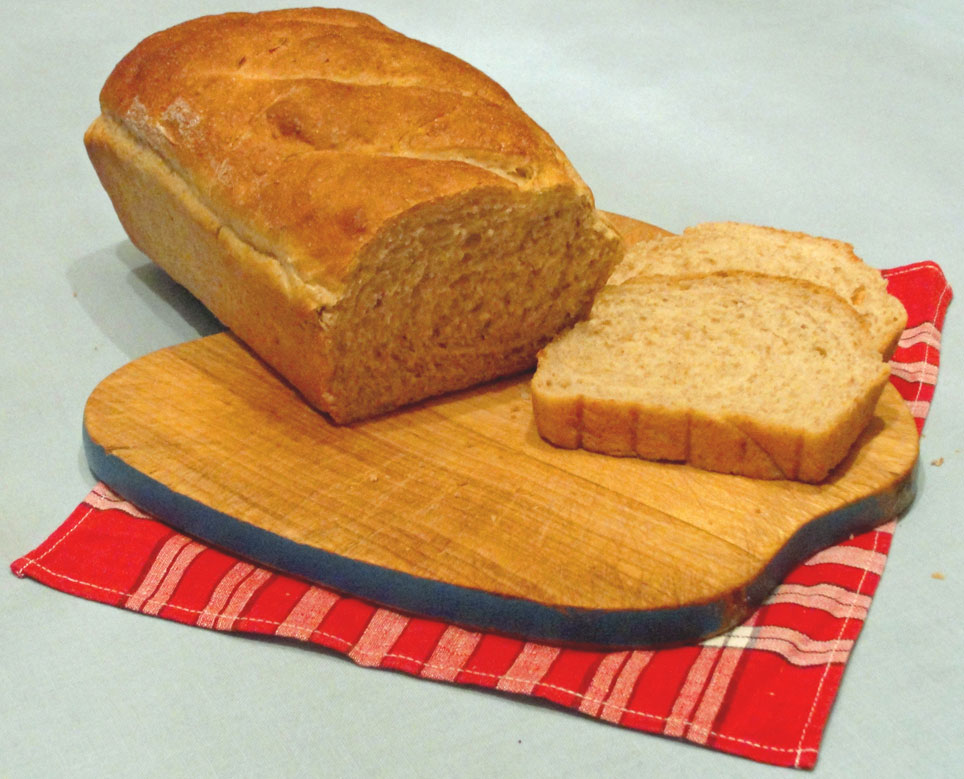
Our No-Knead bread uses a cup of rye flour and my Cabin Wheat Bread recipe calls for whole wheat flour, but I decided to try a combination of wheat and rye flours. We like this bread a lot.

INGREDIENTS:

1/2 cup lukewarm water
1/8 tsp. sugar
1 package or 2 1/4 tsp. active dry yeast
1 cup whole wheat flour
1 cup rye flour
4 to 4 1/2 cups all purpose flour, divided
2 tsp. salt
2 cups buttermilk
3 T butter
3 T honey
1 egg

PROCEDURE:

Put 1/2 cup lukewarm water (100º to 110º) in a cup with 1/8 teaspoon sugar and stir in the yeast. While the yeast is proofing, heat the buttermilk to lukewarm and melt the butter. Blend the whole wheat and rye flours with a cup of all-purpose flour and the salt in a large mixing bowl.

Stir the buttermilk, yeast, honey and butter into the dry ingredients until you have a thick but pourable batter. If necessary, add a little more water. Cover the bowl and set it in a warm place for an hour. You are making a sponge.

After the hour has elapsed, the sponge should have at least doubled in bulk and have some bubbles on top. If it doesn’t look like that, let it continue working for another half hour or so. Stir in a cup of all-purpose flour followed by another half to three-quarter cup to make a dough that begins to pull away from the sides of the bowl.

Scrape the dough out on to a well floured surface and and turn it with a spatula or baker’s scraper to cover the surface with flour. Knead until the dough is smooth and satiny, five to seven minutes. Return it to a greased bowl, turn it to cover the dough lightly with grease, and cover the bowl with a damp towel. Let the dough rise in a warm draft-free place until it has doubled in bulk.

Grease two five by nine inch loaf pans with vegetable shortening.

Tip the risen dough onto a lightly floured surface and and knead it for five or six turns, then divide it in half and form two loaves. The easiest way to form the loaves is to flatten each half of dough and roll it into a nine by 12 inch rectangle. Roll up the rectangles into nine inch logs, sealing the edges and place them seam-side down in the pans. Cover them with a damp towel and set them in a warm draft-free spot to rise.

While the loaves are rising preheat the oven to 400º.  When the loaves have risen slightly above the tops of the pans, beat the white of an egg with two teaspoons of cold water and paint the tops of the loaves. Make three or four angled cuts a quarter inch deep across each loaf with a sharp knife. Place the loaves on the center rack in the hot oven After ten minutes, reduce the heat to 350º and bake approximately twenty-five minutes longer.

When the twenty-five minutes are up, tip the loaves out of the pans and tap them on the bottom. If the loaves sound hollow, the bread is done. You can also test for doneness with an instant-read thermometer inserted into the center of the loaves. When it reads 200º, your bread is done. If you want a firmer crust, turn off the oven and let the loaves bake directly on the oven rack another five minutes. Cool them on a wire rack before slicing.

NOTES: Making the sponge with buttermilk gives the bread a hint of sourdough. If you want to emphasize this flavor, try letting the sponge work a few hours longer or even overnight.

Jerri’s Pumpkin Nut Cookies

Halloween trick or treating can be a lot of fun. Mothers and fathers know it, even though they may not be the ones greeting folks at their doors with shouts of “Trick or treat!!” Even a shy three-year old Tinkerbell or Dracula soon starts running up sidewalks and holding out a plastic pumpkin or paper bag to collect the loot and hurry back giggling to mom or dad ready to move on to the next house.

Jerri and I look forward to Halloween every year. We enjoy the little kids, though sometimes we have to lean down close to hear the whispered “Trick or treat” and we certainly get a kick out of seeing older children participating, especially when they are shepherding a litter of little ones. When Jerri was giving piano lessons, one of the special treats was seeing some of her students in costumes and smiles.

My first few years as a trick or treater involved visiting the neighbors when we lived in Hayward, but we moved into the country when I was seven, and neighbors were far apart. There were only three houses besides ours in the first mile of the town road in front of our house, but they were all in the first quarter mile, so we made them our first stop of the evening. Then Mom and Dad would drive us into town. They would visit with friends for an hour or so while my sisters and I walked the streets on the north side of Hayward.

By the time I entered high school, however, I was feeling a little odd about trick or treating. Teen anxiety, perhaps, but a more sophisticated friend than I suggested that we might have some fun collecting money for UNICEF. To be honest, I don’t think that I knew what UNICEF was when she mentioned it. Once I understood that we would be collecting money for the United Nations Children’s Fund, however, I was all for the project and helped recruit a team.

There were six of us, and we worked in pairs, a guy and a girl, each of us carrying a can with orange construction paper taped around it. My partner and I were doing pretty well collecting nickels and dimes from homeowners happy to help children in need.

When we came to the Twin Gables bar at the end of Beal Avenue we saw quite a few cars in front, which prompted me to suggest that we try our luck for UNICEF inside. Since my parents were good friends of Fritz and Irma who owned the place, I knew them both and was confident that they would give us a chance to explain our reason for coming in.

Collecting for UNICEF in a bar was a brilliant idea. Irma started it off with a dollar bill and explained to the patrons what we were doing. My partner and I set up a squeeze play: She began at the south end of the bar and I took the north. We may have been lucky, but the first two people wiped their change from the bar and dropped it into our little orange cans, then proceeded to bully everyone else into doing the same.

As we walked behind the row of stools, the person who had just contributed encouraged his or her neighbor. The advice was blunt but good-natured. “Jake, Lois is wondering where you are. Just give ‘em the money and go home. You’ve had enough.” and “You missed a quarter, Phil, dump it in.” I think that we collected ten dollars from that one stop. That’s about $75 in today’s money.

When we rendezvoused with the other two teams, we told them what we had done. They had skipped the bars, which were downtown and away from the houses they had called on, so we split up and covered the Karibalis’, Anglers and Moccasin bars in just a few minutes with similar success. It was a fun night that we repeated for the next three years until I headed for the university at Madison. UNICEF did well.

Though we no longer walk the streets on Halloween, Jerri and I still look forward to greeting the trick or treaters who come to our door. We usually have a pretty good turnout. Perhaps they are attracted by the Jack O’ Lantern that I carve each year. While not as artistic as many in our neighborhood, I do think that trick or treaters appreciate the sight of a truly primitive carving. At least, they are often laughing when I open the door.

One extra benefit of carving a Jack O’ Lantern for Halloween is that you can turn it into pumpkin pies, breads and cookies. We used to do that. Today I just break our Jack O’ Lantern into pieces in front of my deer stand, but years ago I cleaned and peeled my work of art so Jerri could make mashed pumpkin.

She found this recipe when we were living in Kentucky and modified it to make cookies that were healthful as well as tasty. Hence the whole wheat flour, mashed pumpkin, raisins AND nuts. It’s a cookie that is almost a balanced diet by itself with dairy products (eggs), whole grains (whole wheat flour) fruits (raisins and pumpkin) and nuts. If, like many of us, you think pumpkins are really vegetables, you will feel even better about eating these cookies.

Since you simply stir stuff together to make a soft dough and drop globs of it on cookie sheets, these cookies are very easy to make. We use canned pumpkin today, but if you are cooking a couple of pumpkins for pies, save a cup of mashed pumpkin for a batch of pumpkin cookies to share with your family and friends this fall.

INGREDIENTS:

1 cup shortening
1 cup granulated sugar
2 large eggs
1 cup mashed pumpkin
1 cup all-purpose flour
1 cup whole wheat flour
4 tsp. baking powder
1 tsp. salt
2 1/2 tsp. cinnamon
1/2 tsp. nutmeg
1/4 tsp. ginger
1 cup raisins
1 cup chopped nuts

PROCEDURE:

Cream the shortening and sugar until the mixture is light and fluffy. Add the eggs and pumpkin and mix thoroughly until you have a smooth batter. Put the flours, salt and spices into a sifter and sift the dry ingredients into the batter by thirds, stirring well after each addition. Fold in the raisins and nuts.

Preheat the oven to 350º and grease the cookie sheets.

Drop rounded teaspoonfuls of batter onto the cookie sheets and bake the cookies for about fifteen to eighteen minutes until the edges begin to brown. You should end up with about four dozen cookies.

NOTE: Depending on the moisture content of the pumpkin and flour, you may need to add a small amount of water or flour to the batter. It should be stiff but not dry.