Eight people stand in front of a car in a field with trees in the background. In the back row, the dapper man on the left with the mustache is my grandfather. He is wearing a three piece suit, tie and a golf-style cap. At the far right is my grandmother in a dress decorated with what appears to be satin. White stockings contrast with her sensible shoes.
Between Grandpa and Grandma stand their three oldest children—George, Margaret and Harry, my father. The three younger children are in front. Like her older sister, Laura is outfitted in her Sunday best complete with a hat and handbag. The naughty one hiding her face with a scarf is Hilda, but her little brother Harold stares directly into the camera.
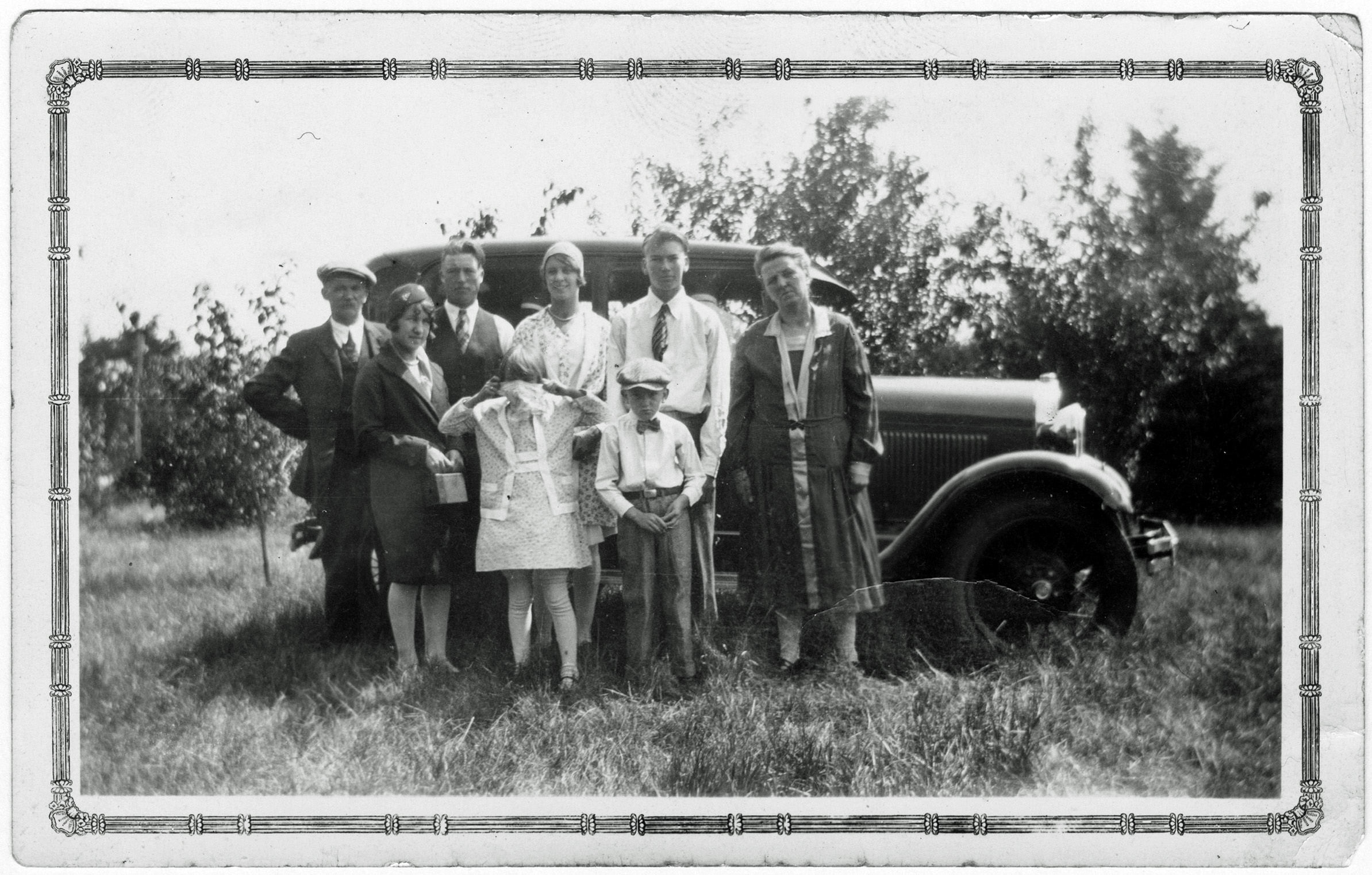 The Rang family was having their photo taken with their new 1929 Ford. It was the last car Grandpa bought, a black Model A Fordor with room enough for the entire family. The price was $613. My father told me that the car was paid for with the money Grandpa got for the potatoes they sold that year from the small field between the house and the road.
Though Grandpa and Grandma Rang had dairy cows and flocks of chickens and ducks and grew oats and hay, potatoes were the cash crop. When my father was growing up, Wisconsin ranked in the top three or four states for potato production. Grandpa was proud of his potatoes, and they gave him some extra money to put into a savings account at the bank in Hayward.
He was lucky to have bought the car before the bank failed. All the savings the family had earned from their hard work in the fields disappeared. A few months before the Crash, Grandpa had started putting the cream checks into a bank in Stone Lake, Wisconsin, which survived the depression, so he had a little cash. They didn’t have much money, but at least they had a new car.
My father told me that the Ford replaced the Overland he had learned to drive when he was about ten years old. He would drive it from the farm to the north side of Hayward, where Grandpa would take over the controls. Grandpa never liked to drive a car, but he felt that it was his responsibility to drive in town.
I don’t think that I have ever seen an Overland except in photos, but I have wonderful memories of Grandpa’s Model A. Dad and his younger brother, Uncle Harold, used it to hunt ruffed grouse, which we called partridges. The Model A was designed to be driven on the roads of the time, complete with rocks, ruts and mud holes. It sat high above the ground on its twenty-one inch wheels and was perfect for negotiating logging roads and fire lanes in northern Wisconsin.
My father was a mechanic and I was interested in cars, so I soon learned that Grandpa’s Model A went about twenty miles on a gallon of gas, that it had mechanical brakes and a three speed transmission. It also had a heater that was adjusted by sliding a metal cover off a hole in the floor behind the engine and a windshield that could be cranked up to let cool air in.
The crank out windshield made it an ideal “bird hunter’s” car. Once we left the highway and were on a gravel road or dirt track through the woods, the windshield would be cranked up and Dad would load his double-barreled shotgun. It was a twelve gauge with big hammers. Uncle Harold drove and I watched from the back seat.
“There’s one!” Dad would say. Uncle Harold would stop or slow down to get closer to the partridge as my father aimed the gun through the open windshield. And then, “Boom!!” My ears would still be ringing as my father brought the partridge back to the car and laid it on a gunny sack on the floor boards next to me in the back.
Not very good for one’s hearing, not very sporting either, but we had lots of partridges for supper when I was growing up.
Scalloped potatoes go pretty well with fried partridge. You can make your own like this.
INGREDIENTS:
5 to 6 cups potatoes
2 to 3 T minced onion
3 T butter
2 T all-purpose flour
2 to 3 tsp. salt
3/4 tsp. freshly ground black pepper
2 cups milk
PROCEDURE:
Preheat the oven to 350º while you mince the onion and peel and thinly slice the potatoes. A mandoline or the slicing side of a kitchen grater makes this job easy. Heat the milk to steaming.
Melt the butter in a saucepan and stir in the flour, salt and pepper to make a roux. Cook the mixture for a minute or two, but be careful not to brown it. Add the hot milk. Stir continuously until the mixture bubbles and you have a smooth sauce. In case you are interested, what you will have made is a white or Béchamel sauce.
Mix the onion with the potatoes and spread them in a nine by nine or eight by twelve-inch baking dish. Pour the sauce over the potatoes. You should be able to see the sauce in the top layer. If you can’t, add a little extra milk. Put the dish on a center shelf in the oven and bake uncovered for about an hour.
NOTES: If you are using reduced fat milk, use an extra tablespoon of butter to make the sauce. Be careful with the salt. Two teaspoons is enough for our taste, but you may want a little more. Remember, you can always add salt at the table, but it is extremely difficult to get those little salt crystals separated from the milk and potatoes after the dish is cooked.
For best results, use waxy potatoes like reds or golds instead of russets. If all you have are russets, however, they will taste fine, though they tend to become mushy,

 Courage in the Kitchen