Kielbasa and Cabbage

As I have written before, Mom’s Boiled Dinner was one of my favorite meals. Paired with fresh homemade bread and some lunchmeat for a sandwich, it was the perfect meal on a cold winter’s night. Kielbasa and cabbage is a good warm-weather dish that gives you that same wonderful combination of meat and vegetables cooked in one pot with only just enough broth to blend the flavors. There is plenty of meat, so you can skip the sandwiches.

Kielbasa is the Polish word for sausage, but there are varieties of sausage called Polish sausage that are not Kielbasa. Today most Kielbasa is found as a smoked cooked sausage, but this recipe uses the fresh variety, which Polish speakers call Kielbasa biala (White Kielbasa). White kielbasa must be cooked. The browned slices of sausage combined with the sweet onions and cabbage give this dish a unique, rich flavor.

1 – 1 1/2 lbs. Fresh Kielbasa
2 T butter, divided
1 1/2 cups sweet onion
1 small cabbage(4 to 5 inches in diameter)
3 or 4 medium carrots
2 or 3 medium potatoes
1 stalk celery
1/2 cup water
1 tsp. beef bouillon
Salt and pepper to taste

Cut the sausage into thin slices and put them into a large skillet with a tablespoon of butter over low heat while you prepare the vegetables.

Cut off the stem and root ends and remove the dry outer layer of the onion. Chop it into a quarter-inch dice and set it aside in a small bowl.

Remove any damaged leaves from the cabbage and wash the head. Cut it into medium wedges about two inches thick and set them aside in a mixing bowl. Scrub or scrape the carrots, remove the stem ends and chop the carrot into half-inch slices. Peel and chop the potatoes into half to three-quarter-inch cubes. Clean and chop the celery into half-inch pieces. Put these vegetables together in a mixing bowl.

Raise the heat under the skillet to medium and fry the sausage until it is well browned. Use a slotted spoon to transfer it from the skillet to a bowl.

Reduce the heat and put a tablespoon of butter into the skillet. Add the onion and cook it until it is translucent but not browned. Add the vegetables, water and bouillon along with quarter teaspoons of salt and freshly ground black pepper. Cover the skillet and steam the vegetables for ten minutes. Stir in the sausage, add a little water if necessary and replace the cover.

Continue cooking the meat and vegetables for about twenty minutes. Taste and adjust the seasoning.

Serve in bowls with bread and a good beer

NOTES: You don’t need to peel thin-skinned new potatoes. If you have some of those tasty potatoes in your pantry, just scrub them well and chop them into pieces. It is easier to slice the sausage if it is partially frozen, but uniform slices are not important. Just be sure that the sausage is cut into small bite-sized pieces.
Maple-Glazed Baked Ham

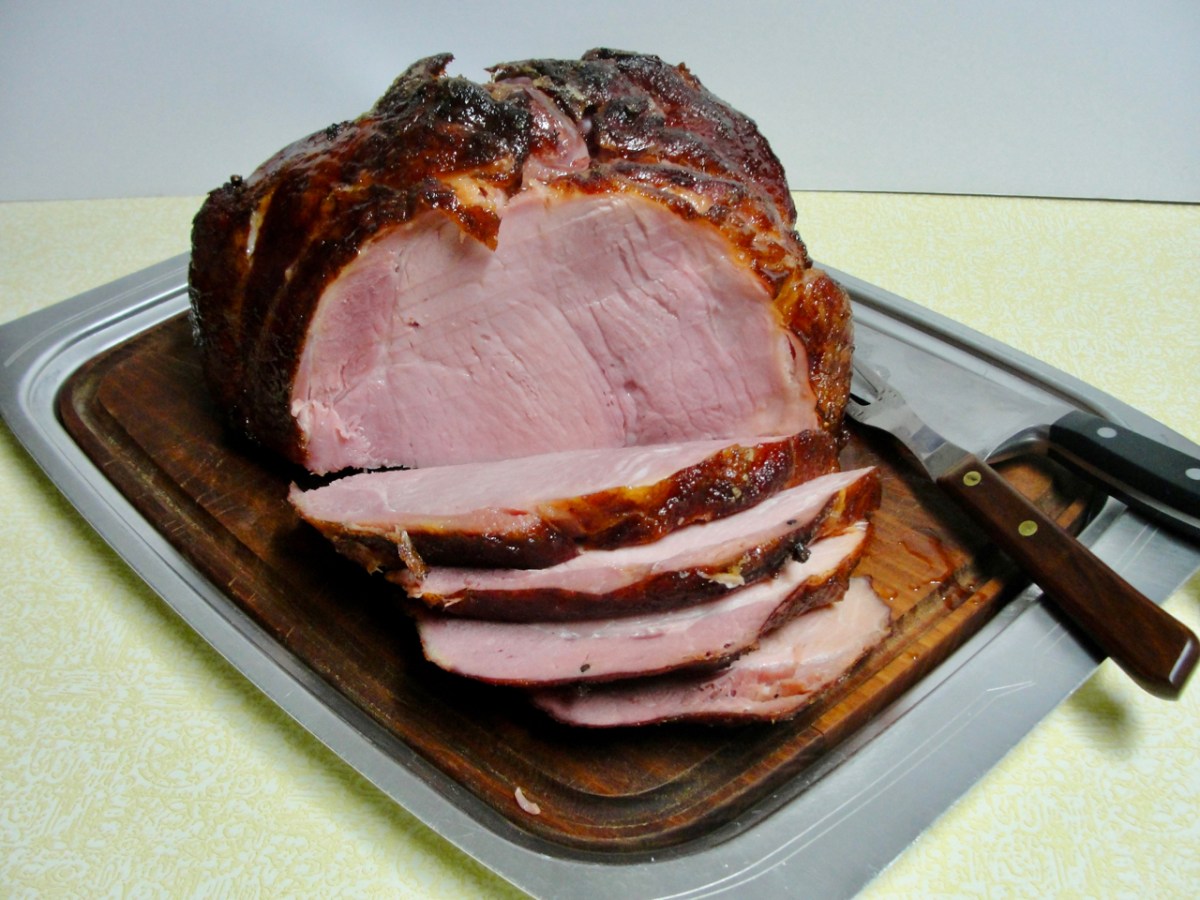
Dorothy Parker is credited as having once observed that “Eternity is a ham and two people.” Though I am not a mathematician I am aware that half of eternity is still eternity, but leftovers from half a ham disappear in less time than they do from a whole ham, so my recommendation is that you ask for half a ham from the butcher. It will weigh somewhere between eight and twelve pounds.

If he (or she) tells you that they sell only whole hams, ask him (or her) to cut and wrap it in two halves. You can bake one half now and freeze the other until you have finished the leftovers in a few weeks.

A properly baked ham is a marvelous meat. Start with a top quality real smoked ham, not one flavored with liquid smoke. Avoid the cheapest hams on display. Most chain grocers sell these inexpensive hams processed in factories that inject water and various flavorings into the meat so it weighs more and looks juicy.

Water is cheap, but pure water has very little flavor. It adds nothing to the ham except weight but does increase the profit for the processor, wholesaler and grocer. Notice that you as a customer are not on that short list.

The best way to get a good ham is to buy it at one of the many meat markets scattered throughout the United States. Those of us fortunate enough to live in Wisconsin or Minnesota have no trouble finding a good ham. Study the awards and ribbons displayed on the walls of the shop. If you find a fairly recent award for ham, you will probably have a good start on dinner.

We have eaten excellent hams from quite a few small markets in Minnesota and Wisconsin, but our favorite source today is Louie’s Finer Meats in Cumberland, Wisconsin. Louie’s hams have won awards from Frankfurt, Germany to Milwaukee, Wisconsin, and we are lucky that the market is located along the highway we take to our cabin.

We stop nearly every trip north, but usually for bacon, brats, or some prize-winning sausage for sandwiches. Serving a ham requires planning so before you buy it you might want to organize a family reunion or invite a football team or two to share dinner or at least make sure you have some extra room in the freezer for leftovers.

After our first ham dinner, we cut the meat off the bone and package it in meal-sized portions before it goes into the freezer. It still tastes fresh and delicious a couple of months later and can be used for everything from sandwiches to casseroles. One of our favorites is Jerri’s Ham and Swiss Lasagna . Incidentally, be sure to leave some meat on the bone to make Mom’s Boiled Dinner.

To create those leftovers, you need to bake your ham. A good ham has lots of flavor already, but a glaze brings it to perfection. There are many opinions about what makes a great glaze, but I prefer a very simple recipe of four ingredients that add color and flavor to the finished product. I hope that you try it sometime.

INGREDIENTS:

1/2 smoked ham (8 – 12 lbs.)
12 – 16 whole cloves
1/4 cup maple syrup
1/4 cup brown sugar
1/2 tsp. dry mustard
1 T cider vinegar

PROCEDURE:

Preheat the oven to 325º. Put the ham fat side up uncovered on a rack in a baking pan. Use a thin sharp knife to poke twelve to sixteen shallow holes in the ham three to four inches apart over the top and sides of the ham and insert a clove into each hole. Set the roasting pan on a lower shelf in the oven and set the timer for ninety minutes.

Make the glaze by whisking the syrup, sugar, mustard and vinegar together in a small bowl while the ham is cooking.

When the timer reminds you, remove the ham from the oven and brush about half of the glaze over the ham. At this time you can insert a meat thermometer into the thickest part of the ham or if you have an instant-read thermometer, simply return the ham to the oven and continue baking for thirty minutes more.

Check the internal temperature of the ham at this time. It is done if the thermometer reads 145º; if it does not, bake it a few minutes longer. You can baste the ham again when you check the temperature. The baking time depends on the size of the ham.

When the thermometer reads 145º take the ham from the oven and baste it once more with the glaze. Return the ham to the oven for about five minutes before removing it from the oven to rest for ten or fifteen minutes before carving your masterpiece.

NOTES: If your roaster is too small to accommodate your baking rack, crumple aluminum foil to make four or five cigar-shaped rolls about a half inch thick and set the ham on them in the roaster.

I almost always visit Louie’s web site before we head north to check out the In-store Specials. Recently I spent a few minutes reading about recent awards won by Louie and his team. Louie’s champion bone-in ham took first place this year at the Wisconsin State Fair and sold for a record price of $8,100 at the 4-H Auction. The $30 I paid for our half ham was a real bargain!