
This is the story of a pot roast cooked over thirty years ago by two men in a primitive cabin along the English River in Ontario, Canada.
I had persuaded four friends that it would be fun to spend a week catching lots of fish in a remote area that would remind them of their childhood. We would fish lakes with shorelines of trees and grassy meadows instead of cabins and docks. We would be the only boats in sight on lakes filled with fish that had never seen a Rappala and didn’t realize that those curved thingies above those juicy minnows were really nasty hooks.
We could hold the costs down by buying most of the food at our local supermarkets and use the savings to buy a couple of cases of Labatt Blue and some Crown Royal in Fort Frances after we crossed the border from International Falls, Minnesota, into Canada. I would cook breakfast and make sandwiches for lunch, and we would take turns cooking supper. I promised them that they would never forget the trip.
I was right. My fishing predictions proved accurate, but there was another event that left us with an indelible impression. I call it the incident of the broken butcher knife.
We had two boats. Doug, Ed and I shared one while Dick and Bud manned the other. On the second or third day of our adventure, Dick was scheduled to cook a pot roast for supper. I had bought a big roast from the butcher in New Richmond and frozen it to help keep things cold in a cooler on our way north. I checked the roast in the gas refrigerator before we headed out that morning and told Dick it would be thawed for him that afternoon.
About three o’clock, Dick and Bud headed back to the cabin to get supper started. The walleyes were hitting well, and the three of us not on dinner detail relaxed in a breeze over the lake that kept the flies and mosquitoes away from us as we caught and released enough nice fish to make a Wisconsin angler give thanks and go to church three Sundays in a row rather than tempt luck again.
About six o’clock, we motored leisurely back to the cabin, ready for the evening Crown Royal and water. The wonderful fragrance of pot roast greeted us as we came into the cabin. Dick and Bud scowled at us as we came in. We thought it was just because they had to quit fishing when the walleyes were hitting so well, but the problem was worse than that. They were sitting at the table, and the Crown Royal bottle looked less full than it had when we corked it the night before.??“Smells good,” I offered, “everything okay?”
“Well, not really,” answered Bud, who gestured toward the little counter and sink. On the counter in plain sight were two pieces of butcher knife.
“What happened,” I asked.
Dick’s answer didn’t make any sense at first. “Too big,” he said, “too damn big.”
Dave or Ed chimed in, “The knife was too big?”
“The roast,” answered Dick.
“It wouldn’t fit in the pot,” explained Bud, “so I got a rock to pound the knife through the damn bone.”
Once they had broken the knife in half, they used the rock to hammer the stub of the knife through the bone in the roast to make the meat fit in the Dutch oven.
“Why did you chop the bone in half?” I asked.
“It was too big to fit,” said Dick. “What would you have done?”
“Cut the bone out of the meat,” I replied.
“Oh,” said Dick, and had another swallow of Crown Royal.
The roast was delicious, but we were charged twelve dollars for the broken knife.
“I’m not surprised,” said Dick, who as a banker was appointed our treasurer, “they charged us twenty-five cents apiece for the minnows.”
But it was worth it. We caught a lot of fish and had a vacation to remember.
Here is how to make a really simple beef pot roast, the sort of dish you put together in a kitchen that has only the basics.
INGREDIENTS:
4 or 5 lb. beef chuck roast
3 – 4 slices bacon
1 – 1 1/2 tsp. salt
Beer
1/2 cup water + more as needed
1/2 – 3/4 tsp. black pepper
1 large yellow onion
4 – 5 russet potatoes
5 – 6 large carrots
5 T all-purpose flour
PROCEDURE:
Cut the bacon into half inch pieces and cook them in a Dutch oven or stew pot over moderate heat until much of the fat has been rendered from the meat, but the bacon is not crisp. Remove the bacon from the grease and brown the roast on all sides until it is good and dark. If there is much more than four tablespoons of fat in the pan, spoon out and discard the extra.
Sprinkle a teaspoon of salt on a three and a half or four pound roast or a teaspoon and half on a five pounder along with the black pepper. Return the bacon to the pan, pour a cup of beer and a half cup of water around the meat, and bring the pan up to a boil. Reduce the heat, cover and simmer for about two hours. Check occasionally and add more beer or water if necessary.
While the meat is cooking, clean and slice the onion and peel and chop the potatoes into inch and a half pieces. Scrape or peel the carrots and cut them into inch and a half pieces. If they are big carrots, I like to split the thick ends lengthwise before cutting them into pieces.
Arrange the vegetables around the meat after about two hours. Sprinkle a little salt and pepper over the vegetables and raise the heat to return the pot to boiling. Cover, reduce the heat and cook until the vegetables are tender, thirty to forty-five minutes.
Remove the meat and vegetables. Add more beer or water so there is about three cups of broth in the pan. Use a fork to whisk the flour into a quarter cup of cold water, then stir the mixture into the liquid. Bring the pan back to a boil and cook for about four minutes to make a smooth gravy. Taste and adjust the seasoning.
Serve with bread and beer or water or whatever.
NOTES: You can use water as the cooking liquid, but beer gives a much better flavor. Don’t worry about the alcohol. All of it will have disappeared before the roast is done. The alcohol will help tenderize the meat, but what you really want is the flavor. If you brought any beef bouillon cubes with you to the cabin, adding one would improve the flavor as well.
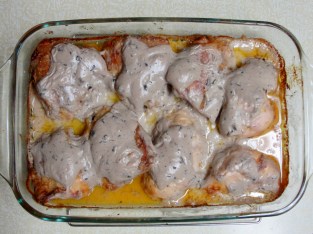 ooked so inviting in the baking dish that I would not be ashamed to set it on the table in front of guests.
 Courage in the Kitchen