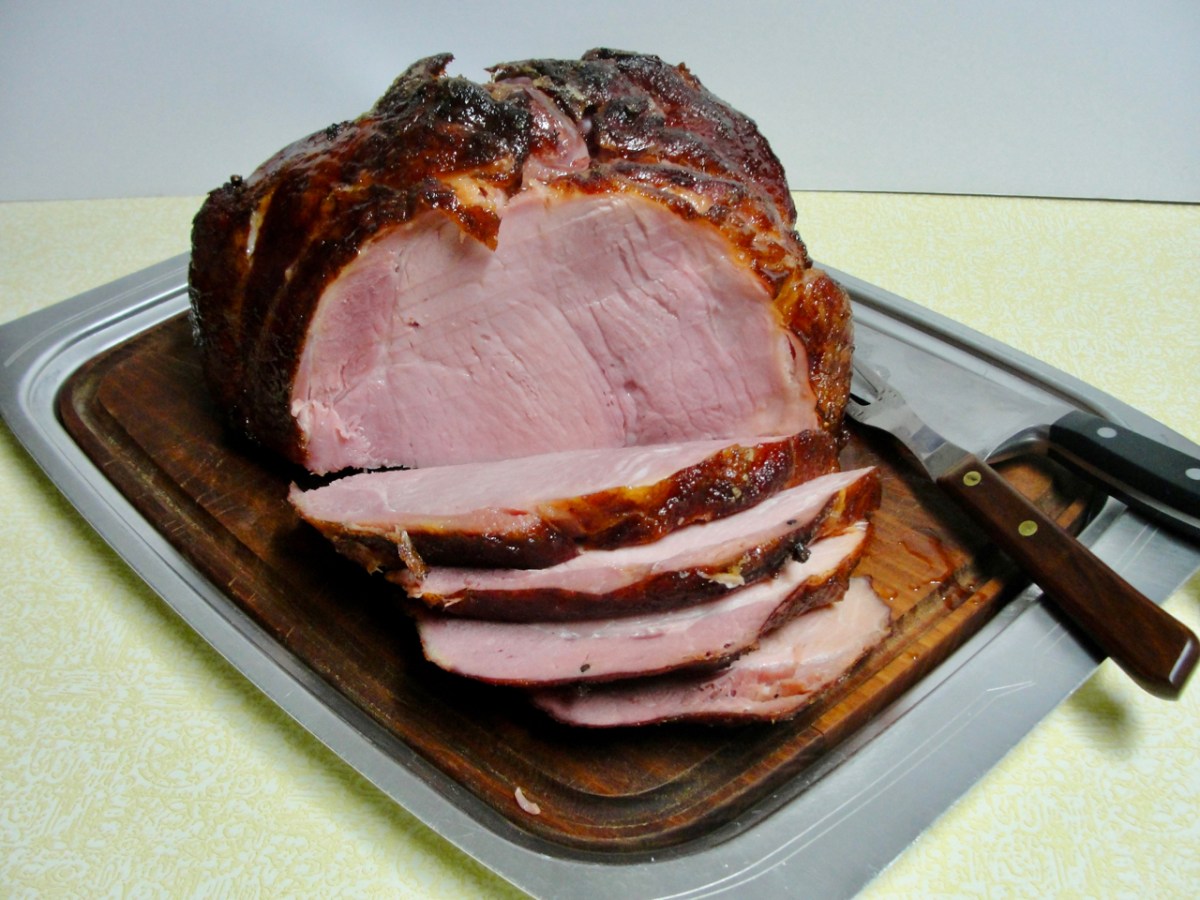
Maple-Glazed Baked Ham

Dorothy Parker is credited as having once observed that “Eternity is a ham and two people.” Though I am not a mathematician I am aware that half of eternity is still eternity, but leftovers from half a ham disappear in less time than they do from a whole ham, so my recommendation is that you ask for half a ham from the butcher. It will weigh somewhere between eight and twelve pounds.

If he (or she) tells you that they sell only whole hams, ask him (or her) to cut and wrap it in two halves. You can bake one half now and freeze the other until you have finished the leftovers in a few weeks.

A properly baked ham is a marvelous meat. Start with a top quality real smoked ham, not one flavored with liquid smoke. Avoid the cheapest hams on display. Most chain grocers sell these inexpensive hams processed in factories that inject water and various flavorings into the meat so it weighs more and looks juicy.

Water is cheap, but pure water has very little flavor. It adds nothing to the ham except weight but does increase the profit for the processor, wholesaler and grocer. Notice that you as a customer are not on that short list.

The best way to get a good ham is to buy it at one of the many meat markets scattered throughout the United States. Those of us fortunate enough to live in Wisconsin or Minnesota have no trouble finding a good ham. Study the awards and ribbons displayed on the walls of the shop. If you find a fairly recent award for ham, you will probably have a good start on dinner.

We have eaten excellent hams from quite a few small markets in Minnesota and Wisconsin, but our favorite source today is Louie’s Finer Meats in Cumberland, Wisconsin. Louie’s hams have won awards from Frankfurt, Germany to Milwaukee, Wisconsin, and we are lucky that the market is located along the highway we take to our cabin.

We stop nearly every trip north, but usually for bacon, brats, or some prize-winning sausage for sandwiches. Serving a ham requires planning so before you buy it you might want to organize a family reunion or invite a football team or two to share dinner or at least make sure you have some extra room in the freezer for leftovers.

After our first ham dinner, we cut the meat off the bone and package it in meal-sized portions before it goes into the freezer. It still tastes fresh and delicious a couple of months later and can be used for everything from sandwiches to casseroles. One of our favorites is Jerri’s Ham and Swiss Lasagna . Incidentally, be sure to leave some meat on the bone to make Mom’s Boiled Dinner.

To create those leftovers, you need to bake your ham. A good ham has lots of flavor already, but a glaze brings it to perfection. There are many opinions about what makes a great glaze, but I prefer a very simple recipe of four ingredients that add color and flavor to the finished product. I hope that you try it sometime.

INGREDIENTS:

1/2 smoked ham (8 – 12 lbs.)
12 – 16 whole cloves
1/4 cup maple syrup
1/4 cup brown sugar
1/2 tsp. dry mustard
1 T cider vinegar

PROCEDURE:

Preheat the oven to 325º. Put the ham fat side up uncovered on a rack in a baking pan. Use a thin sharp knife to poke twelve to sixteen shallow holes in the ham three to four inches apart over the top and sides of the ham and insert a clove into each hole. Set the roasting pan on a lower shelf in the oven and set the timer for ninety minutes.

Make the glaze by whisking the syrup, sugar, mustard and vinegar together in a small bowl while the ham is cooking.

When the timer reminds you, remove the ham from the oven and brush about half of the glaze over the ham. At this time you can insert a meat thermometer into the thickest part of the ham or if you have an instant-read thermometer, simply return the ham to the oven and continue baking for thirty minutes more.

Check the internal temperature of the ham at this time. It is done if the thermometer reads 145º; if it does not, bake it a few minutes longer. You can baste the ham again when you check the temperature. The baking time depends on the size of the ham.

When the thermometer reads 145º take the ham from the oven and baste it once more with the glaze. Return the ham to the oven for about five minutes before removing it from the oven to rest for ten or fifteen minutes before carving your masterpiece.

NOTES: If your roaster is too small to accommodate your baking rack, crumple aluminum foil to make four or five cigar-shaped rolls about a half inch thick and set the ham on them in the roaster.

I almost always visit Louie’s web site before we head north to check out the In-store Specials. Recently I spent a few minutes reading about recent awards won by Louie and his team. Louie’s champion bone-in ham took first place this year at the Wisconsin State Fair and sold for a record price of $8,100 at the 4-H Auction. The $30 I paid for our half ham was a real bargain!
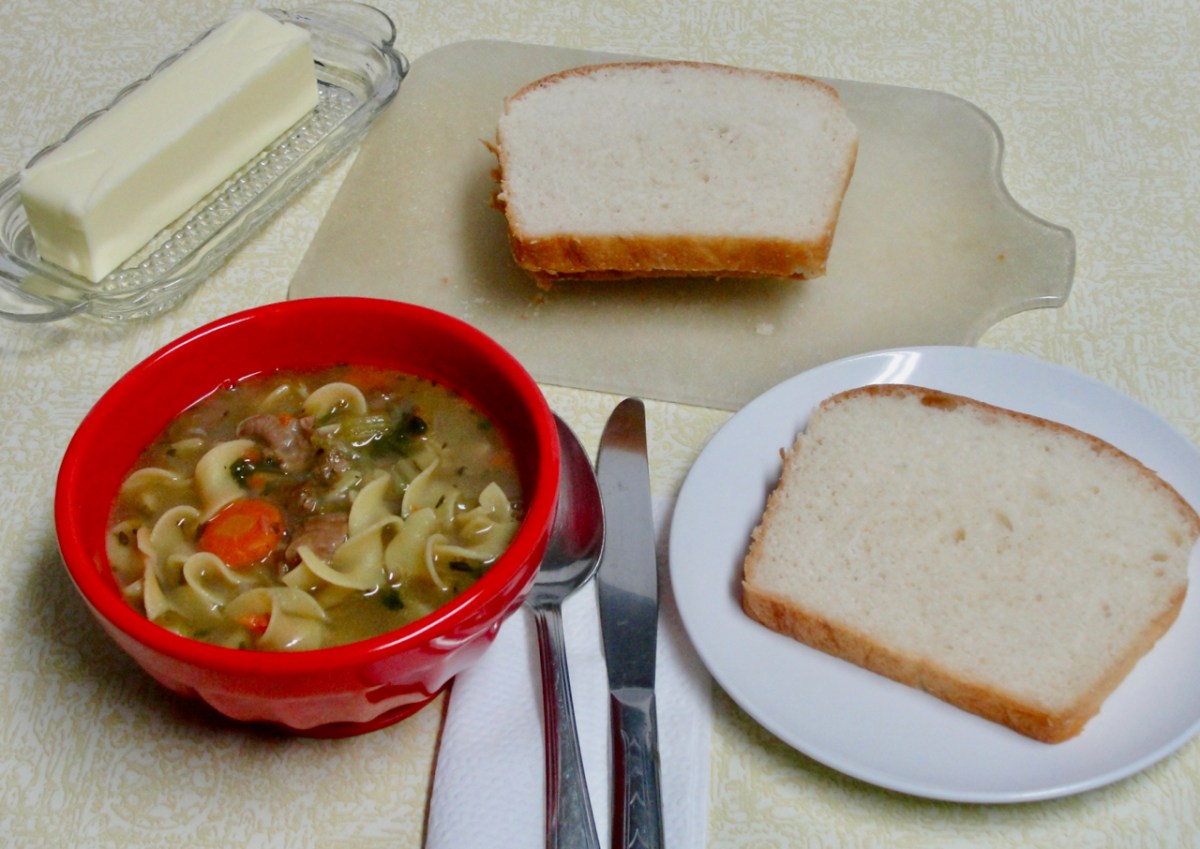
Snowdrifts and Chicken Gizzard Noodle Soup

When I think of winters when I was young, I think of snowdrifts. Our house was situated in a grove of jack pines along Phipps Road, but most of the land around us then was open to the winter winds. To the south across the road were fields extending nearly a mile and to the west the jack pines ended halfway to Highway 63, replaced by low brush on the north side of the road. West across the highway were more fields that explained why northwest winds blocked the highway at least a couple of times every winter.

Every fall, workmen installed snow fences at locations where the wind could drift snow over highways and roads. The snow fences slowed the wind and caused the snow to form drifts that were often so compact that we could walk on them. These piles of compacted snow were perfect for making snow caves, and unlike the huge piles of icy snow plowed from city streets that can collapse and kill or injure adventurous children, these drifts were only four or five feet high and consisted of snow resembling light and airy pumice. When a cave roof failed, we just crawled out of the mess and made another cave.

The school bus picked us up where Phipps Road met Highway 63, nearly a quarter mile from our house. After there was enough snow to work with, we built a snow fort at the bus stop to act as a windbreak. I used a shovel to cut blocks of snow and my sisters raised the walls as high as they could reach. I would add the last two or three courses of blocks until we had a comfortable defense against the wind and blowing snow.

Unlike today, school officials did not cancel school just because it was a few degrees below zero. Mothers bundled their children in winter coats with caps and scarves plus stockings for their daughters who had to wear skirts or dresses even in winter. My sister Patsy described an incident that occurred after I was in college and she was nine years old. Patsy and her older sister Betty, a senior in high school that year, were waiting in their snow fort. The bus was late, so Betty sent Patsy home to check if school had been cancelled.

Patsy explained, “I ran home and Mom told me that school had just been cancelled, so I ran back to tell Betty. It was twenty below zero. Betty was wearing a dress that day but had nylons on. She didn’t want to miss school. She had perfect attendance in high school.” Such dedication helps explain why Betty became a nurse.

I sometimes think that my siblings and I have a seasonal addiction to cold and snow. We still live in Wisconsin and none of us migrates south in winter. When friends mention that they will be going south and ask us where we go to escape winter, we tell them we drive north to our cabin because we like the snow. To explain, I like to paraphrase a nineteenth-century promoter from Bayfield, Wisconsin, who listed some of the advantages of winter along Lake Superior: “The lake offers wonderful skating, the roads are perfect for sledding and there’s no rain, mud or mosquitoes.”

I sometimes add how wonderful it is to go for a walk when it is well below zero, to hear the distant boom of ice contracting on lakes and wolves howling somewhere along the brook. I try to explain the brilliance of a sky filled with thousands of stars or the magnificence of the northern lights instead of the monotonous glow of lights from city streets.

Friends respond by asking, “How about shoveling snow and not having any golf courses open?” I tell them that I don’t golf but admit that I do get a little tired of shoveling, especially when a snowplow piles a new load across the driveway just after I have cleared it.

Maybe I could persuade them by explaining how wonderful it is to come in from the cold to a house filled with the smell of freshly baked bread or the fragrance of cinnamon wafting from rolls better than the ones they walk by on their way to an airplane that will deliver them to some swamp or desert transformed into a faux paradise for senior citizens.

If that didn’t work, I could mention the mouth-watering perfume emanating from a pot of chicken gizzard soup like Mom used to make for us kids when we came in for lunch after a busy morning excavating a new snow cave. We had chicken gizzard soup pretty often. Chicken gizzards were cheap and made a tasty soup. Jerri and I made chicken gizzard soup when we were first married for the same reasons.

If I told you that this recipe is the one Mom used, I would be lying. My mother apparently had James Beard’s philosophy about soup: “Look in your pantry and refrigerator and make soup.” The soup slots in her recipe boxes are empty or hold recipes that wouldn’t fit elsewhere.

However, I know what she did, so this is a pretty close version.

INGREDIENTS:

3 T bacon grease, lard or butter

1 lb. chicken gizzards

Dashes of salt and pepper to flavor the meat

2 cups chicken broth

7 cups water

4 chicken bouillon cubes

3 medium carrots

3 ribs celery

1 onion (about 2 inches in diameter)

1 bay leaf

1/4 tsp. freshly ground black pepper

1/8 tsp. salt

4 whole cloves

1/4 tsp. thyme

1/4 tsp. tarragon

1/2 tsp. brown gravy sauce

1 T corn starch dissolved in 1/4 cup cold water

2 T chopped parsley

About 8 oz. uncooked noodles

PROCEDURE:

Gizzards from a market are already cleaned, but I always give them a rinse before starting the soup.  Cut the gizzards into small bite-sized pieces and let them dry on a paper towel while you melt the grease or butter in a Dutch oven over moderate heat.  Put the meat into the pot and season it very lightly with salt and pepper.  Use a wooden spoon to stir the meat occasionally so it does not burn.

After six to ten minutes the meat will have begun to turn brown.  Add the broth, water, bay leaf, ground pepper, cloves, thyme, tarragon and bouillon cubes and bring the pot up to a boil.  Reduce the heat and simmer the meat for two to three hours, until the meat is tender.

Prepare the vegetables while the meat is cooking. Cut the stem and root ends off the onion and remove the dry outer layer. Wash the celery ribs and cut off a little of the top to freshen the cut end. Keep the celery leaves to chop with the ribs. You can peel or thoroughly scrub the carrots and cut off the stem and root tips. Chop the onions into a quarter-inch dice. Chop the carrots into quarter-inch-thick rounds or half rounds. Chop the celery into a half-inch dice.

Test the meat for tenderness after two hours. Test a meaty piece of gizzard. Gizzard meat includes a lot of connective tissue which is perfectly edible, but never becomes really tender. If the fork goes easily into the meat, add the vegetables. If it does not, continue simmering the meat for another half hour or forty-five minutes before adding them.

Bring the soup back to a boil, reduce the heat once more and simmer the vegetables until they are tender. At this point you can either raise the heat and add the noodles or let the soup cool if you want to serve it later. Wash and finely chop the parsley and stir it into the soup before adding the noodles. Cook the noodles in the broth until they are done, usually eight or nine minutes.  Stir in the brown gravy sauce.

Dissolve the corn starch in the water and stir it into the soup.

Taste and adjust the seasoning.

Serve with bread and a beverage of your choice.

NOTES: Barbara told me that she would never eat gizzards, but she was willing to help me with some memories of winter to introduce this recipe. Our younger sister Patsy also contributed details about her winter experiences that I have used in this and other posts. I thank them both.

Finally, as a know-it-all brother, I am compelled to set the record straight about Barbara and gizzards. I have watched her eating mashed potatoes and chicken or turkey gravy on many Sundays and holidays, and I know that Mom almost always included chopped gizzards in the gravy. Sorry, sis.