Spaghetti of the Night

My mother would never have made Spaghetti of the Night (Spaghetti alla Puttanesca) if she had known any Italian. She and my father once did give a young woman who had quit her job as a stripper at the Phipps Tavern a ride into Hayward so she could catch the bus back to St. Paul. Mom told me that the woman seemed like a nice girl. Women who took their clothes off to make money were one thing, prostitutes something entirely different, and translated into English, Spaghetti alla Puttanesca is “spaghetti in the style of prostitutes.”

There are stories that the dish was invented by “women of the night” in Naples who made the fragrant pasta sauce to attract customers. That’s possible, since it is a simple and inexpensive recipe. You could say that Spaghetti alla Puttanesca is like the free peanuts some taverns offer customers to boost the bar trade.

However, I think that the newspaper story attributing the recipe to Sandro Petti, co-owner of a restaurant on the island of Ischia, near Naples, is more credible. As the story goes, late one night in the 1950’s a group of hungry customers demanded that he make them something to eat after the kitchen larder was nearly bare. He took some tomatoes, olives and capers and made a simple sauce that he poured over spaghetti.

His customers that night liked it, so Sandro made it again and finally listed it on the menu as “Spaghetti alla Puttanesca.” It’s a good name that customers will remember. The one indisputable fact is that “Spaghetti of the Night” (to use the prudish name) is now a popular dish in southern Italy. There are many variations. This version is adapted from Betty Crocker Italian Cooking and is a delicious light variation on a tomato sauce for spaghetti.

One thing I will guarantee. You will not taste the anchovies in the sauce. Period. The anchovies add a complexity of flavor that you will love, but they do not lend a “fishy” taste to the sauce. They do add a little salt, so be careful to taste before you add very much Parmesan.

INGREDIENTS:

1 large can (28 oz.) of Italian-style Plum tomatoes
1 large can (28 oz.) of diced tomatoes
1 red jalapeño pepper
1/3 cup olive oil
2 large cloves garlic
1 T capers
4 flat anchovy fillets in oil
1/2 cup sliced Kalamata or other large ripe olives
1 lb. package spaghetti
Parmesan cheese to pass at the table

PROCEDURE:

Chop the plum tomatoes into half to three-quarter-inch pieces and set them aside in a bowl with their juice. Add the diced tomatoes. Wash, remove the stem end and slice the jalapeño into quarters. Remove the seeds and white membrane. Slice each quarter in half and chop the slices into an eighth-inch dice. Chop the anchovy fillets into half inch pieces. Add the diced peppers and anchovies to the tomatoes.

Heat the oil in a three or four quart saucepan over moderate heat. Remove the paper from the garlic cloves, slice them in halves and cook them in the oil until they are golden brown. Be careful not to overcook the garlic, as it will leave a bitter taste in the oil if you do. Remove and discard the garlic.

Stir the tomatoes, capers, pepper and anchovies into the oil. When the mixture comes to a boil, reduce the heat and simmer the uncovered tomato mixture for about half an hour. Stir frequently to prevent sticking as the sauce gradually thickens.

When the sauce has begun to thicken start a pot of water heating to cook the spaghetti and slice the olives into thin rings. I usually try for three or four rings per olive.

Cook the spaghetti according to the directions on the package. The spaghetti should be cooked just barely to the al dente stage as it will continue cooking when you combine it with the sauce. Remove the sauce from the heat and stir in the olives.

Drain the spaghetti and put it back into the pot. Pour the sauce over the spaghetti and return the pot to the cooktop. Stir in the olives. Cook the spaghetti over moderate heat for two or three minutes, stirring constantly, until the spaghetti is coated with the sauce.

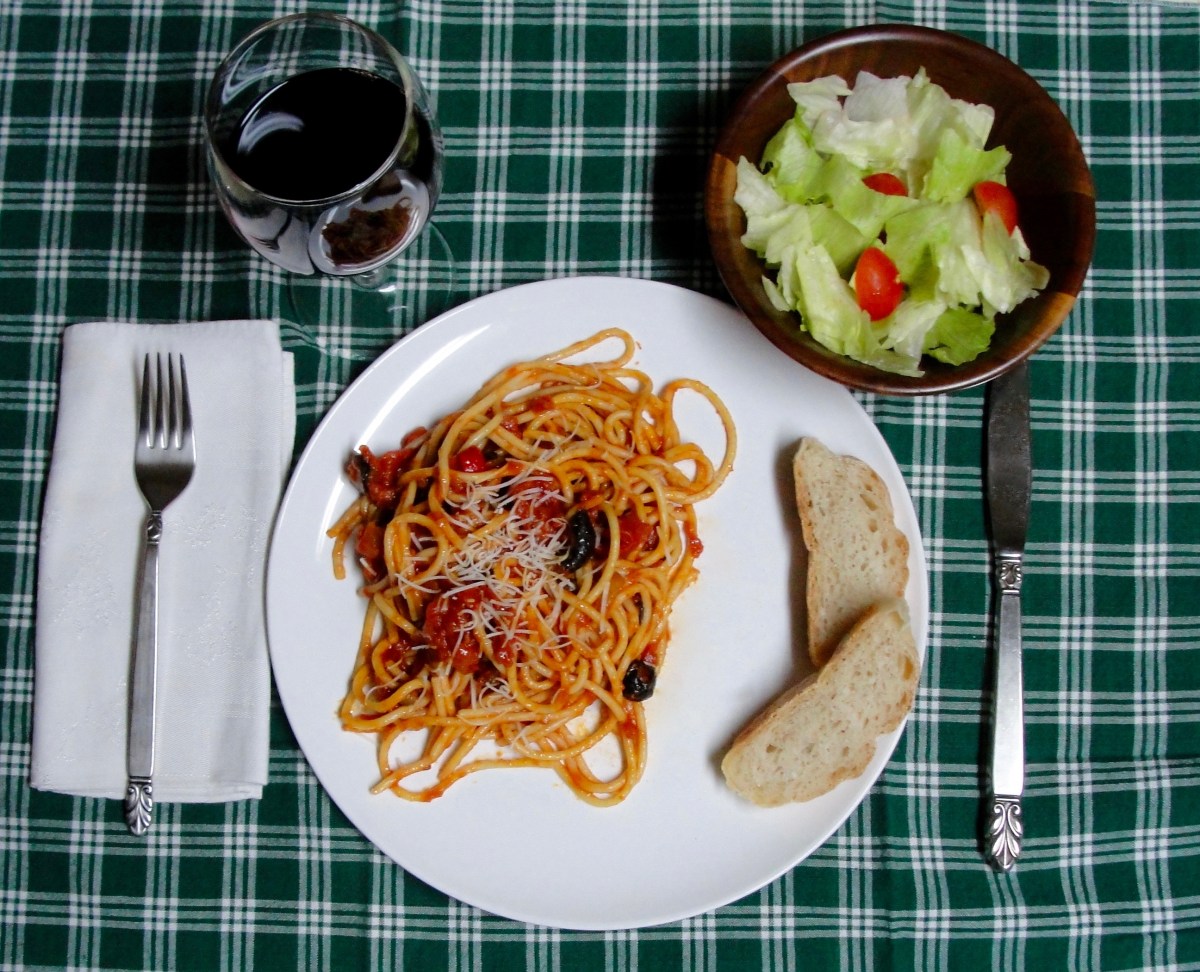
Serve with a green salad, bread and a dry red wine. Pass the Parmesan.

NOTES: Unless someone had served it to her, I doubt that my mother would have ever considered making this recipe, even it it was called spaghetti of the night. Like many people, she was prejudiced against anchovies.

She made her spaghetti sauce with chopped tomatoes and some diced onion simmered with salt, pepper and a little basil. She always added browned hamburger. There were no vegetarian dinners in the Rang household.

After I left the nest, Italian cuisine became more popular in the Hayward area so Mom may have experimented with Italian recipes from the Superior Evening Telegram or Woman’s Day. One thing I’m sure of is that she would have rejected any recipe that included anchovies. She wouldn’t have allowed any of those “fishy things” in her kitchen.

Our daughter-in-law introduced me to this recipe. She said that she didn’t have any red jalapeños, so she used a green one. Either kind works just fine. The last time I made this recipe, I added some finely chopped Italian sweet red pepper that I had picked up on impulse at a farmers market. The Spaghetti of the Night was still a hit.

Chris’s Fiery Texas Chili

Every hunting camp needs a cook, if only to provide an opportunity for a really great hunting story. My father’s favorite camp cook story involved the hunter who drew the short straw on the night before opening day and thus was occupied doing the breakfast dishes when a big buck walked past the window.

Dropping the dishrag and picking up his trusty 30-30, he killed the buck, field dressed it and had it hanging on the buck pole before the other members of the gang came in for coffee. Before I had graduated from high school, I had heard three or four versions of the story. Dad’s was one of the more believable, since it involved only a “nice eight-pointer.” The most spectacular kill was “a sixteen pointer, the biggest buck ever taken at Fritz’s camp.” Ah well…

Our cabin becomes a hunting camp for the opening weekend of deer season, and we do have a camp cook. Since Chris does not hunt, we don’t have any stories to tell of how he bested the rest of us by bagging a prize buck from the comfort of a warm cabin while we hunters were shivering on our stands. There are other stories, however.

Like the time we came in for coffee and doughnuts which Chris always has ready for us at midmorning. He was sitting in the old Morris chair typing on his laptop when we straggled in. We leaned our rifles outside against the wall next to the patio door and came in to warm up with caffeine and carbohydrates.

When Chris announced, “Now that’s a nice buck,” we thought he was kidding us and told him so. “Look for yourselves. He’s by the fire pit. An eight-pointer at least.” There we were, three hunters with our rifles leaning again the cabin in plain sight of what turned out to be a ten-point buck. As he walked up the trail from the yard, we tried to retrieve a rifle by quietly opening the patio door.

The result confirmed my father’s proverb: “Big bucks don’t get that way by standing in front of hunters with guns.” We now make sure that one rifle is left next to the back door just in case. Fond hope, of course, but the experience did give us a better understanding of what it means to lock the barn door after the horse has escaped.

And then there was the time when we found a trail of clothes scattered in front of the bathroom door when we showed up at midmorning for our snack on opening day. “Chris,” we called,”Are you all right?”

“Just a moment,” came the muffled response, followed by Chris wrapped in a towel as he exited the bathroom. While he dressed we dug into the doughnuts and waited for an explanation. It was a pretty simple and, for three of us, an amusing story. He had been chopping jalapeño peppers for the chili when he felt the need to empty his bladder.

That led to his discovery that the oil from jalapeños burns more than mouths and eyes. Once we quit laughing we thanked him for sharing his new discovery with us. My guess is that we all are now more careful with jalapeño peppers.

Jalapeños are an essential ingredient in Chris’s Fiery Texas Chili. He has been making it since his first season as camp cook at the cabin. His wife sent him north with a cookbook and instructions to follow the recipe, which he does religiously. Over the years, the makeup of the gang has changed a bit, but everyone likes the chili, and Chris keeps making it.

I suggested that he bake some corn bread to go with the chili, and after some coaching, he has become an expert on that recipe as well, and he makes a wonderful cranberry raisin pie. Thanks to Chris, we are very well fed, even if we don’t bag a lot of bucks.

Chili, like many soups and stews, tastes even better when it has had a chance to cool and be reheated. Chris now makes his chili on the Friday before the season opens Saturday morning, so the chili is perfect for lunch on opening day. Speaking from years of experience, I can say that it makes a delicious Sunday lunch too.

INGREDIENTS:

4 lbs. chili meat
1/2 – 3/4 cup vegetable oil
3 cups beer
16 oz. can tomato sauce
2 medium onions (about 3 1/2 inch diameter)
2 medium green bell peppers
10 – 12 cloves garlic
2 tsp. oregano
2 tsp. cumin
1/2 cup chili powder
1/8 – 1/2 tsp. cayenne
2 tsp. salt
1 tsp. sugar
8 – 10 medium jalapeño peppers

PROCEDURE:

Ask your butcher to coarsely grind four pounds of lean beef chuck. Cut off the stem and root ends and the dry outer skins of the onions. Wash and quarter the bell peppers and remove the stems, seeds and white membranes. Chop the onions and peppers into about a quarter-inch dice and set them aside in a bowl. You should have about two cups of each.

Cut off the root ends and remove the papery outer skins of the garlic cloves. Mince the cloves and add them to the bowl of onions and peppers.

Wash and cut off the stems of the jalapeño peppers. Slice the peppers lengthwise into quarters and remove the seeds and white membranes. Slice the peppers into quarter-inch pieces and set them aside in a separate small bowl.

Put about a third cup of vegetable oil into a large skillet. Add the chili meat and put the pan over moderate heat. Use a wooden spoon to break up the meat and stir it until the meat is lightly browned. It should be gray but not crisped.

Use a slotted spoon to transfer the meat to a Dutch oven or soup pot, leaving the liquid in the skillet. Add the beer and tomato sauce to the meat and put the pot over low heat to begin cooking.

Put the onions, peppers and garlic into the skillet with the liquid left over from browning the meat. Add a quarter cup of oil (or a bit more if the meat was very lean) and bring the vegetables to a simmer over moderate heat. Stir in the salt, sugar and spices along with the jalapeño peppers, reduce the heat and simmer very slowly for about half an hour.

Combine the vegetables with the meat meat and simmer the chili slowly for two to three hours. Remove the pan from the heat for at least thirty minutes to let the grease rise to the top of the chili. Skim off the excess grease. If necessary, reheat the chili, taste and adjust the seasoning.

Serve with warm Buttermilk Corn Bread and butter.

NOTES: If you or your guests are very sensitive to spicy foods, use the lower recommended amounts of cayenne and jalapeño peppers. I suppose you could use only six jalapeños, but even with ten of them, our resident Norwegian, hesitant the first time, now eats his share of this tasty chili.

This recipe makes eight to ten servings, but you can freeze the leftovers. It keeps well for up to six months.