Easy Egg Foo Young

It is not that many years ago, so my meeting with the diabetes dietician at our local medical clinic is still very sharp in my memory. I had done some research into foods low in carbohydrates after my doctor told me that I had type-2 diabetes, so I was prepared for the dietician.

She began by explaining that carbohydrates included sugar and starches found in common foods and drinks.

Holding up a test tube nearly filled with a white granular powder, she told me, “This is how much sugar is in the average can of a soft drink.”

“I don’t drink many cans of pop,” I responded.

She held up a tube only half full of the powder. “Here is the amount of sugar in an average serving of cake.”

“I like cake, but I don’t eat it very often,” was my answer. Fortunately she did not have a test tube stuffed with sugar from a large slice of cherry pie.

“Things don’t have to taste sweet to have lots of carbohydrates,” she said, ticking off a list on her fingers. “Soda crackers, potato chips, pretzels, bread sticks, Chex mix and tortilla chips all have significant quantities of carbohydrates.”

“I binge on potato chips and dip or tortilla chips and salsa once in a while,” I said, “but not very often.”

I could tell she thought I was exaggerating my will power. “Everybody snacks,” she said, “so what do you snack on?”

“Well, I really like dry-roasted peanuts and mixed nuts and a martini on the rocks while I am reading or watching the news on TV. And I enjoy one or two slices of good lunch meat as a snack. I have been checking out low-carb foods on the web, and these all look pretty good to me,” I answered.

I was feeling smug about my dietary research before she gave me a “gotcha” smile and announced. “You’re right about the carbs, but all those things have lots of calories. Calories lead to weight gain and excess fat.”

She stared pointedly at my rounded front and said, “Fat interferes with the body’s response to insulin. You might want to switch to celery and carrots and cut back on the martinis.”

Rather than taking such drastic steps I began looking for foods that were low in carbohydrates and calories to compensate for my afternoon delights. Here is a dish low in both of the “C’s” that I lucked into long before I began paying attention to such things.

Many years ago when I was still gainfully employed, there was a Chinese restaurant less than a mile from my office in Plymouth, Minnesota. Weekdays at noon they featured a luncheon special that let customers choose from several different menu items. The parking lot was usually nearly full, and there was inevitably a line at the serving counter. One got in the line and pointed to the items that he or she wanted for lunch.

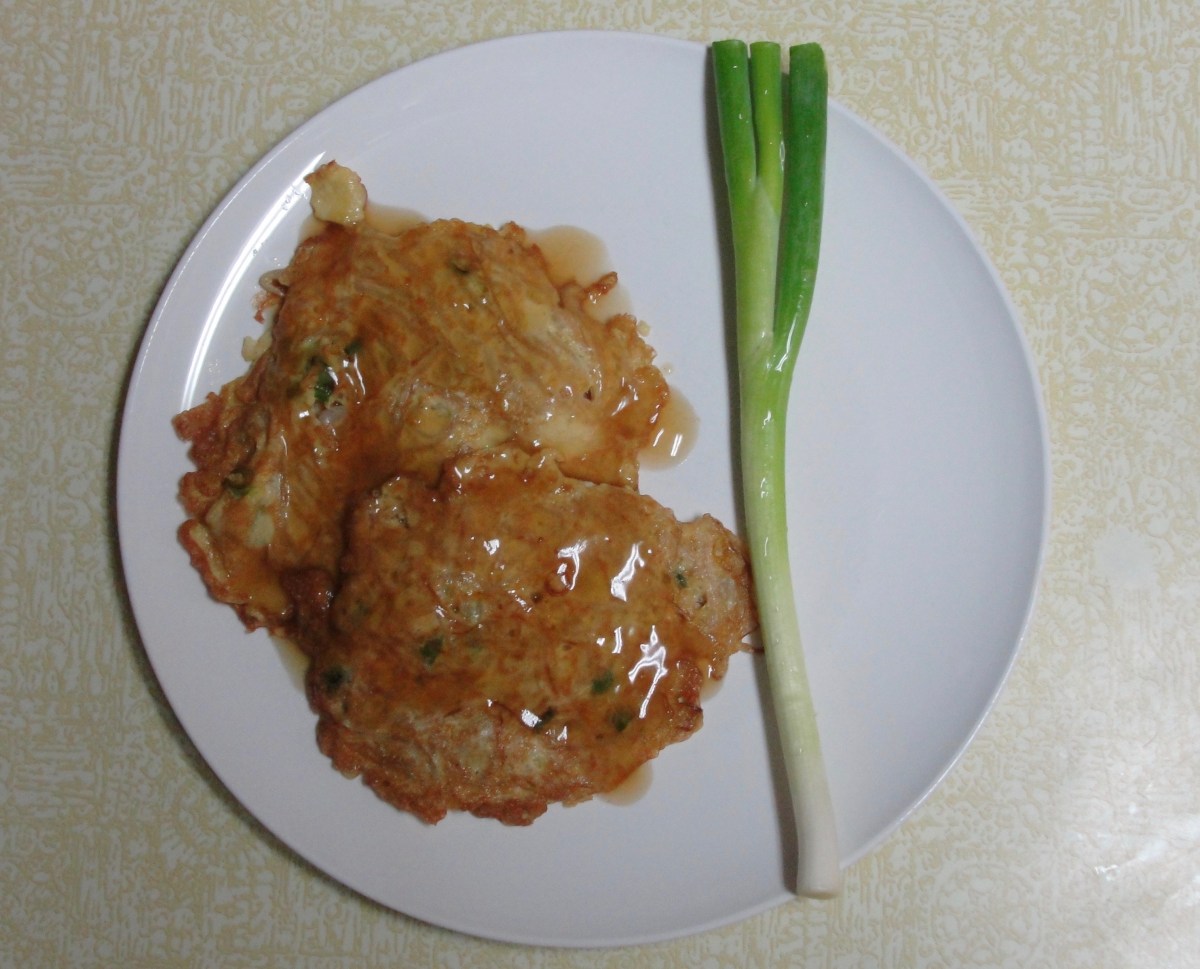
That restaurant got me addicted to Egg Foo Young. I liked their fried rice, egg rolls, beef and mushrooms and stir-fried vegetables too, but it was the Egg Foo Young that kept calling me back to the place. There are many variations of the dish, which is a Chinese omelet made with eggs and other ingredients. The mixture is fried like a relatively thick pancake and served covered with a tangy sauce or gravy.

A generous serving of Egg Foo Young made with this recipe contains only about eleven grams of carbohydrates and fewer than two hundred fifty calories. You could eat all four servings and still be within the recommended carbohydrate intake for a meal. However, as the dietician lectured me, “They do have calories.”

INGREDIENTS:

For the omelet:
1 can bean sprouts (about 2 cups)
1/3 cup thinly sliced scallions
1/4 cup finely chopped celery
1 large clove garlic
1 cup salad shrimp or equivalent
5 large eggs
1 tsp. soy sauce
1/8 tsp. salt
About 2 T canola oil for frying

For the sauce:
1 cup water
1 tsp. instant chicken bouillon or 1 cube
2 tsp. sugar
2 tsp. soy sauce
2 tsp. cider vinegar
1 T cornstarch dissolved in 1 T cold water
Dashes of white pepper and garlic powder to taste

PROCEDURE:

Make the sauce first. Dissolve the bouillon in a cup of cold water in a small saucepan over moderate heat. Add the sugar, soy sauce and cider vinegar. Dissolve the corn starch in a tablespoon of cold water in a cup.

When the bouillon mixture has come to a boil, reduce the heat and whisk in the cornstarch along with a dash each of white pepper and powdered garlic. Bring the sauce back to a simmer and cook for about three minutes. Taste and adjust the seasoning if necessary. Set the sauce aside while you make the omelets.

Drain the bean sprouts and put them into a colander. Clean and chop the scallions and celery and mince the garlic after removing its outer paper. Add the vegetables and shrimp to the bean sprouts. Let the vegetables and shrimp drain for fifteen minutes. Beat five large eggs in a small bowl until they are lemon colored. Season the eggs with a teaspoon of soy sauce and an eighth teaspoon of salt. and stir them into the vegetables and shrimp.

Heat about two teaspoons of canola oil in a non-stick frying pan over moderate heat and put two or three third-cup scoops of the egg and sprout mixture into the pan. Flatten the scoops slightly with a spoon or spatula. Turn the patties after three to four minutes and fry until both sides are lightly browned. Warm the sauce while you fry the rest of the patties. This recipe makes eight patties, which are enough for four generous servings.

Pass the sauce with the patties at the table.

NOTES: We seldom have salad shrimp in our freezer, so I usually chop larger shrimp into a half-inch dice. Incidentally, you can substitute cooked chopped chicken or pork for the shrimp. Any vegetable oil works fine for frying.

Egg Foo Young is a delicious low-carb addition to the menu. This entire recipe totals only about forty-four grams of carbohydrates. Complement the Egg Foo Young with a bowl of Hot and Sour Soup, LINK and you will be serving a meal with fewer than twenty grams of carbohydrates for each diner.

Aunt Ruth’s Sour Cream Coffee Cake

Have you ever walked into a room and suddenly been reminded or something you hadn’t thought about in many years? In his novel, In Search of Lost Time, Marcel Proust tells how the narrator is transported back to his childhood by the scent and taste of a Madeleine.

If a little cake can take a man back to his childhood, think what a kerosene lamp can do.

I have a clear and detailed memory of my grandparents’ home whenever we light a kerosene lamp at the cabin. When we visited Grandpa and Grandma Rang in the evening, Grandma would light lamps at dusk. The odor of kerosene transports me back to what I remember as a huge country kitchen. There was a large dining table at the south end of the room, a small table on a side wall and a big cookstove at the north end.

The stove was white and silvery with a black top and a warming oven and water tank above the cooking surface. The stove sat about three feet from the wall, and my father told me how he spent a couple of nights as a boy on a chair between the stove and wall wrapped in a wool blanket and fortified with Grandma’s dandelion wine as he battled whooping cough.

The lamps were on the tables. The light was warm and inviting, but the corners of the room were in shadow. Mosquitos whined outside and crickets sang to each other. I remember hearing an owl call a few times, but I didn’t pay much attention to the voices of the adults.

I was more interested in exploring the mysteries of the room. There was the little table by one of the west windows with a straight-backed chair where Grandma sat and read or did needlework during the day. The sink had a pail beneath it to catch wash water, and there was a beautiful kitchen cabinet next to it. The stove, which was always warm, even on the hottest days, was about halfway between two doors on the north wall. Grandpa kept the woodbox next to the stove full so Grandma could cook breakfast, dinner and supper.

In the northeast corner of the room was the door, usually open, into Grandpa and Grandma’s bedroom. It was a large room that also served as the parlor. It had a tall wood stove with chrome fenders at the bottom where Grandpa could brace his feet while he read the paper after supper.

In the northwest corner of the kitchen was the door that led upstairs to the bedrooms where my father had shared the “bunk room” with his brothers. The second bedroom was smaller and had a door to provide privacy for the girls. I don’t remember whether the bunk room had decorative wallpaper, but I recall the floral print in the girls’ room. It had a south-facing window and was sunny and cheerful.

Both rooms had small grills set in the floor to let warm air from the stoves downstairs provide heat in the winter. The girls’ room was above the kitchen and was probably colder than the boys’ in winter, since the small firebox on the cookstove would not have held a fire through the night.

The tall wood stove in Grandpa and Grandma’s room was the main source of heat in the house. Grandpa would stoke the fire with some big logs before going to bed to make sure the fire lasted through the night. Still, my father told me that he remembered waking up in the morning with frost on the blankets. Of course, he may have only been trying to make me feel lucky that we had an oil stove that kept the whole house warm on the coldest winter nights.

Jerri doesn’t have kerosene memories, but when she steps into a walk-in freezer, she is reminded of trips to the locker plant in El Dorado, Kansas. Her family rented a storage locker to store the meat from their farm or purchased from neighbors on butchering days. “Maybe it is just because El Dorado was the big town,” she muses, “but I always remember those trips to town.”

When we stop to buy deer corn or sunflower seeds at a feed mill, the smell of cracked corn and other grains transports her back to her family’s chicken coop on the farm where she lived until she was six years old. Her parents gave the coop to Caroline, a neighbor who insisted on showing her appreciation by bringing a gift chicken from time to time. She delivered the live chicken in a gunny sack, much to Jerri’s mother’s dismay.

“If she brings me another live chicken, I don’t know what I’ll do!” she would say, as she expertly decapitated the innocent bird. Sunday dinner was assured.

Jerri associates the “closed up smell where old people lived” with her grandparents’ home where her father’s sister Ruth lived with her parents. She remembers the odor of the gas space heater in the bathroom. When we light a burner on the range, Jerri often thinks of how she asked her mother if she could have a bath in the tub. It was a memorable occasion, her first tub bath.

Jerri also remembers Aunt Ruth’s Sour Cream Coffee Cake, not because of the smell but because of how good it tasted. Here’s how to make it. Jerri doesn’t have her aunt’s recipe, but here is what Mennonite ladies were baking when Jerri was a girl.

INGREDIENTS:

1 cup lukewarm water
4 tsp. yeast
1 tsp. granulated sugar
2 cups milk
2/3 lard or shortening
3/4 cup granulated sugar
4 tsp. salt
2 large eggs
6 – 8 cups all-purpose flour
Topping:

1 1/2 – 2 cups sour cream
1/2 cup granulated sugar
About 1/2 tsp. cinnamon

PROCEDURE:

Warm a cup of water to about 100º in a small bowl and stir in the yeast and a teaspoon of sugar. Allow the yeast to proof until it begins to foam. Heat the milk until it steams and add the lard or shortening, stirring until it has melted, then pour the milk into a large bowl.

While the milk cools, stir in three-fourths cup of sugar and four teaspoons of salt. Test the temperature of the milk by shaking a drop on the inside of your wrist. If the milk feels only slightly warm, beat in the eggs followed by the yeast.

Add flour a cup at a time, beating well between additions, until you have a soft dough that just begins to come away from the sides of the bowl. You should have added between five and five and a half cups of flour.

Let the dough rest in the bowl for five minutes, then turn it out on a lightly floured surface and knead for five or six minutes until the dough is smooth and elastic. Form the dough into a ball and put it into a greased bowl, turning the dough to cover the surface with grease.

Cover the bowl with a damp kitchen towel, Put the bowl in a warm, draft-free place and allow the dough to rise until doubled in bulk. Turn it out on a lightly floured surface and knead for a minute or so, then form it once more into a ball and return it to the greased bowl, turning the ball as you did the first time. Cover it and allow it to rise until the dough has again doubled in bulk.

Once the dough is ready, divide it into four equal parts, make four balls and press them into well-buttered eight-inch cake pans to rise.

Preheat the oven to 375º.

When the dough has nearly reached the tops of the pans, dot with teaspoonfuls of sour cream, sprinkle with generous amounts of cinnamon and sugar and bake twenty to twenty-five minutes.

NOTES: You can be creative with this recipe. The dough is tender and only slightly sweet. At Jerri’s suggestion we used some poppy seed filling left over from her Christmas baking to make a delicious variation on Aunt Ruth’s coffee cake. We divided the dough for one coffee cake into two parts, rolled out one and put it in the bottom of a pie plate. We spread a generous layer of poppy seed filling on the dough and finished the cake with a second layer of dough. We let it rise and baked it for twenty-five minutes.

I’m sure that you could do the same with your favorite preserves or pie filling. How about a cherry or blueberry filled coffee cake?