I still remember how exciting it was when Dad brought home the snowplow for the tractor. He had designed it himself and built it over a few evenings from scrap steel welded and bolted together in the garage where he worked. Attached to the John Deere Model LA tractor, it freed us from a chore we all dreaded. We still had to shovel the porches and paths to the woodshed, chicken coop and storage building, but that was nothing compared to shoveling the driveway and turnaround, especially when the town plow pushed a four-foot-high pile across the end of the driveway.
The arrival of the snowplow is just one of the many memories that I associate with winter when my sisters and I were growing up. We made snow angels, had snowball fights, created snow men and built long snow dragons that we could ride on. We went sledding and tobogganing on the hills along the Namekagon River. Oddly enough, I don’t remember ever being cold when we were out playing.
My mother knitted most of our winter accessories—warm stocking caps, mittens, gloves, scarves, sweaters and socks for all of us. She loved to knit and kept at it until the last few months before her death. I still have and use every winter a pair of heavy wool socks, cream-colored with robin’s egg blue tops, that keep my feet warm at thirty below zero. She gave them to me for Christmas at least twenty years ago. My deer hunting mittens with trigger fingers knitted into them date from shortly after Wisconsin recommended visible orange hunting clothing, so they are at least forty years old but still in excellent condition, if just a little faded.
Those gloves remind me of how concerned Mom was that Dad or I could get shot by someone mistaking us for a deer. She insisted that Dad use a large red bandanna for a handkerchief when he went deer hunting. I protested, so she bought me a pocket pack of red Kleenex. Waving a white handkerchief or tissue really was not a good idea when people with high-powered rifles were in the woods. That flash of white could be mistaken for a deer tail or ear.
Even with such precautions, sometimes bullets came too close. I was seventeen years old and hunting on the bottom of a deep valley north of Mosquito Brook. I was cautiously walking on a deer trail through a brushy ridge when there was a gunshot close to me. While I watched for the deer that I assumed I had jumped I heard a bullet zip past me and another gunshot. That deer must be close, I thought, until another bullet hit a small tree next to me.
I dropped behind an old stump, hollered and waved my hunting cap. The response was another bullet and gunshot. Peeking around the stump I saw a hunter taking aim again from his vantage point a couple hundred yards away and firing again. Another bullet thudded into something near me.
I braced my rifle against the stump, aimed about ten feet above the hunter and fired four shots as fast as I could. The shooter turned and ran. I started after him, losing distance as I climbed the hill. I saw a hunter off to my right and was relieved to see my Uncle Harold approaching. He told me that he had seen a hunter running toward the road who had been joined by another hunter. We walked to Mosquito Brook Road and found a half dozen beer cans where the men had parked their car.
Maybe I shouldn’t have shot towards the man, but then again if he had kept shooting, he might have hit me. Maybe I was lucky that he had had too many beers to shoot straight. The only thing I can say for certain is that it was another example of the luck that has kept me alive for nearly seventy-five years. And it does make a good true story.
Here are some possible titles to other true stories that young people today may find hard to believe. “Why Dad put a pan of hot coals under the car and a blanket over the hood,” “The winter I went skating on the rapids in the Namekagon River,” “Building fires on the lake,” “When my sister stuck her tongue to the mailbox” and “When the snow was so deep, Mom couldn’t get the doors open.” The last two are humorous stories of winter events, though not for my sister or mother.
Another true story could be titled “The many soups Mom made in winter,” for she made a lot of them. Bean soup, vegetable soup, chicken soup, tomato soup, oxtail soup and maybe even “Leftover Soup.” However, I am sure that she never made “French Cabbage Soup.” When she put cabbage in soup, she called it “Boiled Dinner,” and we had it often. Here is where you can find the recipe for my Mom’s Boiled Dinner.
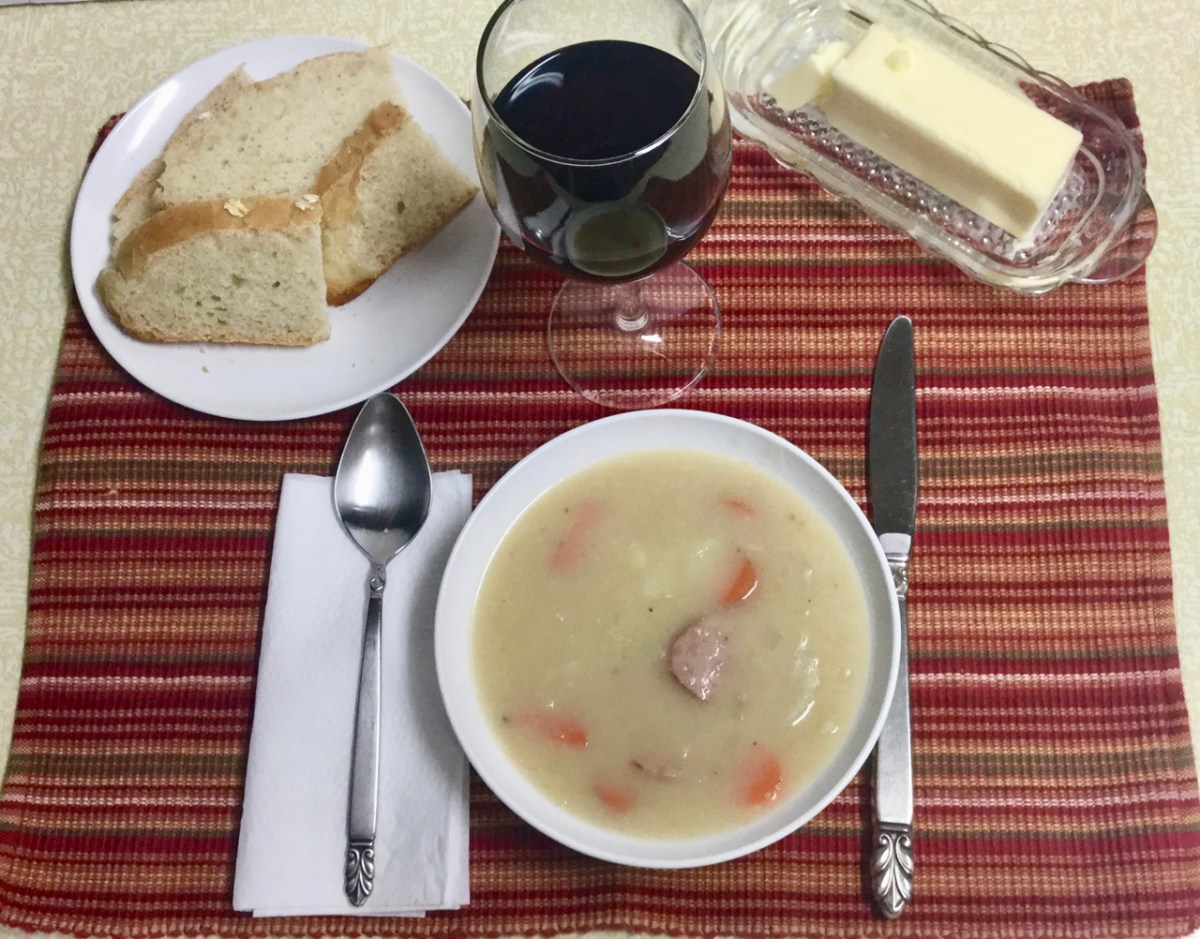
I found the recipe for French Cabbage Soup in the Wisconsin Supper Club Cookbook by Mary Bergin, which my sister Patsy loaned me. The recipe is from Mr. G’s Logan Creek Grille in Jacksonport, Wisconsin, and it makes a rich and satisfying meal on a cold winter day.
INGREDIENTS:
4 T butter
1/2 cup all-purpose flour
3/8 cup chopped onions
1 3/4 cups chopped carrots
1 1/2 cups cubed potatoes
Water to steam the vegetables
1 1/2 quarts chicken broth
1 1/2 cups chopped fresh cabbage
1/4 – 1/3 lb. cooked kielbasa or Polish sausage
1/4 tsp. salt
1/8 tsp. pepper
PROCEDURE:
Start by preparing the vegetables. Clean and chop the onion into a quarter-inch dice. Peel or scrub four or five carrots, cut off the stems and cut the carrots into quarter-inch slices. Peel and chop the potatoes into a half-inch dice. Put these vegetables into a large saucepan with about a half cup of water and bring the pan to a boil. Reduce the heat to low and steam the vegetables until they are tender but not soft. Drain them and set the pan aside.
Wash a small head of cabbage (five or six inches in diameter) and remove any damaged leaves. Cut half of the head into quarters, then cut each quarter into half inch slices. You should have about one and one-half cups of cabbage, but a little more is okay.
Melt the butter in a small saucepan or skillet. Blend in the flour and cook it for a minute or a minute and a half over moderate heat to make a thick roux. Using a wooden spoon, stir the flour mixture continuously to make sure that it doesn’t brown or burn. Set the roux aside.
While the vegetables are cooking, cut the sausage into slices an eighth to a quarter of an inch thick and bring the chicken broth to a boil in a soup pot or Dutch oven. Set the sausage aside.
Add the cabbage, salt and pepper to the broth and cook for two minutes.
Blend in the roux and cook until the soup has thickened. Stir in the vegetables and sausage. Bring the soup to a simmer and cook for a minute.
Taste and adjust the seasoning if necessary.
NOTES: This is a soup to serve to people who say they are not fond of cabbage. If you don’t tell them, they may not know that they are eating a cabbage soup.
The original recipe makes about a gallon of soup, but I have cut it in half to produce eight generous servings. If you want a thinner soup or an extra serving you can add a little more broth.
Be careful not to overcook the vegetables.
Like most soups, this one tastes even better on the second day.

 Courage in the Kitchen