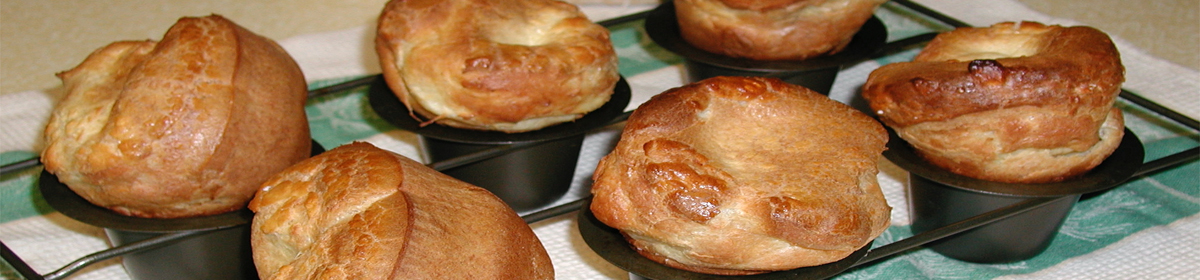
Jerri’s Yorkshire Chicken

This is another recipe Jerri found in the Better Homes and Gardens Meat Cookbook long ago when we lived in Kentucky. My mother and father would have loved it, and I sure do.

The name is a play upon Yorkshire Pudding, a delectable dish made in England to accompany the beef roast traditionally served for Sunday dinner. The pudding seems to have originated in the north of England, and the first recipe was published in 1737. It was first called “Dripping Pudding” because it used the drippings from the roast. It was served before the roast, and may have been a cheap way to fill up the diners before the meat appeared.

Food historians believe that thrifty English housewives were making dripping pudding long before the recipe was written down. It is an obvious way to turn beef fat into something that people will want to eat rather than wasting it or feeding it to the dogs. Today, Yorkshire pudding is served as a side dish with the meat. It is still made with beef drippings and may be baked in a flat casserole or in muffin tins in a hot oven.

The ones baked in muffin tins look like collapsed popovers. When a waitperson offers you a popover before the steak arrives, that delicate muffin dripping butter on your fingers is the cousin of a humble pudding probably invented to stretch the meat budget.

Unlike Yorkshire pudding, which is baked separately from the meat, the batter for Yorkshire chicken is baked in the casserole with the meat. Since the chicken pieces have been browned before they are placed in the casserole, most of the fat has been rendered from the skin. The batter picks up flavor from the chicken without adding a lot of fat to the dish.

Jerri’s Yorkshire chicken has a simple batter that you pour over the chicken pieces. The pudding complements the chicken for a great Sunday dinner, and you have made the bread as well as the main course in one dish. I especially like the crusty pudding on the edges of the casserole.

INGREDIENTS:

3 to 4 lb. frying chicken
1 1/4 cups all-purpose flour, divided
2 tsp. salt, divided
1 tsp. ground sage
Dash of freshly ground black pepper
Dash of cayenne pepper
3 T shortening
1 tsp. baking powder
3 large eggs
1 1/2 cups milk
4 T butter
2 T chopped parsley

PROCEDURE:

Preheat the oven to 350º and melt the shortening in a skillet.

If you bought a whole chicken, cut it into eight pieces. Mix a quarter cup of flour with a teaspoon of salt, a teaspoon of sage and a dash or two of the two peppers. Dredge the meat in the flour mixture and brown the pieces in the skillet over moderate heat, turning them to make sure that they are browned on all sides. Remove them from the skillet and allow them to drain on a rack or paper towels.

While the chicken is browning, beat the eggs until lemon colored in a mixing bowl. Warm the milk and melt the butter in the microwave. Stir the milk and butter into the eggs. Mix a teaspoon of salt and a teaspoon of baking powder with the flour and sift the dry ingredients into the liquid. Stir just until smooth. Chop the parsley and blend it into the batter.

Put the browned chicken into a deep three quart casserole and pour the batter over the pieces. Place the casserole on the middle shelf in the oven and bake for about an hour. You can test for doneness by sticking a fork into one of the larger breast pieces to make sure that the juices run clear.

Yorkshire chicken makes a wonderful meal with a green salad and cranberry sauce.

Homemade Pizza

Do you remember where you ate your first slice of pizza? Growing up in the small town of Hayward, Wisconsin in the 1950’s, I can. It was at Vin’s Pizza on Main Street which Vin and Verance Ketterer opened in a building that had housed an appliance store next to Karibalis Restaurant.

I couldn’t remember the name, but I called Shirley, a fellow Haywardite who lives in New Richmond. She proceeded to call her sisters Bonnie and Pat who still live in Hayward and have better memories than mine. None of us is sure, but we think Vin’s Pizza opened in 1957 or early ’58.

Whenever I think of good pizza, I think of Vin’s with its high tin ceiling and a jukebox playing Dean Martin’s “That’s Amore” or Patti Page’s “Tennessee Waltz.” It was not a very large place, and Vin and Verance spent their money on a big pizza oven rather than fancy decor. There was a counter, a shoulder-high wall separating the dining area from the kitchen, and cafeteria tables with red checked tablecloths along each wall. The main decorations were the jukebox and pizza oven, both of which you could see from the sidewalk.

Vin and Verance owned Club 77, a supper club near Round Lake a few miles east of Hayward on Highway 77. My memories of Club 77 involve steak dinners and Prom, Homecoming or Christmas Ball dates but Linda, who was a year ahead of me at Hayward High School, tells me that Vin was serving pizzas at the Club well before he opened Vin’s Pizza.

I knew that Club 77 featured Italian food, but my idea of fine dining was a steak dinner, not spaghetti and meatballs. That gives you an idea of how much I knew about Italian cuisine when I was a teenager.

Bonnie put me in touch with Linda, who worked at Vin’s her last two years in high school and after her first year of college. She earned $.85 an hour, which was well above the state minimum wage, and she and other employees were allowed to keep any tips! She remembers working evenings with friends and walking home late at night.

Besides busing tables and serving customers, they all learned to make pizzas according to Vin’s recipe. “All we sold were pizzas and pop, but we were packed most of the time.” That’s what I remember about Vin’s. It was the place to go to hang out with friends after the drug stores closed. We put nickels in the jukebox, nursed our glasses of Coca Cola, 7 UP or root beer and ate great pizza.

When the Ketterers decided that running two restaurants was too much work, they sold the pizza parlor with the equipment and goodwill and included their pizza recipe for an additional $200. “I didn’t know people sold recipes and I thought that was an awful lot of money,” Linda told me.

“But it was a great recipe,” she added, “and I still sprinkle oregano on the tops of my pizzas like we did at Vin’s.” She also recalled that Vin was very particular about the cheese he used. In the 1950’s most mozzarella was made with whole milk, and some batches had more butterfat than others. To make sure that the pizzas were not greasy, Vin taught Linda and the other employees how to blend cheeses together to avoid the problem.

When Shirley called Bonnie, the first thing Bonnie said was, “They made great pizzas. They sold individual pizzas for fifty cents each.” The next thing she said was “Linda knows all about Vin’s. She used to work there.”

We still enjoy going out for pizza, and I particularly enjoy finding a pizza parlor that reminds me of Vin’s. There’s one in Spooner that resides in what was once a Ford garage right along Highway 63 on our way to the cabin at Cable. No tin ceiling but lots of headroom and darned good pizza.

When we were living in Kentucky forty years ago, we started making our own pizzas and still make them occasionally. The original recipe is from a newspaper, probably the Louisville Courier-Journal. The paper is taped to the inside of a cabinet door and is so yellowed and delicate that I thought it was about time to preserve it with our revisions and comments on the hard drive of the computer.

The recipes make enough dough and sauce for four twelve-inch regular crust pizzas or two twelve-inch pizzas and one fourteen-inch deep dish pizza. If you have sauce left over, you can freeze it for up to a year.

INGREDIENTS:

For the dough:
2 cups water
1/2 tsp. sugar
1 T yeast
4 1/2 cups all-purpose flour plus extra for kneading
2 T olive oil plus a little to grease the bowl

For the sauce:
1 can (about two cups) diced tomatoes
1 eight oz. can tomato sauce
1 six oz. can tomato paste
2 T water
1/2 cup chopped onion
1 bay leaf
Dash of garlic powder
1 tsp. dried basil
2 tsp. dried oregano
3/4 tsp. salt
1/2 tsp. black pepper
1/2 tsp. fennel seed
1/2 tsp. anise seed
1 tsp. olive oil
1 to 2 tsp. sugar

For the toppings:
Use your favorite vegetables, meats and cheeses, but start by painting a thin layer of olive oil on the crust.

PROCEDURE:

Put two cups of lukewarm water (about 100º) in a large mixing bowl. Stir in the sugar and a tablespoon of active dry yeast. When the yeast begins to foam, beat in a cup of flour to make a smooth batter. Stir in the olive oil, then add the next three cups of flour a cup at a time, stirring well between additions. After you stir in the fourth cup of flour, the dough should be nearly ready to knead.

Add the rest of the flour a couple of tablespoons at a time and stir until the dough comes away from the side of the bowl. Depending on the humidity and the flour, you may need a little less or more than a half cup of flour.

Let the dough rest for five minutes, then turn it out onto a well-floured surface, scraping the bowl thoroughly. Use a spatula or baker’s scraper to turn the dough until the surface is floured, then knead for four or five minutes until the dough is smooth and elastic.

Grease the bowl with a little olive oil. Turn the dough in the bowl to cover the surface with the oil, then cover the bowl with a damp towel and put the bowl in a warm place until the dough has doubled in bulk. This will usually take from an hour to two hours, depending on the temperature of the room.

Make the sauce while the dough is rising. Put the tomatoes, tomato sauce and tomato paste into a two or three quart saucepan. Use a couple of tablespoons of water to rinse out the tomato paste can and thin the sauce slightly. Chop the onion fine and stir it into the sauce. Put the pan over moderate heat.

Add the bay leaf and stir the garlic, basil, oregano, salt and pepper into the sauce. With a mortar and pestle or cup and spoon, crush or grind the fennel and anise seed and stir them into the sauce. Stir in the olive oil and a teaspoon of sugar and bring the sauce to a simmer. Turn the heat to low and simmer slowly for at least thirty minutes, stirring often to prevent the sauce from sticking to the bottom of the pan.

After the sauce has cooked for a half hour, taste it and adjust the seasoning. You may need to add a little more salt or sugar.

While the sauce is cooking, prepare your toppings. Grate the cheeses and clean and chop or slice the toppings as necessary.

To assemble and bake your pizzas, preheat the oven to 425º. Grease your pizza pans with a thin coating of shortening. If you are making twelve-inch pizzas, divide the dough into four quarters. Form one quarter into a ball and flatten it in the center of the pan. Use your fingers to spread the dough to cover the pan and make a raised edge around the outside. If you are making larger deep dish pizzas, simply divide the dough in half.

Use a pastry brush to paint a thin coating of olive oil over the dough. Spread a generous layer of sauce over the crust, add your toppings, ending up with the cheeses. Bake for about twenty minutes until the edges of the crust and the cheese start to turn brown. Remove the pizza from the oven and allow it to cool for five or six minutes before cutting and serving.

NOTES: For toppings we use Italian sausage, pepperoni, anchovies, mushrooms, green or red bell peppers, green or ripe olives and mozzarella, Parmesan or Romano cheeses, but there are at last a hundred other foods that some folks like for toppings.

We brown and drain any fat from the Italian sausage, although many folks do not.

You don’t need special pizza pans. We have used sheet cake pan lids, flat frying pan lids and cookie sheets.

I like to use diced tomatoes or even chopped fresh or frozen tomatoes from the garden which give some texture to the sauce, but you can substitute tomato sauce if you prefer.

I have not tried Linda’s tip about sprinkling a little oregano on top of the cheese before putting the pizzas in the oven, but next time we make them I will.