Baby Sitting And Jazzed Up Pizza

Everything was wonderful until 8:30 PM. Jerri and I jazzed up a frozen pizza, played with our baby grandson, changed a couple of wet diapers and all three of us had lots of fun. Our grandson started crawling ten days ago, and his progress has been remarkable. He can already climb the step up from the sunken living room (his daytime play area), which gives him access to the kitchen, library and the main hallway.

He learned this the old fashioned way. He tried, fell, bumped his head on the floor, cried a bit, got up and tried again when his parents were momentarily distracted until he mastered the procedure. His technique for going down the step is still a work in progress, as his grandmother discovered. It consists of getting close to the edge, turning sideways to it and rolling off, bumping his head and squawking for a moment until he rights himself and heads off to see if the pillows blocking access to the floor lamps have been removed.

Like other eight-month-old babies, he is is busy learning about the new world opening up to him. He enjoys feeling the different textures of fabrics, walls, cabinets, plastics and people. Beards, ears, noses and hair attract equal attention when he is being held, and he seems intrigued by the fact that he can make things happen—lamps to sway back and forth, toys and books that fall on the floor and wooden spoons that make lots of noise when pounded on the table or on the tray of his new high chair.

He is already becoming crafty in a small sort of way. A few days earlier he had discovered a night light in the hallway that plugs into an outlet just the right height to attract a small person. Though I did not witness the event, he must have eluded his mother or father long enough to discover that if he pulled on the light, it could be moved. Now he is determined to see if he can pull it free so he can study it more closely.

Over the course of an hour he made repeated attempts to achieve this end. I would pick him up, carry him to the play area or into the kitchen where I was chopping vegetables for the pizza. He would bide his time, then begin the long crawl back to the light. Once he neared it, he would stop, look at me over his shoulder as if he were considering the odds of success and then make a four-limbed, two-foot long dash for the glowing target.

Forestalled in achieving the goal of removing the light, he began picking at the edge of the plastic cover blocking the receptacle below it. Once he learns that those covers are removable, I don’t know what will stop him from disabling an important child safety system. Jerri thinks that it just shows he will probably grow up to be an electrical engineer.

Shortly after learning that he could make lots of noise by pounding on a popcorn can, he once more headed for the hallway. This time, however, he ignored the light and crawled all the way to the door, sat up and looked at me without the smile that I expected. Next he crawled past the darkened library and down the hall to the living room. No mother or father anywhere. It was 8:30 P.M.

We can confirm that our grandson’s lungs are in good shape. Ever the optimist, Jerri thought that he might be hungry, but he twisted away when she tried to give him his bottle. “Maybe he’ll take it from you,” said Jerri, and I really did my best. At least I didn’t drop him as he stiffened his legs, pushed the bottle away with both hands, took a deep breath and increased the volume.

“Maybe he’s wet,” I volunteered. “Probably,” replied Jerri, but a dry diaper did not produce the contented baby one sees on the packages.

I carried him up to the bedroom he shares with his mother and father and put him in his crib. Jerri sang softly as she lay on the bed to let him know he was not alone. By this time the cries had changed from expressions of loss and unhappiness to screams of pure anger. I could almost understand his frustration. “Wahh!!” which translated means, “Stop trying to distract me. Stop that singing. Just get my mom and dad here. Now! Now!!”

Jerri laid him on the bed next to her, thinking that might comfort him. Wrong. He just shook his little fists and upped the volume some more. She put him back in his crib and waited for the half hour it took him to tire and fall asleep. Like any sensible grandfather, I took the pizza from the oven, removed my hearing aids, donned headphones and proceeded to watch a movie while I began my nightly exercises. Jerri appeared shortly after the noise subsided.

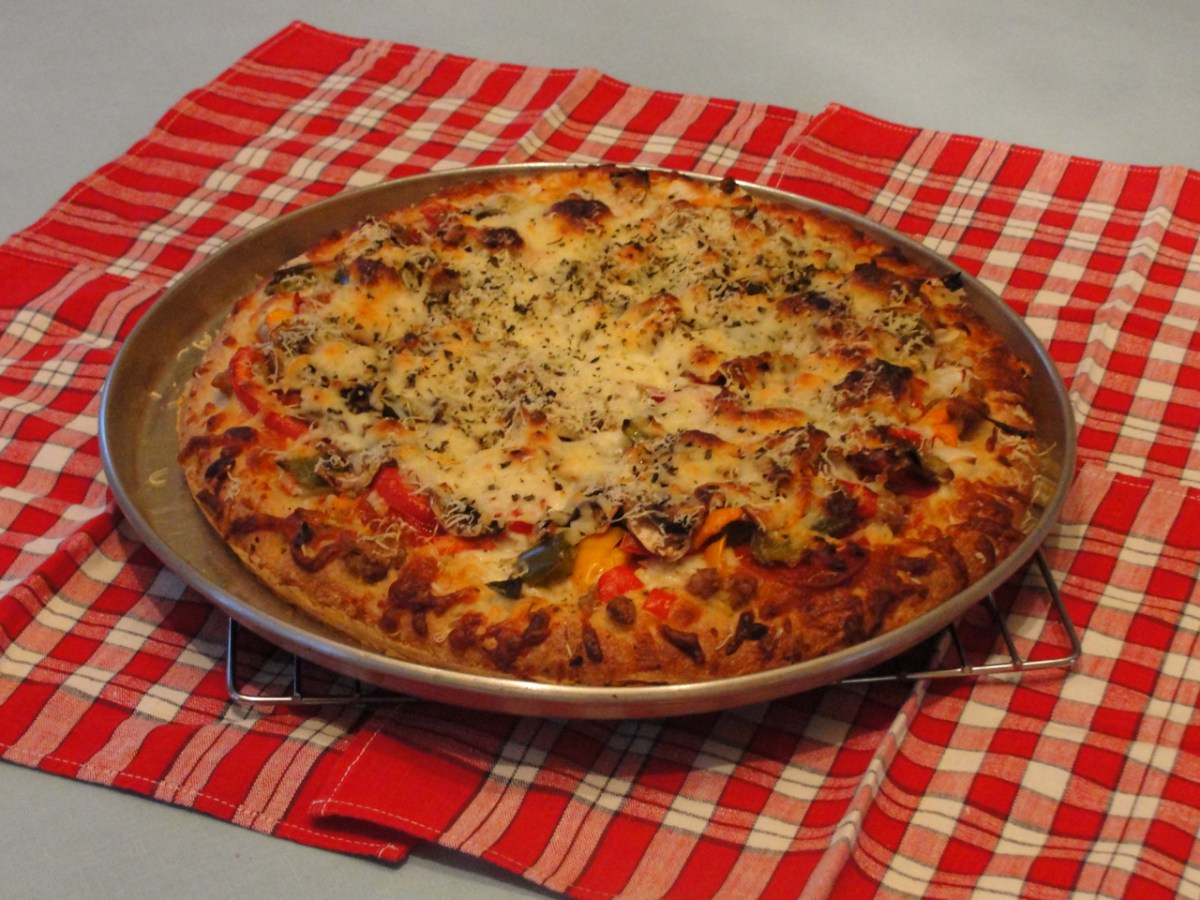
It was a frozen pizza, but I had jazzed it up with fresh vegetables that turned it into the kind of pizza that we really enjoy. I guess that liking frozen pizza makes me a “heat and eat” cook, but adding some ingredients lets me think that I can perfect a recipe that needs some tweaking.

Here is what I usually do to jazz up our frozen pizzas. We like lots of vegetables and extra cheese on our pizzas. Your tastes and approach may be different, but if you want to make something resembling a Chicago Deep Dish Pizza, give this combination a try or customize the ingredients as you wish.

INGREDIENTS:

1 12-inch rising crust pizza
1/4 cup chopped green bell pepper
1/4 cup chopped red bell pepper
1/4 cup chopped sweet onion
4-5 fresh mushrooms
2 Roma tomatoes
1/4 tsp. fennel
1/4 tsp. basil plus a little to sprinkle on top.
1/8 tsp. oregano
Dash of cayenne
Dash of salt
1/2 cup shredded mozzarella cheese
1/4 cup grated Parmesan cheese.

PROCEDURE:

Preheat the oven as instructed on the pizza package.

Prepare the pizza while the oven is heating. Clean and chop the peppers and onion into a quarter-inch dice. Clean and thinly slice the mushrooms and tomatoes.

Put the herbs and spices into a mortar or cup along with the salt and crush them as best you can. If necessary, shred and grate the cheese. For the best flavor, shred and grate good quality cheeses, but the commercial varieties are okay.

Put the frozen pizza on a pan. Arrange the sliced tomatoes on the pizza and distribute the peppers and onion evenly over the tomatoes. Sprinkle the spices over these vegetables. Arrange the mushrooms on the pizza, then distribute the mozzarella over the mushrooms. Sprinkle the Parmesan cheese on top and finish with a little dried basil.

Bake for twenty-eight to thirty minutes until the cheeses begin to brown. Remove the pizza from the oven, allow it to cool for two or three minutes, then cut it into eighths and serve. Pass crushed chile peppers for people who like a little extra bite to their pizza.

NOTES: Remember that pizzas need to be cooked thoroughly and that you need to bake jazzed up pizzas longer than the time specified on the package. How much longer depends on what and how much stuff you add. Adding fresh vegetables also adds liquid, so the extra cooking time helps with that too.

There are hundreds of different kinds of pizza, and I like most of them. I don’t like pizzas made with fake cheese, but if I am hungry enough or the guest of someone who likes such things, I even eat those.

I like pizzas with extra thin crusts, thin crusts, regular crusts and thick crusts. I like cheese pizzas, pepperoni pizzas, sausage pizzas and with just about any kind of vegetable or fruit added. Even anchovy and goat cheese pizzas are OK.

But I really like the taste of our jazzed up pizzas, and while the extra vegetables don’t transform a rising crust pizza into a health food, they are good for you. If you are like me, you may even feel a little virtuous as you bite into a slice of pizza loaded with those crunchy extras.

Dale’s San Francisco Stew

When I applied for admission to the University of Wisconsin in the spring of 1961, acceptance was automatic for any Wisconsin resident who graduated from high school with at least a “C” average grade point. Freshman students were also automatically assigned a room in one of the university residence halls. In loco parentis was the policy then, and parents wholeheartedly approved.

Most new students also approved, and we sent our checks for the first semester dorm fee. About $400 paid for a room, twenty meals a week and even a maid to change the linens and make our beds once a week.

What was not automatic was a choice of roommate.

The big brown envelope that arrived from the UW stuffed with information for the prospective student and parents included a roommate preference form. Brought up as a Missouri Synod Lutheran near Hayward, Wisconsin, I responded by indicating that I would like a Protestant roommate from a small town and mailed it to the University Residence Halls office in the provided envelope.

My new roommate turned out to be a Jewish boy, Lauren, from a large suburb of Milwaukee. Since he had asked for someone from a large city, he was surprised to find that I grew up in the country a few miles outside of a small town where nearly everybody knew everybody. He had heard of Hayward, because a friend’s family had vacationed there, but he had never met a Lutheran before.

Within an hour we had discovered that we agreed on at least one thing. Whoever made roommate assignments was probably a retired US Army clerk who had sent wool underwear to troops fighting in Guadalcanal and cotton socks to soldiers freezing in the Battle of the Bulge. Lauren and I ended up enjoying each other’s company so much that we even rented an apartment together one summer.

That was after I had learned a lot about reformed Jews. The breakfasts served in the Van Hise Dining Hall were very good. I looked forward to getting up early so I could chow down before heading off to my 7:45 quiz section. The typical menu included bacon, ham or sausage and eggs, toast or pancakes, juice, fruit, milk and coffee or tea. At least a couple days a week, there were also cinnamon rolls or Danish pastries still warm from the oven.

Lauren seldom got up for breakfast. I noticed also that he never chose pork for lunch or dinner. He seemed to be a macaroni and cheese fancier at noon and a fish or sirloin beef tip man at dinner. On the one or two occasions when he did get up for breakfast, he avoided the ham and sausage. Since I knew that Jews did not eat pork, I didn’t have to ask why he didn’t pile any on his plate.

About nine weeks into the semester, when mid-term examinations were threatening us, Lauren started joining me for breakfast nearly every day. I still remember the morning when we arrived at the bacon station in the cafeteria line. Lauren piled a half dozen strips on his plate, added some scrambled eggs and toast and led me to a table. I was flabbergasted.

It turned out that he simply didn’t like sausage, ham or roast pork but loved good bacon. He proceeded to educate me about the differences between Orthodox and reformed Jewish observances and explained the peculiarities of Jewish mothers and grandmothers.

Lauren’s mother and grandmother visited us on a Sunday afternoon every six weeks or so. They always brought him two or three large cartons of homemade blintzes. Unlike me, Lauren was slender, and they were sure he was not getting enough good food at the university.

There were five or six dozen tender buckwheat crepes stuffed with meat, cheese or jam. Neither I nor the other guys on our floor had even heard of blintzes, but once we tasted them, Lauren was the most popular student in the hall on those Sundays. We had no dorm room refrigerators, so it was just as well that we finished off the blintzes quickly, probably before our benefactors had made it back to Milwaukee.

Lauren’s mother and grandmother helped outfit the kitchen in the apartment we rented for the summer after our sophomore year. The best thing I can say about the place is that it taught me how crafty landlords could be and how little time some students wasted cleaning their home. Vultures are probably better housekeepers.

We didn’t realize how bad the place was when the landlord showed it to us because he explained that he didn’t like to invade the privacy of his tenants, so he just conducted us quickly through the living room to a bedroom and guided us back out before we had a chance to inspect the kitchen or bathroom.

Two days before we had to move out of our room in Tripp Hall, we picked up the keys to our summer home. The moderately clean rug that had covered most of the living room floor was gone, revealing a greasy disgusting layer of cheap carpet. The bathroom was as bad, with soap scum on the lavatory, a toilet that had not been cleaned since the first time someone had vomited over it last fall and a tub/shower combination that looked like it had been used to hose down hogs.

The kitchen was even worse. Until I pulled out the crisper drawer of the refrigerator, I had not realized that sometimes one needed a putty knife to clean a kitchen. A half-inch-thick layer of black gunk that looked like something from a science fiction movie had taken over. The putty knife was useful for cleaning the range and countertop as well, so it turned out to be a good investment.

We rented a steam cleaner from the hardware store where I bought the putty knife and a box of steel wool, picked up a couple bottles of bleach and various detergents plus the first of a number of cans of Comet at a grocery store and hauled the load back in a taxi. Later we took a break to buy a scrub bucket, sponge and cleaning brush along with a bottle of room deodorant that the hardware clerk assured us would destroy any nasty smells. We agreed that it helped.

After shampooing the sofa we bit the bullet and invested in a throw cover for that monster. We took turns scraping the kitchen and bathroom tile floors, scrubbed them with steel wool and applied two coats of floor wax. We thought that they looked pretty good. We scrubbed the walls, cleaned the ceiling light fixtures and took the curtains to a laundromat. We bought a bottle of window cleaner and some furniture polish in hopes that it would also help cover up various odd odors.

My mother had put together a basic kit for our experiment in independent living with some silverware, plates, glasses and cups for our table and a couple of saucepans. She also furnished some cleaning rags, washcloths and towels, a set of sheets and a blanket along with a pillow and pillowcase. After two long days and evenings of housecleaning we felt pretty satisfied with the job we had done. Compared with what we had started with, we thought that the place looked like something out of Better Homes and Gardens.

Lauren’s mother and grandmother arrived on the third day with his linens plus an electric skillet, a frying pan, some mixing bowls and a tablecloth. And blintzes to put in a really spotless refrigerator.

I will never forget watching Lauren’s mother sit down gingerly on the new throw cover, survey our scrubbed domain and announce diplomatically, “This will be pretty nice, once you clean it up.” We did not contradict her. She took us out to dinner.

Lauren and I actually cooked every day in our meticulously cleaned kitchen. We ate a lot of “heat and eat” meals, usually with some kind of healthful addition. For example, I remember hot dogs and onions stirred into a can of beans served over bread, which today makes me think that I was making a predecessor of San Francisco Stew.

I had never even heard of San Francisco Stew until Dale introduced us to it at a church potluck. I liked it and asked for the recipe. Dale said that it was really easy to make, and he was right. It shares a lot with the meals Lauren and I stirred up when we got home from classes or our summer jobs at the university.

Open a couple of cans, add some fresh ingredients and meat, let things simmer for awhile and “Voila! Dinner is served.” San Francisco Stew is a little more complicated since it has both bacon and hamburger in it and needs to be baked in the oven, but we made similar dishes on top of the stove.

Dishes like this are not haut cuisine, but neither are many popular comfort foods. Macaroni and cheese, tuna salad sandwiches and cheeseburgers come to mind. We call them comfort foods because they remind us of eating at the kitchen table when we were kids and didn’t have to worry about the problems of the world.

Make a casserole of San Francisco Stew for your family on a day when the kids are busy playing outside and are sure to be hungry when they come in for dinner. If they ask for pizza, tell them the pizza oven isn’t working; if they want hamburgers, tell them the hamburgers are in the stew. For good measure you might point out that there are also baked beans in it, so it’s almost  a picnic on a plate.

Here is Dale’s recipe.

INGREDIENTS:

4 or 5 slices meaty bacon (about a quarter lb.)
1 medium onion (2 1/2 to 3 inches in diameter)
1 lb. hamburger
1 large can (28 oz.) baked beans
1 large can whole tomatoes
1 T brown sugar
1/2 cup uncooked white rice

PROCEDURE:

Chop the bacon into half-inch pieces and clean and chop the onion into a quarter-inch dice. Fry the bacon in a skillet until it starts to turn brown but is not crisp. Use a slotted spoon to remove the bacon from the skillet and put it in a mixing bowl. Sauté the onion until it is translucent and use the slotted spoon to transfer it to the mixing bowl.

Preheat the oven to 350º.

Brown the hamburger over medium heat. Drain any excess grease from the hamburger before you put it into the mixing bowl. Add the baked beans, tomatoes, brown sugar and rice. Stir everything together and transfer the mixture to a large casserole or a nine by thirteen-inch glass baking pan.

Bake covered for eighty-five to ninety minutes. Remove from the oven, uncover and allow to rest a few minutes before serving.

NOTE: You can substitute about three cups of fresh tomatoes for the canned. Put six to eight small to medium tomatoes in a pot of boiling water for about a minute. Remove them from the boiling water with a slotted spoon and cool them in a bowl of ice cold water.

Peel and cut the tomatoes into halves or quarters, depending on the size. Put them in a small saucepan, add a quarter cup of water, a half teaspoon of celery salt and a grind of black pepper. Bring the pan to a boil, reduce the heat and simmer the tomatoes for a minute, stirring gently. Remove the pan from the heat and let the tomatoes cool while you prepare the other ingredients.