Jane’s Turkey Hash

If, like us, you roast a turkey for your family’s Thanksgiving or Christmas dinner, you may already follow our after dinner tradition of simmering the turkey carcass to create a delicious broth and salvage some tender meat. While Jerri offers suggestions, I carve the last few pieces of meat from the bones and break the carcass into pieces. Then our roles are reversed, and I suggest how much meat should be included in each package that we will freeze for sandwiches or to make turkey a la king.

Eventually the turkey bones end up in the roaster with some water. We bring it to a boil, turn down the heat and simmer them for a couple of hours. When the broth has cooled to a warm room temperature, we remove the last bits of meat from the carcass and strain the broth.

The result is a quart or so of really flavorful broth and two or three cups of turkey meat. Since the meat has already given up some of its flavor to the broth, it is not the best meat from the turkey, but it works just fine for making turkey hash, particularly if you have some sliced turkey left over from the roast.

This recipe is another one from Jane Marsh Dieckmann’s Use it All: The Leftovers Cook Book, which Jerri’s niece Susie loaned to us. Turkey hash is easy to make, tastes good and helps make room in the freezer for other leftovers.

INGREDIENTS:

1 1/2 cups diced turkey or leftover turkey salvaged from the carcass
1 cup cooked diced potatoes
1/2 cup cooked chopped celery
1 T minced parsley
1 T finely chopped chives or a scallion
1 cup gravy or sauce
1/4 tsp. salt
1/4 tsp. freshly ground black pepper
3 T butter or olive oil

PROCEDURE:

If you don’t have any leftover boiled potatoes, peel and chop one or two raw potatoes into a half-inch dice. Spread them in a pie plate, cover it with waxed paper and microwave on high until the potatoes are soft enough to pierce with a fork, about four or five minutes.

Clean and chop the celery into a quarter to half-inch dice and microwave it in a covered bowl until it is starting to soften, two or three minutes.

Clean and finely chop the parsley and chives or scallion and if necessary warm the gravy so it is liquid enough to mix with the other ingredients when you assemble the hash.

Make sure that the turkey is cut into pieces no larger than a half-inch dice and put it into a mixing bowl. Add the potatoes and celery along with the parsley, chives or scallion. Blend everything together, then stir in the gravy, salt and pepper.

Set a skillet or frying pan over moderate heat and coat it with the butter or oil. Transfer the hash to the skillet or frying pan. Stir to prevent burning, but allow the hash to crisp a little as it heats.

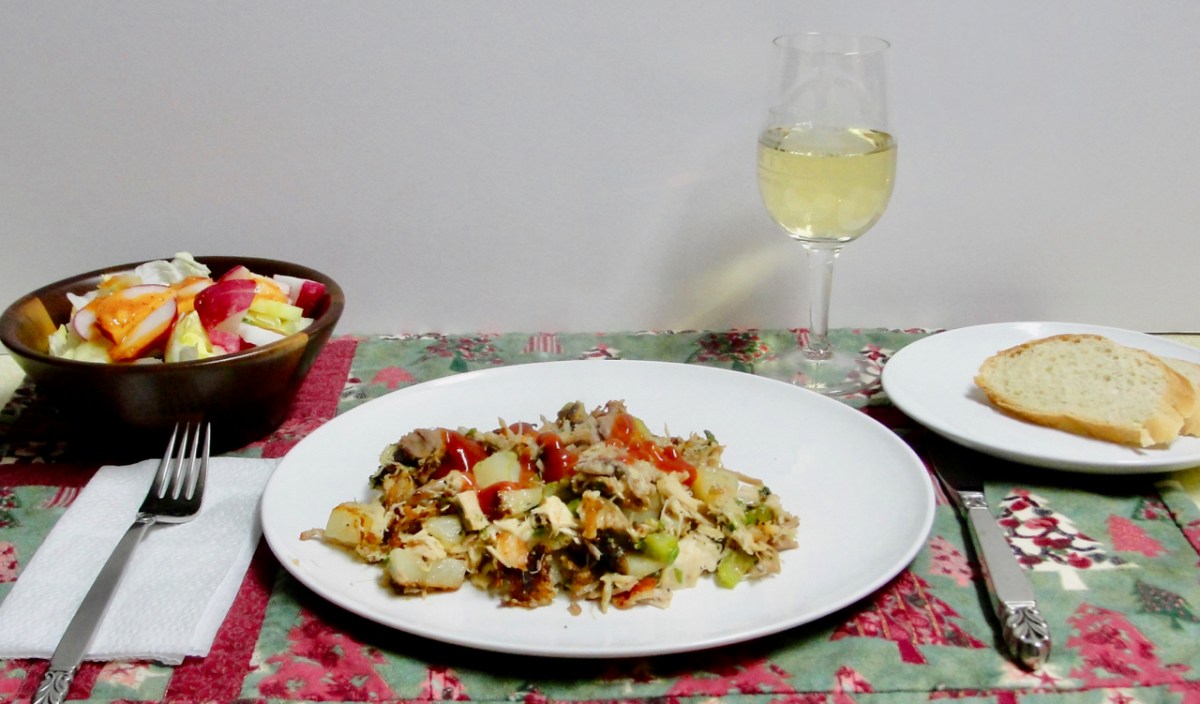
Serve hot and pass the ketchup.

NOTES: The first time I made this recipe, I used all the leftover gravy from our Christmas dinner. Nearly two cups of gravy produced a kind of stew. It wasn’t really hash, but it tasted fine and used up another leftover.

Since we don’t always have leftover gravy in the refrigerator or freezer, I make a satisfactory substitute with chicken bouillon. Dissolve a chicken bouillon cube in three quarters cup of hot water, season with dashes of sage and thyme and thicken with a tablespoon of corn starch dissolved in a quarter cup of cold water.

Jerri’s Spaghetti Sauce

This is a simple but flavorful spaghetti sauce that Jerri made dozens of times when I was gainfully employed selling recycling equipment and she was a piano teacher and church organist. Since my office was in a western suburb of Minneapolis, and my customers included companies from Milwaukee, Wisconsin, to Warroad, Minnesota, I usually called to let her know when I thought I would be home for dinner. However, I was sometimes delayed. Anyone who has commuted through the Twin Cities knows what a shower or snow flurries can do to traffic on highways in the Metro area.

Jerri thus became an expert in flexible meal scheduling. Her students began arriving when the school day ended. She usually said goodby to the last one after 6 PM. To accommodate this schedule she assembled a main dish before her first student arrived, put it in the refrigerator and popped it into the oven or put it on the burner at the appropriate time.

She made a lot of wonderful casseroles and soups and learned how to create a spaghetti sauce that seemed to improve the longer she had to wait for me. Her recipe for the sauce reveals her as not just an expert at putting a meal on the table when the family was ready to eat but also as a “make do” cook who was willing to substitute ingredients that she thought would not be rejected by her husband, son and daughter. Her judgment was nearly always good. At least she never had the kinds of disasters I produced from time to time.

Her basic recipe for spaghetti sauce consisted of the first six ingredients listed below. The final seven represent my guesses about quantities of ingredients contained in her note that said something like, “Add some salt and pepper. Anise or fennel seeds and basil if you like them. Thin with water or red wine and smooth it out with some olive oil. If you like the flavor, mushrooms can be added with the garlic.”

As you can see, you can adjust the recipe to whatever is on your spice rack and “make do” with what you have. I think that fennel or anise, basil, wine and olive oil improve the sauce, but it is edible without them.

You can “make do” with whatever you have, so there’s no excuse for not making Jerri’s spaghetti sauce.

INGREDIENTS:

1 lb. Italian sausage
1 or 2 garlic cloves
1/4 cup chopped onion
1 6 oz. can tomato paste
1 8 oz. can tomato sauce
1 16 oz. can whole tomatoes
1/2 tsp. anise or fennel seed
1/2 tsp basil
1/4 tsp. salt
1/4 tsp. freshly ground black pepper
1/4 cup dry red wine
2 tsp. olive oil
Grated Parmesan cheese to pass (if you have some)

PROCEDURE:

Remove the paper from the garlic and mince it. Clean and chop the onion into a quarter inch dice. Chop the tomatoes into bite-sized pieces, reserving the juice. Brown the sausage in a two or three quart saucepan over moderate heat. Drain the grease if necessary and add the garlic and onion and cook them for about two minutes. Add the chopped tomatoes, juice, tomato sauce and paste.

Blend the fennel seed, basil, black pepper and salt in a mortar or cup and stir them into the pan. Stir in the wine and olive oil.

Reduce the heat and simmer for an hour or so. Stir occasionally and add wine, water or tomato juice if the sauce becomes too thick.

NOTES: If you include mushrooms, clean and slice them thinly and add them with the garlic.

I sometimes use a mixture of fennel and anise.

You can take this sauce off the heat when it has simmered long enough to suit your taste, then reheat it while the spaghetti is cooking.

This sauce freezes well and keeps for at least three or four months.H