Nellie’s Potica Recipe

Here is another recipe from my brother-in-law Patrick, who grew up in Hibbing. His mother died in childbirth when he was four, and when he was six his father married Nellie. Patrick and his brothers got a stepmother who baked some special desserts that still rank high on the list of his favorites. Potica and rhubarb cake are near the top. He isn’t sure where she got the recipes. Nellie was from Duluth, so she might have brought them with her when she moved to Hibbing, or she may have gotten them from a relative there.

Potica (pronounced po-TEET-suh) is the Slovene version of a nut roll. Slovenia is a small country on the north coast of the Adriatic Sea bordered by Italy, Austria, Hungary and Croatia. The largest number of Slovenes came to the United States between 1880 and 1920. Many of them came to Ely, Tower, Hibbing and other cities on Minnesota’s Iron Range to work in the mines.

While the men worked in the mines, their wives worked in their kitchens. They used the recipes they had learned from their mothers, and one of those recipes was for a special bread called potica. Of course, people from other countries also came to the Iron Range. One of them was Giulio Forti, who opened the Sunrise Bakery with his wife,Virginia, in 1913.

When their oldest son, Vincent, married the daughter of a Croatian immigrant in 1932, she taught him how to make potica. For over twenty years he baked it for friends and family, but finally, Vincent’s daughters persuaded him to add it to the regular offerings of the bakery. Today, the descendants of Giulio and Virginia ship thousands of loaves of potica to customers around the world from the Sunrise Bakery.

The dough for Sunrise potica is stretched paper thin, but many housewives on the “Range” simply roll the dough out as thin as they can and spread a generous layer of filling on it That is how Nellie made hers. The thinner you roll it, the more authentic your potica will be, but it will always taste good.

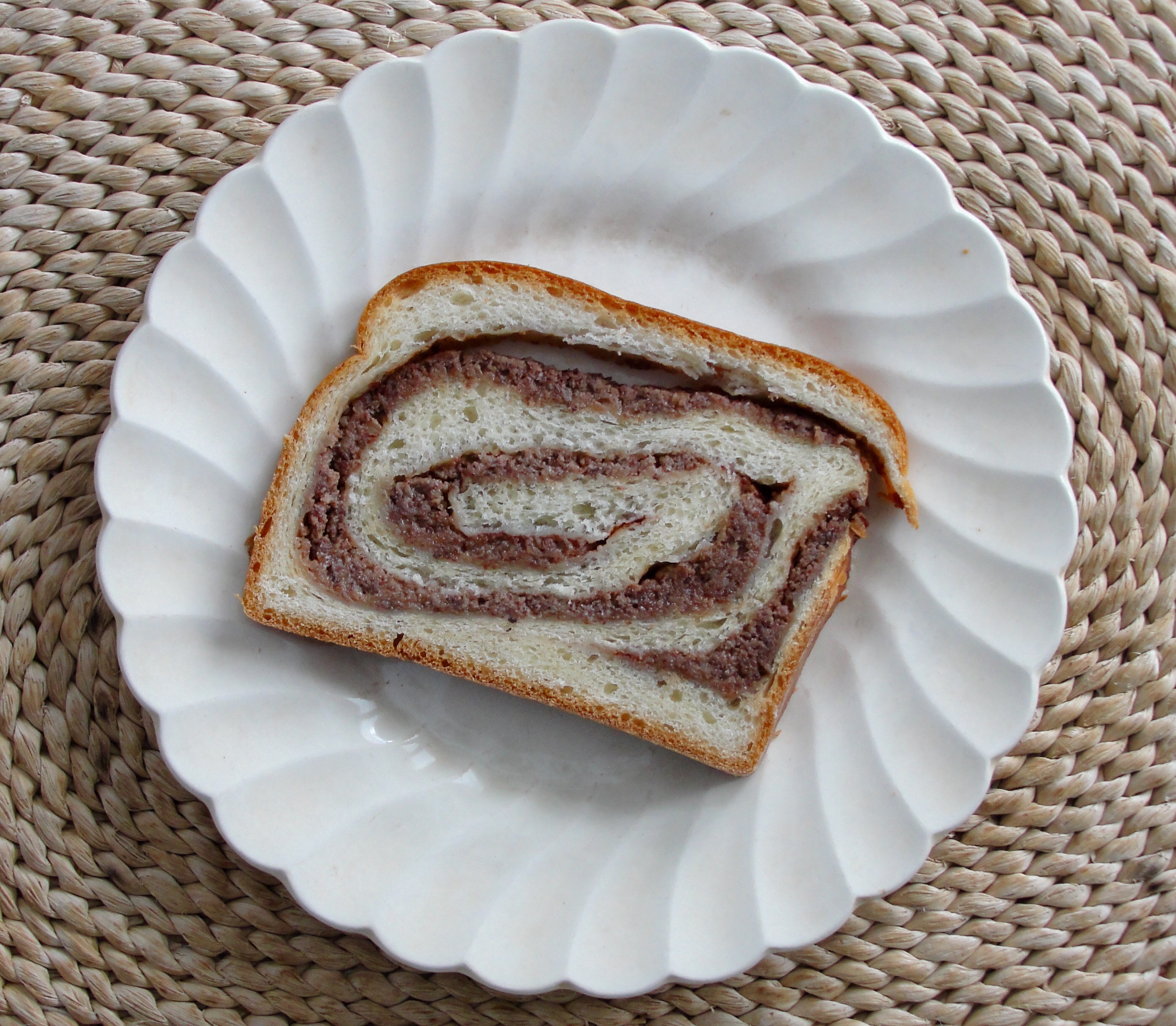
Here’s slice of my potica.
image

INGREDIENTS:

Dough:
1/2 cup water
4 tsp. yeast
2 cups scalded milk
1/2 cup sugar
3 tsp. salt
2 eggs
6 T butter
6-7 cups flour
Cinnamon and sugar when forming loaves

Nut Paste:
1 lb. ground walnuts
1 cup honey
1 cup milk
1 egg

PROCEDURE:

As usual, scrub your hands well as you will be kneading dough.

Dissolve the yeast and a quarter teaspoon of sugar in a half cup of lukewarm water. Heat the milk until it is steaming and put it into a large mixing bowl. Stir in the butter, salt and sugar into the hot milk. When the milk has cooled to lukewarm, beat in the two eggs and a cup of flour to make a thin batter. By this time the yeast should be foaming. Stir it into the batter.

Continue adding flour a cup at a time, beating thoroughly after each addition, until the dough begins to come away from the bowl. Turn the dough out onto a floured board and knead until it is smooth and satiny. This will take six or seven minutes. Form the dough into a ball.

Grease the bowl with butter or shortening and put the dough into the bowl, turning the ball to coat the surface with grease. Cover the bowl with a damp kitchen towel and set the bowl in a warm, draft-free place until the dough has doubled in bulk.

Make the nut paste while the dough is rising. Use a fork to mix all the ingredients together to make a smooth batter in a three quart saucepan. Set the pan over medium heat and bring the batter to a simmer, stirring continuously. When the batter just starts to steam, reduce the heat to low, keep stirring, and cook the batter until it turns to a smooth paste. Cover the pan and keep it warm on very low heat until you are ready to spread it on the dough.

Grease three loaf pans and melt a stick of butter in a small bowl or pan.

Turn the dough onto the floured surface and knead it five or six turns. Divide the dough into thirds.

Roll the first third of dough into a rectangle on a well-floured surface. The dough should be as wide as your loaf pan and as long as practical. Paint a layer of butter on the dough and sprinkle it with sugar and cinnamon. Spread one-third of the nut paste on the dough. Starting at the narrower end, roll the dough tightly as if you were making a jelly roll. Tuck the ends of the loaf together and put the loaf into the pan. Repeat these steps for the other two pieces of dough.

Put the pans in a warm, draft-free place and cover them with the damp towel. Preheat the oven to 350º while the loaves are rising. When the dough is even with the tops of the pans, place them on the center shelf of the oven and set your timer for thirty minutes. Turn the pans to help with even browning after thirty minutes and set the timer for another ten minutes. Check the loaves regularly after the timer sounds the second time and remove them from the oven when they are golden brown and sound a little hollow when tapped on top.

Brush the hot loaves with a little butter. Let them cool a few minutes in the pans, then carefully remove them from the pans and allow them to cool thoroughly on a rack.

NOTES: Nellie’s recipe does not say how much sugar and cinnamon to use when you assemble the loaves. I sprinkle three or four tablespoons of ordinary granulated sugar over the butter followed by a half or three-quarter teaspoon of cinnamon sprinkled on the sugar before I spread the nut paste.

If you can keep the loaves straight you might try varying the amounts of sugar and cinnamon in each loaf the first time you make potica and using the amounts you prefer the next time you make it.

Whole milk works best for making potica. You can fortify that reduced fat milk with some half and half or heavy cream or even with some melted butter.

The first time I made potica I used ground pecans sent to us by one of Jerri’s nieces. The potica was delicious.

My sister Patsy bakes her potica on baking sheets instead of loaf pans. Take your choice.

Grandma Hopp’s Meatloaf

In the spring of 1951 I got a bicycle for my eighth birthday. It was a red Schwinn bike that had belonged to my Uncle Bill, my mother’s youngest brother. I admired him immensely. He was a soldier serving at an American Army Base in Germany and no longer needed the bike. After we wheeled it out of the haymow where Grandpa had carefully stored it, Dad gave him $10 to save for Uncle Bill. Then we loaded the bike into the trunk of the Plymouth and drove home.

I was excited but also a bit apprehensive. I was eight years old, didn’t know how to ride a bike and had short legs. When we got home, Dad offered to teach me how to ride. After I fell over a few times I refused to get back on the bike, so Dad got on to show me that it really was possible to keep it upright. Even Mom came out and demonstrated her skill on a two-wheeler.

It would have been easier learning to ride if the road in front of the house had been paved. Our driveway wasn’t very long, and when I got to the rutted sand and loose gravel I was in trouble. However, after a few days and a number of scrapes and bruises, my skill improved. Soon I was riding the quarter mile down to where Phipps Road ended at U.S. 63.

My usual method of stopping was a controlled fall, and starting was also a challenge. Since I could not hold the bike upright and get a leg over to the pedal to start riding, I positioned the bike next to the front steps, climbed on the bike and pushed off. There were, of course, no front steps along the highway. After pushing the bike home a couple of times, I loaded an unsplit block of firewood into my wagon and pulled it down to the highway. A day later I hauled one down to the bridge at the river, a quarter mile in the opposite direction.

With a half mile of road to ride on, I was in heaven. Our neighbors had front steps, so I could visit Gus Gauch, Mr. and Mrs. Hagberg and my friend, Bob Hanus, who lived with his parents just beyond the bridge. By September I no longer needed steps or blocks. I may have had a growth spurt that summer, or maybe I just learned how to tilt the bike, get my leg over the crossbar and push off with enough speed that I almost always managed to stay upright.

I also learned that my Schwinn was actually an all-terrain vehicle. The balloon tires were ideal for riding across fields, of course, but I also rode it on the trail to the garden and even through the garden until I was told to stop. I rode it on the footpath along the river used by trout fishermen and raced across pastures, dodging rocks and cow pies and bouncing over fallen tree limbs.

When I turned ten, I was allowed to ride on the highway into Hayward. By then I had a basket mounted to the handlebars which made it possible for me to run errands for Mom when she needed something from town. The shoulders along 63, though it was a U.S. Highway, were not very wide, but I squeezed as far to the right on the pavement as I could, and I never had any close calls. Perhaps I should thank the drivers, the slower speeds that most people drove and the fact that we didn’t have cell phones to distract us.

I’m pretty sure that I first rode my bike to Grandma and Grandpa Hopp’s farm when I was eleven. I had been spending a week or two with them every summer since I was eight or nine years old and looked forward to my “vacation” all year long. Grandpa had a small herd of dairy cows that he milked twice a day by hand. I was especially impressed that he could squirt milk into the cats’ mouths as they sat begging near him. When he had finished milking, I would help carry the buckets up to the milk house where Grandpa strained the milk and stored it in milk cans in the cooling tank for pickup by the milkman who also delivered butter and cheese.

It was a little over eleven miles from our home to Grandma and Grandpa’s, and my mother worried that I would “get run over.” I worked out a route that put me on town roads with little traffic except for the final three or four miles on a county highway, which was, as I explained, the distance I rode into Hayward. My father did not seem very worried in any case, and my mother approved the route when I promised to be very careful.

I had only two problems in the four years that I made the trip. The first year I learned that deep sand at the bottom of a steep hill would make me take a header. On the second or third trip a front axle broke and I had to walk the last two miles. Grandpa and I called my father at work from a neighbor’s phone. Dad brought out an axle and the tools to repair the otherwise trusty Schwinn. Incidentally, that road is paved now, but I still think about walking my bike down the hill and pushing it through the sand whenever we drive it.

A few moments from those summer weeks at Grandma and Grandpa’s are still fresh in my memory. I remember waking up one morning when it was just getting light. Grandpa must have made a noise as he was getting dressed, so I pulled on pants and joined him in the kitchen. As we drank our morning coffee (mine heavily laced with milk), I asked him how he woke up every morning without an alarm clock. He answered, “I just wake up when it starts to get light. I like to watch the sun come up.”

I made him promise to get me up every morning, and he was true to his word. After coffee we would go out, open the chicken coop and let the ducks and geese out of their sheds so they could get busy eating bugs and weeds. Then we would sit on the steel lawn chairs and watch the hummingbirds at Grandma’s flowers and the acrobatics of the barn swallows and purple martins as they caught breakfast on the wing while we waited for the cows to come walking through the pasture on their way to the barn.

When I asked, Grandpa explained that the cows came to the barn because they wanted to be milked, that their udders started feeling full and they knew it was time, but sometimes the cows did not show up for the morning milking. That always meant that they had gotten through the fence and couldn’t find the way back.

The pasture was mostly woods with some small clearings where Grandpa had cut trees for firewood, and there was a larger meadow by the ponds where moonshiners had cut fuel. The cows did a good job of keeping things clear, so it was easy walking.
We would follow the fence until we found the problem. It was always where a dead tree had fallen over the barbed wire and pulled down a post.

We would listen for the bell on Bossy, the head cow. It didn’t take long before we found the herd in the forest and guided them back to the opening in the fence. After milking and breakfast I would help Grandpa put in a new post and splice the wire.

My grandfather loved to read, and he was interested in lots of different things. I remember reading Zane Grey novels, mysteries and books about history and geography. But most of all I loved Grandpa’s collection of The National Geographic Magazine shelved on the porch. When he built the house, Grandpa included a stone porch on the north end. The stone walls, about five feet high, were topped with screen panels.

As I read about faraway places, the fresh air carried the smells of pines and flowers and the screens let in the songs of birds, the chattering of squirrels and the raucous conversations of the chickens, ducks and geese. It was a marvelous place to read about ancient civilizations, beautiful islands, temples and palaces, castles and people living in the jungles of South America and Africa. Like many boys my age, I saw my first female breast in a National Geographic photograph illustrating an expedition to Equatorial Africa. I was fascinated.

Not too fascinated to skip meals, however. When Grandma called, Grandpa and I came. It was not fancy food. Grandma was a meat and potatoes cook, but she baked great bread and cookies and, with Grandpa standing in for an electric mixer, wonderful cakes. “Three hundred strokes, pa,” she would tell him, and he would sit at the table cradling the mixing bowl and whipping the batter with a big wooden spoon.

My Aunt Dorothy preserved this recipe she got from Grandma. I probably ate a few slices of this meatloaf before I tackled the dessert.

INGREDIENTS:

1 1/2 lbs. hamburger
1/2 lb. pork sausage
2 slices bread
1/4 cup milk
1 large egg
1/2 medium onion (3 inches diameter)
1/2 cup green bell pepper
2 cloves garlic
1/2 tsp. seasoned salt or equivalent
Grind of black pepper
1 or 2 cans cream of mushroom soup
1/2 – 1 cup water

PROCEDURE:

Preheat the oven to 350º.

Clean and chop the onion into a quarter inch dice. Do the same for the green pepper. Remove the papery outer skin of the garlic cloves and mince them.

Tear two slices of bread into pieces and put them in a mixing bowl. Soften the bread with enough milk to make a paste. Add the vegetables, egg, salt and meat and mix everything together.

Pack the meat into a casserole or loaf pan and bake, uncovered, for about an hour or until a fork stuck in the top of the loaf doesn’t bring up any red juices. Pour off any fat.

Mix a can of cream of mushroom soup with a half cup of water and pour it over the meatloaf. If you want more gravy, use two cans and a cup of water. Bake an additional fifteen to twenty minutes.

Serve with bread, potatoes and any other vegetable of your choice.

NOTES:

The amount of onion and green pepper is not specified, and my guess is that Grandma put in enough of both to be noticeable but not enough to overwhelm the flavor of the meat and gravy. I think I remember eating this when I was a kid and being suspicious about the green chunks. Mom did not put peppers in her meatloaf.

The original seasoned salt was Lawry’s, and that is probably what Grandma used. Today there are dozens of different varieties and brands of seasoned salt. If you have one you like, use it in this recipe. We don’t have seasoned salt in our spice racks, so we improvise for recipes calling for it. A half teaspoon of salt with a grind of black pepper, a little turmeric and paprika with dashes of onion and garlic powder and-voila!-you have seasoned salt. I also added a little extra black pepper to the recipe.

The recipe says to form the loaf in a three quart casserole. We don’t have one, so I decided to try putting the meat in a standard bread loaf pan. I packed it firmly into the pan, and the resulting loaf was excellent. If you do it this way, you will have room for only one can of soup.

For best results, use extra lean (93%) ground beef.

Aunt Dorothy noted that this is a “nice change from traditional meat loaf.” An understatement: This is a different but delicious meatloaf. Peas, carrots and cranberry sauce all go well with it.