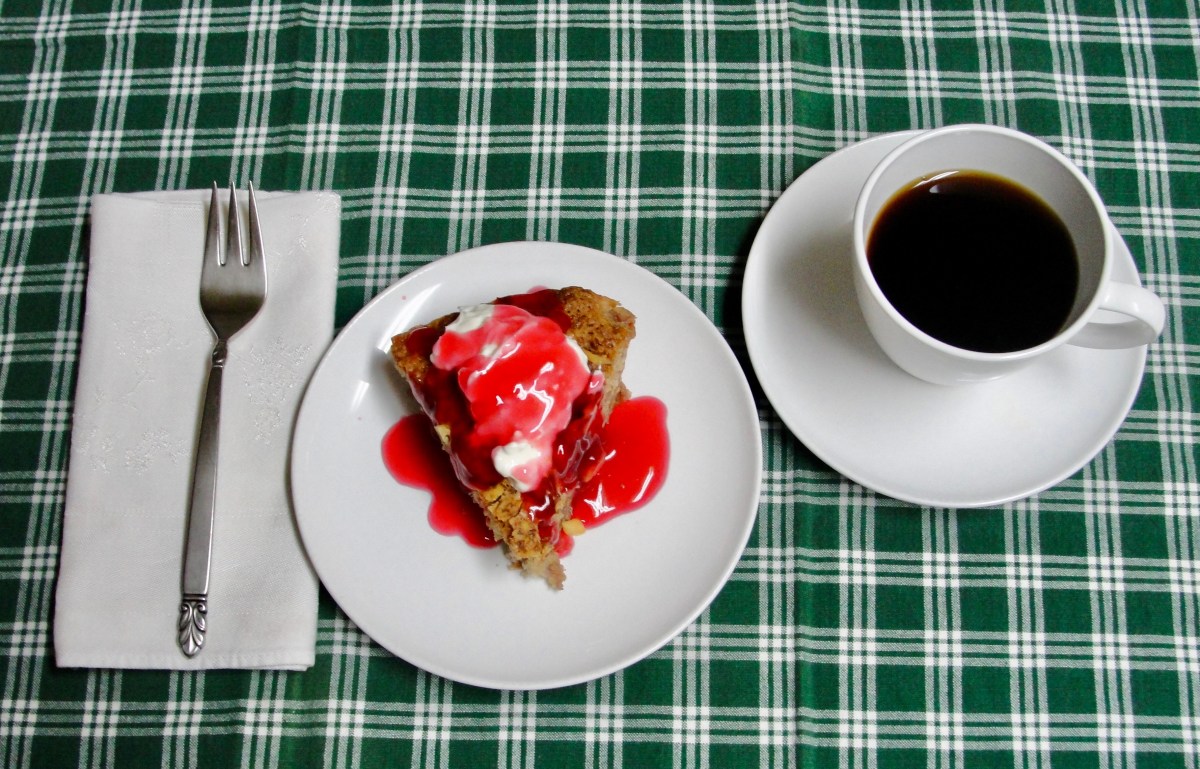
Jerri’s Cherry Torte

Over four thousand years ago, a scribe in Sumeria (modern-day southern Iraq) wrote down the recipe for beer on a clay tablet. He composed it as a hymn to Ninkasi, the goddess of beer and brewing. The name means “The Lady who fills the mouth,” and the hymn may have been written to help apprentice brewers memorize the ingredients and method to make one of the staple foods of early civilizations.

About four hundred years later, the first known cookbook was written during the time of Hammurabi, famous for the Code of Hammurabi. Thus, this famous king of Babylon (also in Iraq) is responsible not only for giving us the first law book but also for a collection of twenty-five recipes probably enjoyed by him and his court. Twenty-one are meat stews and four are vegetable stews.

The recipe for Jerri’s Cherry Torte is not as old as those from ancient Iraq nor was it stamped in cuneiform on clay tablets, but nevertheless, it has an interesting history. I found the recipe while reading The Krehbiel Family Cookbook compiled by Lynne, Jerri’s oldest niece, to preserve recipes that she and her three sisters enjoyed while growing up near Medicine Lodge, Kansas. Concluding the recipe was a note that Jerri served this dessert when Jerri’s oldest brother, Lynne’s dad, brought his family to visit us in Murray, Kentucky.

When I asked Jerri where she got the recipe, she said it had to be from one of her older cookbooks, since I did not begin my cookbook buying binge until we had left Kentucky. We checked that small collection beginning with The Joy of Cooking, Liz Specials, and Betty Crocker’s Dinner for Two. Nothing even close. Then she exclaimed, “I’ll bet it was from the cookbook I got from my Home Ec teacher in high school.”

Sure enough. It took some doing to find the old book since the spine is gone and it is hard to spot on the shelf, but on page 250 of Food From Famous Kitchens is the recipe for Cherry Torte. In Jerri’s neat handwriting is a note: “Very good.” That is true enough, but it is also very simple to make, which may help explain why Lynne included it in their family cookbook.

I value simple recipes that taste good too. If you feel the same way, give this easy recipe a try.

INGREDIENTS:

For the torte:
16 oz. can of red sour pitted cherries
1 large egg
1 cup sugar
1 cup flour
1/2 tsp. salt
2 tsp. baking powder
1 tsp. cinnamon
1 T butter
1 tsp. almond extract
1/3 cup chopped nuts
6 oz. cream cheese
2 T milk

For the cherry sauce:

1/4 cup sugar
1 T corn starch
1/8 tsp. salt
Water
Reserved cherry liquid
2 tsp. lemon juice
1/8 tsp. red food coloring

PROCEDURE:

Preheat the oven to 350º and grease and line an 8 by 2-inch round cake pan with waxed paper.

Drain the cherries and reserve the liquid. Beat the egg until lemon colored, gradually add the sugar and beat thoroughly. Stir in the well-drained cherries.

Sift the flour, salt, baking powder and cinnamon into the cherry mixture and mix well. Melt and stir in the butter and almond flavoring. Turn the batter into the cake pan and sprinkle the nuts evenly on top.

Bake at 350º for forty to forty-five minutes. Check for doneness with a toothpick. If the toothpick comes our clean, the torte is done. Invert the pan on a rack and cool the torte .

Make the cherry sauce while the torte is baking.

Mix the sugar, corn starch and salt together in a small saucepan. Add enough water to the reserved cherry juice to make one cup. Stir the liquid gradually into the sugar mixture and put the pan over medium heat. Stir constantly until the mixture comes to a boil. Boil for one minute. Remove the sauce from the heat and stir in the lemon juice and food coloring.

To serve, cut the cooled torte into wedges. Blend together the cream cheese and milk. Put a spoonful on each wedge and and top with cherry sauce.

Pork and Broccoli Stir-Fry

Lard sandwiches. They don’t sound very tasty to me, but lard is actually lower in saturated fats than butter and contains none of the trans fats found in most margarines. Of course, in the Great Depression people didn’t eat lard sandwiches for the health benefits. They ate them because lard was cheap. They trimmed the pork roast before it went into the pot, rendered the fat to make lard and used the lard to make sandwiches.

Cooks like my grandmother and mother also used the lard to make biscuits and pie crusts and saved bacon grease to fry potatoes or season vegetables. They didn’t do it because bacon grease happens to be really great for frying potatoes or because lard makes good biscuits and crusts. They did it because they couldn’t afford to waste food.

Things were tough for millions of families during the 1930’s and my mother’s family was no exception. When my grandmother developed tuberculosis and went to the sanatorium in Eau Claire, Wisconsin, my mother became the family cook and learned to make lard sandwiches.

Even as a girl she was willing to experiment in the kitchen. She told me that her onion lard and apple lard sandwiches were popular. I don’t remember eating any, but my father said Mom’s apple lard sandwiches were delicious, so I may have eaten them without knowing what they were. When I asked how she made them, she told me that she just chopped an apple, fried it in lard and mashed it to make a spread. It’s possible that when I thought I was eating apple butter it was really apple lard.

I don’t remember Mom making apple peel jelly or chicken foot soup (two other recipes popular in the Great Depression), but she didn’t waste very much food. She taught me to enjoy the core from the cabbage she chopped to make boiled dinner and fed any bad outer leaves to the chickens. She never threw away a potato or apple just because it had a bad spot. Jerri’s mom had the same thrifty habits. Our mothers cut away the damaged parts and used the rest, and we do the same today.

Americans waste a huge amount of food. According to a 2015 study by the Natural Resources Defense Council, forty percent of harvested food in the United States is now wasted. That amounts to 35 million tons each year worth $165 billion dollars or over $2,000 per family. Jerri and I waste some food, of course, but our mothers trained us well. For instance, we use the thick stems from the broccoli that some people throw away. Good chefs use those stems too. They don’t throw out something that costs over a dollar a pound and tastes good.

Broccoli florets are the unopened flowers on the head of the broccoli. The small stems and flower buds are tender and cook very quickly. The large stems taste just as good as the florets but they are tougher and take a little longer to cook. Just follow the recipe below and add them a few minutes before you cook the florets.

This stir fry is delicious for dinner and the leftovers make a tasty lunch the following day. We warm them in the microwave. No need to waste anything!

INGREDIENTS:

1 lb. lean boneless pork
1 T vegetable oil
1 large or 2 medium garlic cloves
1/8 tsp. dried chili pepper flakes
4 cups fresh broccoli
1/2 red bell pepper
1/2 green bell pepper
1/2 lb. mushrooms
3-4 scallions
3/4 cup water
3/4 tsp. instant chicken bouillon
1 T cornstarch
2 T oyster sauce
1 T soy sauce
1/2 tsp. minced fresh ginger
1 cup white rice
2 cups water
1/2 tsp. salt
Black pepper (optional)

PROCEDURE:

First prepare the ingredients. Slice the pork into quarter inch strips about an inch and a half long and set them aside in a bowl. Peel and mince the ginger and add it to the meat.

Wash and trim thin slices from the cut ends of the broccoli stalks. Discard the trimmings and chop the stalks into a half-inch dice and set them aside in a small bowl. After removing the paper from the garlic, mince it and put it in the same bowl as the broccoli stem pieces. Top the stems and garlic with the chili pepper flakes.

Separate the florets into bite-sized pieces and set them aside in a medium-sized bowl.

Clean and cut the mushrooms in half, then cut each half into four or five slices. Clean and chop the scallions into quarter inch rounds. Put the mushrooms and onions into the bowl with the broccoli florets.

Wash and remove the stems, seeds and white membrane from the peppers. Cut the peppers into thin slices about two inches long. Set the peppers aside in another small bowl.

Dissolve the chicken bouillon, cornstarch, oyster sauce, and soy sauce in three-fourths cup of water in a small bowl and set it aside.

Now you are ready to begin cooking the ingredients. Start by rinsing the rice and bringing two cups of water and the salt to a boil in a one quart pan with a tight-fitting lid. Stir in the rice and bring the pan back to a boil. Turn the heat down to a simmer, put the lid on and allow the rice to cook until the water is all absorbed. Do not remove the lid for the first fifteen minutes. Turn off the heat and fluff the rice with a fork before serving.

After the rice is simmering, heat the oil in a large skillet or wok, coating the bottom and sides of the pan. Add the garlic and meat and stir fry it until it has turned from pink to white, about three minutes. Add the broccoli stalk pieces, garlic and pepper flakes and continue cooking for another three to four minutes.

Add the broccoli florets, mushrooms and onions to the pan and stir fry them for three minutes. Stir in the peppers, add a teaspoon of water, cover, and steam the meat and vegetables for another minute.

Add the broth mixture to the pan and stir to coat the meat and vegetables with the sauce as it cooks for about three minutes, thickens and becomes smooth and clear.

Taste and adjust the seasoning with a little more soy or oyster sauce or pepper if necessary. Serve over the rice with tea, beer or white wine.

NOTES: This recipe is a fun one to do when you are expecting guests for dinner, since you can prepare everything ahead of time. Once the rice is simmering, you can continue visiting from the kitchen as you empty bowls into the skillet or wok and keep stirring. People will be impressed.