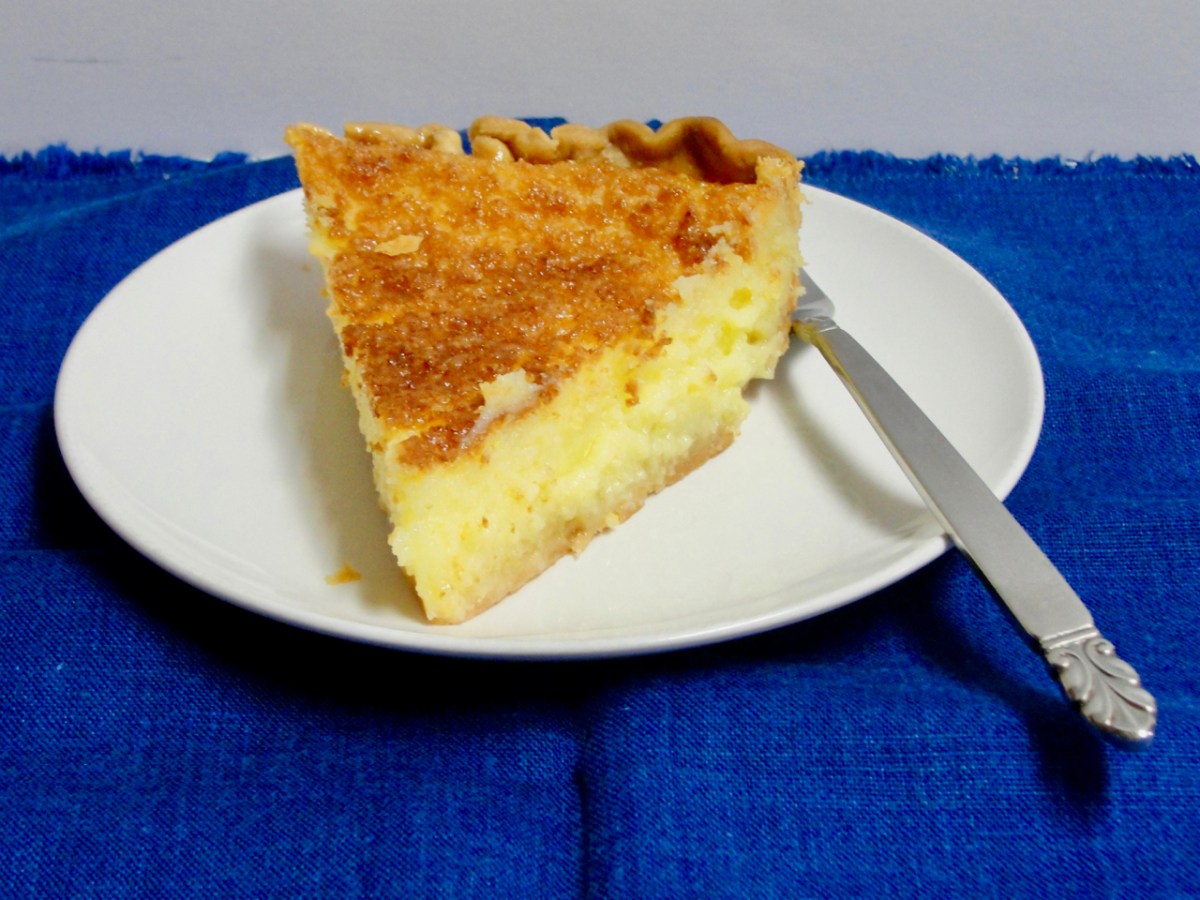
Bill Clinton’s Lemon Chess Pie

I was squeezing lemons to get the juice for a lemon chess pie when I was reminded of helping squeeze oranges and lemons for my mother. Before the days of frozen concentrates in cans at the Co-op or A & P, if you wanted orange juice or lemonade you did what Mom and Dad did. You bought oranges or lemons, took them home and squeezed them in your kitchen.

Oranges and lemons were expensive, so a glass of orange juice on a winter morning was a real treat. We each got a small glass once or twice a month. After juicing the oranges, my mother soaked the pulp in some water and added it with a little sugar to make the juice go further. The result was what something like orangeade and we loved it.

Lemonade replaced orange juice in the summer, and we enjoyed some almost every week. The juice from three or four lemons could make a half gallon of lemonade complete with slices of lemon rind floating with the ice cubes. Perhaps Mom’s lemonade would not satisfy a gourmet, but we all loved it, especially on hot evenings when the mosquitoes drove us indoors to a house that felt like an oven.

As I pressed and turned the halves of three small lemons on the ridged glass cone in the center of what is technically called a juice reamer, I flashed back to how I did the same thing nearly seventy years ago at the kitchen counter next to the sink. I think that the only difference is that Mom’s juicer (or reamer) was made of pale green glass while ours today is clear.

You can still buy juicers like ours, probably because they are dependable and inexpensive. If you need to juice a lot of fruit, they are not for the weak of arm, but for making a half gallon of lemonade or getting a quarter cup of lemon juice for chess pie, they are more than adequate and work well even if the electric power goes off on a hot day and the air conditioner fails.

There are many different recipes for lemon chess pie. Like all chess pies, the ingredients include fresh lemon juice, eggs, sugar, butter and cornmeal or flour or both. Chess pies are usually thought of as a southern specialty, but there are variations from northern states as well. Mildred Jorgensen, who gave our children piano lessons and was organist at St. Luke’s Lutheran Church in New Richmond for many years, gave us a cookbook from the Cedarhurst mansion in Cottage Grove, Minnesota, that includes a recipe for lemon chess pie.

The recipe below produces a richer pie with a more lemony flavor than most lemon chess pies. That is probably why it is said to be Bill Clinton’s favorite chess pie.

Like all chess pies, it is really easy to make.

INGREDIENTS:

2 cups granulated sugar
1/2 cup salted butter
5 large eggs
1 cup milk
1 T all-purpose flour
1 T yellow cornmeal
1/4 cup freshly squeezed lemon juice
The zest from two or three lemons (2 – 3 T)
1 nine-inch unbaked pie shell

PROCEDURE:

Begin by lining a nine-inch pie plate with a crust. You can make your own with this recipe for plain pie crust or use a commercial crust.

Bring the butter, eggs and milk to a warm room temperature. I microwave the butter under low power until it begins to soften, heat the milk at full power for a minute or so and put the eggs in a bowl of warm water.

Next, juice and zest the lemons. You will need two or three lemons, depending on the size. Remove the zest from the lemons with a zester or a kitchen grater and strain a quarter cup of juice. Set the zest and juice aside.

Preheat the oven to 350º.

Measure the sugar into a large mixing bowl and add the softened butter. Cream the butter and sugar with a wooden spoon until they are light and fluffy. Beat in the eggs one at a time, then stir in the milk.

Add the flour, cornmeal, lemon juice and zest and beat at medium speed for a minute with an electric mixer.

Pour the filling into the crust and bake on a center shelf for forty to fifty minutes. Use a table knife to check for doneness. Insert the knife near the center of the pie at forty minutes. If the knife comes out clean the pie is done. If not, bake another six or seven minutes and check again.

Let the pie cool completely before serving. Cut small slices as this is a very rich pie. If a diner asks for more, you can always relent with another small slice.

Ham and Great Northern Bean Soup

Americans waste lots of good food today, between thirty and forty percent of our food supply, according to the United States Department of Agriculture. Some of that waste occurs during harvesting and processing food, but the USDA estimates that thirty-one percent of food is wasted at the retail and consumer levels.

We, of course, are the consumers, and we all waste food. When surveyed, most Americans feel that they waste less food than their friends and neighbors. In other words, like the parents in the Prairie Home Companion city of Lake Wobegon, where “all the children are above average,” we all believe than we are below average in wasting food. As a logical statement, this must be a self-evident falsehood.

Since I think that we waste less food than most people, I offer a little quiz to determine whether you actually do waste less food than Jerri and I.

Question 1:  Do you eat bananas after they have turned brown?

Question 2:  Do you cut the “bad spot” off the apple you forgot about and eat the rest?

Question 3:  Do you save three tablespoons of mashed potatoes for lunch?

Question 4:  Do you save the tablespoon of leftover gravy to put on the potatoes?

Question 5:  Do you boil the turkey carcass, pick off the meat and save the broth?

Question 6:  Do you save ham bones to make soup?

If you can answer yes to all six, you are doing very well. But if you want to compete with Jerri, you have to answer yes to this question also.

Question 7: Do you clean out the shortening can with a spatula to save the last bit of grease to season the cast iron frying pans?

If your answer is a resounding YES! you are a leading warrior in the battle against food waste.

And if you saved that ham bone from your Easter dinner, you have a good start on a great soup.

INGREDIENTS:

1 lb. Great Northern Beans
Water
1 ham bone
Ham skin (if available)
1 or 2 cups chopped ham
1 or 2 chicken bouillon cubes
1 1/2 cups chopped carrots
1 1/2 cups chopped celery
1 cup chopped onion
2 cloves garlic
1 bay leaf
1 tsp. dried thyme
1/8 tsp. ground cloves
1/2 tsp. white pepper
Salt and black pepper if necessary

PROCEDURE:

Rinse the beans the night before you make the soup, discarding any debris. When I was a kid, it was not uncommon to find a tiny stone or two in the dry beans. I haven’t found one in the last three or four years, but I always look. Put the beans into a large bowl and cover them with cold water.

Next morning, put the beans into a five-quart saucepan or Dutch oven and cover them with water. Bring the pan to a boil, reduce the heat and simmer the beans for about forty-five minutes until they begin to get tender. Drain the beans and set them aside. Reserve the bean water.

Put the ham bone into the Dutch oven or a soup pot. Cover the ham bone with cold water and bring the pot to a boil. Reduce the heat and simmer the bone for at least an hour to make the broth.

While the ham bone is simmering, clean and chop the vegetables. I like to chop the carrots into quarter-inch rounds, the celery into half-inch pieces and the onion into a quarter-inch dice. Mince the garlic and chop the ham. The amount of ham you need depends on how much meat was on the ham bone. I chop it into a half to three-quarter-inch dice. Set the meat and vegetables aside in a bowl.

After simmering for an hour or so, the meat should be falling off the bone and most of the flavor from the bone and skin (if used) will be in the broth. Remove the ham bone and skin from the broth and set them aside to cool.

Add the chopped ham, chicken bouillon cube, vegetables, bay leaf, thyme, cloves and white pepper to the pot. If necessary add enough of the bean water to cover the vegetables by a half inch or so. Bring the pot to a boil and reduce the heat to a simmer.

Remove the meat from the ham bone and add it to the soup. Mash a half cup of beans and stir them into the soup, then add the rest of the beans plus a little more bean water and continue simmering the soup until the beans are tender.

Taste and adjust the seasoning with salt and freshly ground black pepper if necessary.

Serve with a salad and good bread.

NOTES: If the ham bone and meat are from a very salty ham, you might want to use only one bouillon cube. Add a teaspoonful of instant bouillon if the the soup needs more salt when you first taste it. Stir and simmer the soup for a minute and taste it again before making the final adjustment.

Many people are becoming more interested in reducing food waste. The USDA has a good page about the Food Waste Challenge which sponsors programs to help businesses and organizations achieve a goal of cutting food waste in half by 2030.

The United States Environmental Protection Agency has an excellent site on the Sustainable Management of Food.

One good example of a program designed to reduce food waste was started several years ago at Pine City, Minnesota. Named after a western Wisconsin lady known for her Christian generosity, Ruby’s Pantry now serves dozens of communities in Minnesota and Wisconsin from distribution warehouses in southeastern Minnesota and central Wisconsin.

Trucks deliver food and other items to communities where volunteers work at a “Pop Up Pantry” once a month. Several years ago, a friend of ours active in First Lutheran Church inspired her church to sponsor a Ruby’s Pop-Up Pantry every third Thursday in New Richmond.

Everyone is invited to attend. Ruby’s Pantry is devoted to sharing food and other necessities to anyone who can use them. People of all income levels and diet preferences are welcome. The only request is that you not waste the items you receive. If there is something that you can not use, give it to a neighbor or a local food shelf.

That’s what Jerri and I do, and we think that it is a wonderful program.