A friend introduced me to Morello cherries a few years ago. I didn’t know what they were, but he told me that they could be used to make cherry pies. The next time he visited Trader Joe’s in Woodbury, Minnesota, he brought me a jar of the dark red cherries as a gift.
The pie cherries I knew were bright red cherries that my mother bought every summer from traveling fruit vendors. Thanks to the Internet, I learned that the cherries I was familiar with were Montmorency cherries. They belong to the Amarelle family of sour cherries, but I also found out that Morello is the name of another large family of sour cherries that make delicious jams, crisps and pies like those made with Montmorency cherries.
Amarelle cherries were brought to America by settlers from England long before the Revolutionary War, and the Montmorency variety became the most common sour cherry planted by settlers as they moved west from the Atlantic. Morello cherries, on the other hand, are recent immigrants.
The dominant variety grown in Hungary, the Balaton cherry, was introduced first to cherry growers in Michigan by Dr. Amy Iezzoni, a professor at Michigan State University, in 1984. It is now the most popular commercial Morello cherry in the the United States, but some other varieties of English Morello cherries such as the Kansas Sweet and Northstar are grown in backyards or smaller orchards.
Morello cherry trees flower a bit later than Amarelles, which means that Morello trees have an advantage in areas subject to late frosts. For someone who likes to cook and eat, however, the biggest advantage of Morello cherries is that canned Morellos make wonderful cherry pies and crisps any time of the year. You can buy them online or at some supermarkets. In our area, Aldi and Trader Joe’s both carry them.
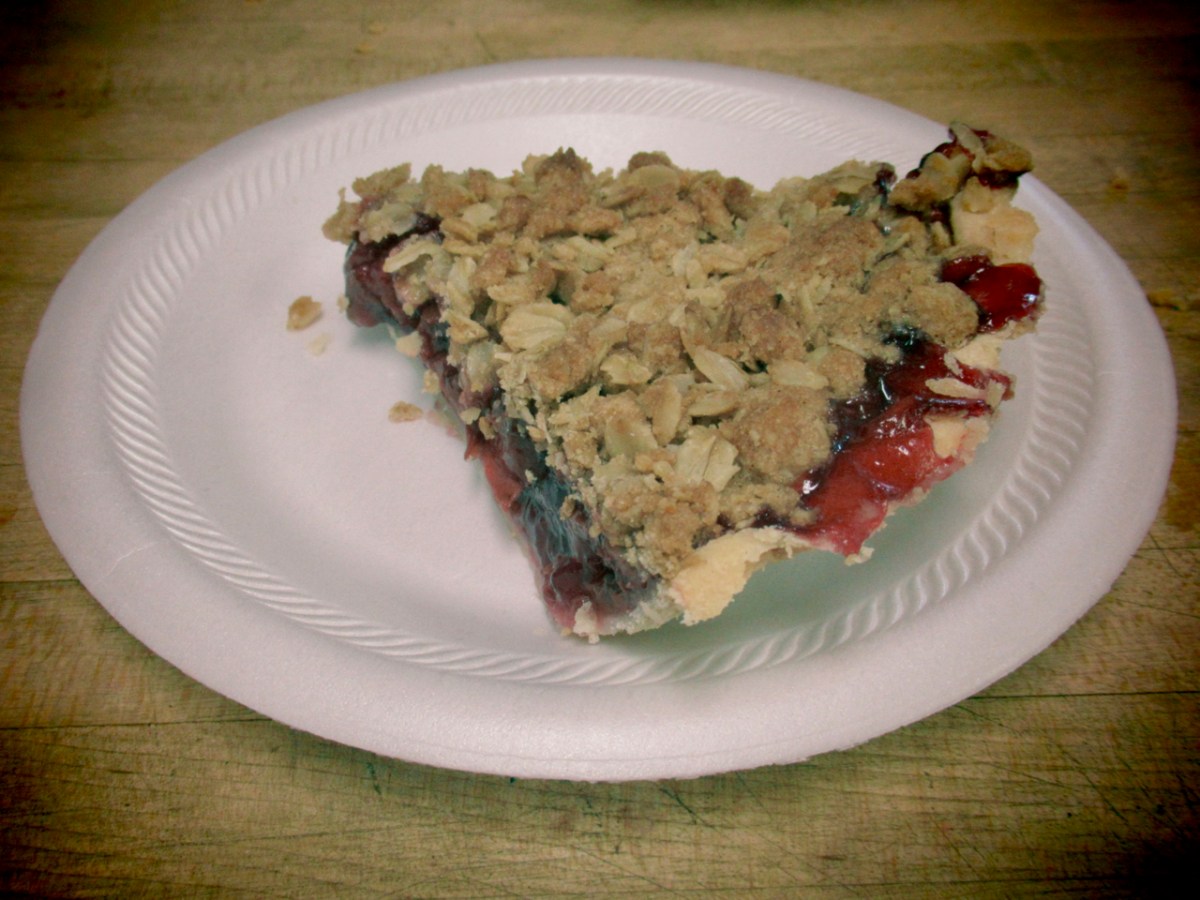
Here is how to make a delicious cherry pie with Morello cherries.
INGREDIENTS:
For the filling:
1 24 oz. jar Morello Cherries in light syrup
1/3 cup granulated sugar
2 T + 1/2 tsp. corn starch
1 tsp. lemon juice
1/4 tsp. almond extract
1 tsp. butter
For the topping:
1/4 cup all-purpose flour
1/2 cup old-fashioned oatmeal
1/3 cup light brown sugar
1/4 tsp. cinnamon
3 T butter
PROCEDURE:
Soften three tablespoons of butter in a small bowl. If you use unsalted butter, add an eighth teaspoon of salt to the butter when you soften it.
Line a nine-inch pie plate with a crust and crimp the top edge. If you don’t already have a recipe you prefer, you’ll find my recipe for pie crust here. It makes two crusts, so you can line two pie plates and freeze one to use later when you are in a hurry to make a dessert. Take the crust out of the freezer, pour in the filling, and in just a few minutes you’ll have a pie in the oven.
Preheat the oven to 400º.
Drain the juice from the cherries into a two quart saucepan and reserve the cherries. Mix the corn starch into the sugar in a small bowl. Whisk the sugar and corn starch into the juice and set the pan over moderate heat. Use the whisk or a fork to stir the juice often as it heats to make sure that you get a smooth sauce.
Reduce the heat as the juice thickens and becomes clear, and stir in the lemon juice, almond extract and butter. Stir the cherries into the thickened juice, bring the mixture back to a boil and simmer the filling for a minute. Remove the pan from the heat and let the filling cool a bit while you finish the crumb topping.
You can mix together the flour, oatmeal, brown sugar and cinnamon in a medium-sized bowl while the juice is cooking. Once you have set the filling aside to cool, cut the softened butter into the dry ingredients until you have a uniform mixture.
Pour the filling into the crust, sprinkle the crumb topping evenly over the filling and put the pie on a baking sheet on a center shelf in the preheated oven. Reduce the heat to 375º and bake for thirty-five to forty minutes. When the topping and crust are lightly browned, remove the pie from the oven to cool on a rack before serving.
NOTES: Be sure to put a baking sheet under the pie, as it, like many cherry pies, tends to run over a little as it bakes.
A scoop of good vanilla ice cream goes perfectly with a slice of cherry pie.

 Courage in the Kitchen