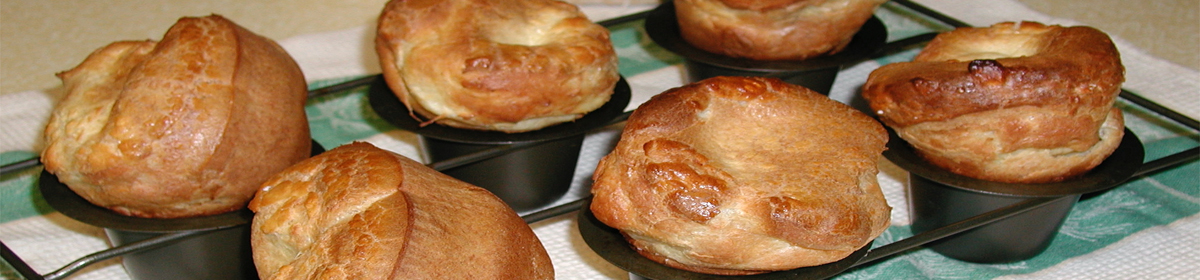
James Beard’s Crumpets

If, like ours, your house does not feature central air conditioning, you probably noticed that we had a few hot days recently. We have one small window air conditioner which keeps our bedroom comfortable, and the house, which was built more than sixty years before home air conditioners were available, does a pretty good job of handling heat waves.

Air conditioning has a long history. The ancient Egyptians, Romans and Chinese all developed various ways to cool the air. The Egyptians made evaporative coolers by trickling water down reeds hung in windows and the Romans piped cold water through building walls. Nearly 2,000 years ago a Chinese inventor, Ding Huan, invented a large rotary fan powered by servants to cool the air for the emperors of the Han dynasty.

But lacking servants and having only one small window air conditioner and a couple of fans, Jerri has devised a fairly effective energy management routine. As the temperature drops at night we open windows and use a fan to pull nice cool air into the house. When the temperature rises next morning we close the windows and use the fan to circulate the air. During beastly hot spells like we just endured we keep the bedroom air conditioner running in hopes that some cooler air will fall down the stairs to the main floor.

When I start gasping and complaining, Jerri suggests that I man up, that her mother used to remind her that “Grandma Goering lived 90 some summers without a fan.” Kansas farm women were tough back then. Tougher than most of us, I suspect.

One thing you don’t do on hot days if your home lacks central air conditioning is heat the oven unnecessarily. We bake breads, cakes and pies in the evenings or on cooler days. Even if you have central air you may want to hold down the electric bill or simply not waste energy. Generating the electricity we use to cool our homes contributes to climate change that is partially responsible for those long hot spells. Using less electricity can help reduce the need for air conditioning a little bit, which as we all know is better than doing nothing.

Another thing you can do is bake breads that don’t require heating the oven. Crumpets are an excellent example. You just bake them like pancakes on a hot griddle. Once mainly a bread eaten with butter and jam at teatime in Great Britain, crumpets are now enjoyed by people from New Zealand to Wisconsin. You don’t even need to like tea. Try a crumpet instead of toast with eggs and bacon for breakfast or a nice toasted crumpet dripping with butter and honey for dessert.

Wonderful things, crumpets, and they are easy to make. Stir up the batter, let it sit, then spoon it into rings sitting on a hot frying pan. Empty tuna cans used to make perfect crumpet rings, but the extruded kind now used for tuna don’t work. You can make do with water chestnut or bamboo shoot cans, or you can buy crumpet rings in many kitchen supply stores or online at reasonable prices.

I have used James Beard’s recipe for crumpets for over thirty years with never a failure, which is something I can’t say for a lot of recipes I have tried.

INGREDIENTS:

1/2 cup milk
1/2 cup boiling water
2-1/4 tsp. active dry yeast
1 tsp. sugar
1-1/2 tsp. salt
1-3/4 cups all-purpose flour
1/4 tsp. baking soda, dissolved in 1 T hot water
8 to 10 crumpet rings or tuna cans with the tops and bottoms removed

PROCEDURE:

Put a half cup of milk into a large bowl and stir in a half cup of boiling water.

When the milk mixture is lukewarm, stir in the yeast and sugar. Let it sit for 5 minutes to proof. When the liquid gets bubbly, mix the salt with the flour, and add it to the yeast mixture. Beat the batter with a spoon for several minutes, then let the batter rise until it has doubled in bulk and is slightly bubbly.

Dissolve the soda into a tablespoon of hot water and beat it into the batter. Let it rise again until it has again doubled in bulk.

Heat a griddle or large frying pan over medium-hot heat. Grease the rings and pan. Place the rings in the pan and spoon batter into the rings to a depth of about a half inch. Cook until dry and bubbly on top.

Use a table knife to loosen the crumpets and remove them from the rings. Turn the crumpets and brown them lightly on the other side.

Transfer them to a rack to cool. Serve them warm from the rack, or toast and serve them later with plenty of butter, jelly, jam or honey.

NOTES: If you can make pancakes, you can make crumpets. Crumpet batter is like a thick pancake batter that you spoon into the rings rather than just pour onto a griddle.

The problem with the water chestnut cans is that they are about an inch and a half high, which makes it a bit awkward to loosen the crumpets. A pair of tongs or pliers make it easy to remove the rings.

I like to use an electric griddle to bake crumpets because I can set the thermostat for about 325 degrees, which results in a nice brown crust when the top is nearly dry. A cast iron skillet over medium high heat works okay too. You can check how the crumpets are browning by lifting them with a turner. A properly done crumpet will be moist but not sticky.

Perfect Popcorn

Uncle George was my father’s older brother. He had a farm near Orchard, Nebraska and came to visit Grandma and Grandpa Rang every couple years when I was growing up. He raised corn, hogs and beef cattle. When we visited Uncle George and Aunt Alice and their family in Nebraska one time, my cousin Vernon took me out to see all the piglets. Vernon was seven and I was nine.

We climbed over the fence into the farrowing pen and watched the piglets nursing on the biggest sow I had ever seen. I am still impressed by that massive sow. Vernon then showed me the bull, the grain bins and his father’s big John Deere tractor, which also impressed me. It was an exciting introduction to another way of life that I shared with everyone when we came back into the house for supper.

Vernon’s mother was not pleased to hear that we had gone into the pen with the sow. I remember her saying that we could have been attacked and killed. But, young as he was, he had been taught to be careful around the sow. We did not go too close and so we lived to eat a good supper and have a ride around the fences on a wagon pulled behind the tractor.

One time Uncle George brought us some popcorn from his garden. For some reason it had never occurred to me that farmers like Uncle George could grow popcorn, and it prompted me to start begging my father to plant popcorn. When he explained that northern Wisconsin was not a good place to grow popcorn, I just kept saying that maybe if we tried we would have all the popcorn we wanted.

We planted two short rows of popcorn the next summer, and I hoed it with special care. I even carried water in buckets on my wagon to irrigate the rows during a bad dry spell in July. A frost in August before the kernels were hard ended my hopes, and we never tried growing popcorn again. Today I understand that some varieties have been developed that mature in a shorter time.

So we kept buying our popcorn at the A & P or Co-op, and my mother popped lots of it, especially in the winter. Watching “Gunsmoke,” “Dragnet” or “The Red Skelton Show” was even more fun with popcorn fresh from the pan and I think I saw my first Shakespearean play on “The Hallmark Hall of Fame” while chomping away. Mom first popped it in her large frying pan until she got an electric popper.

Our cook at Blair School, the one-room school I attended for three years, popped gallons of popcorn for us about two weeks before Christmas. She and our teacher showed us how to make ropes of popcorn and cranberries that we used to decorate the school Christmas tree. On the day before Christmas vacation, the janitor would show up early, and we would all help move the tree outside so the birds and rabbits would have a special Christmas treat too.

Once I entered college I graduated to an electric popper that was actually a multifunction food cooker used for everything from frying fish to warming soup. Over the years we have used at least two different electric poppers, a popper designed to be held in the fireplace or over a bonfire, many different frying pans and skillets and even those handy little packets you put in the microwave. The one thing that all these devices have in common is that they always leave a bunch of “old maids,” unpopped kernels, in the bottom of the bowl.

When a neighbor gave us an ice cream pail full of premium popcorn kernels last fall, I decided to search the Web for a popcorn recipe that might solve this problem. In a few minutes I found one on a wonderful food blog called “Simply Recipes.” I followed the instructions and am happy to report that it works. The ice cream pail is nearly empty, and I have had fewer than four old maids in any batch. Here is what you do.

INGREDIENTS:

3 T canola oil or other high smoke point vegetable oil
1/3 cup high quality popcorn kernels
Salt to taste

PROCEDURE:

Heat the oil and four kernels of popcorn over medium high heat in a three or four quart covered saucepan or skillet. When the kernels pop, remove the pan from the heat and add the corn. Cover the pan and swirl the kernels in the hot oil for thirty seconds.

Return the pan to the heat. The kernels will begin popping in a few seconds. Gently shake the pan over the burner. After the corn has been popping a few seconds, you can lift the lid slightly while shaking the pan to release any steam.

When the popping slows to a couple of seconds between pops, take the pan from the heat and dump the popcorn into a large bowl. Salt lightly and serve immediately.

NOTES: Popcorn pops because the moisture in the kernel expands when heated. Like any food product, popcorn dries out gradually. When I popped some from a partial bag of popcorn which had been hiding on a shelf for several years at the cabin, only half of the kernels popped, so buy good quality popcorn and try to use it within a year.

Some folks like to add melted butter to their popcorn, and until theaters started using imitation butter I used to order it when we went to movies. I love butter, but it makes my fingers greasy when I am eating popcorn. Besides, popcorn is one healthful food that I like as is. I do have some cheese-flavored salt that is pretty tasty, however.

Elise Bauer has a good explanation of why this method works so well. You can visit her site at simplyrecipes.com.