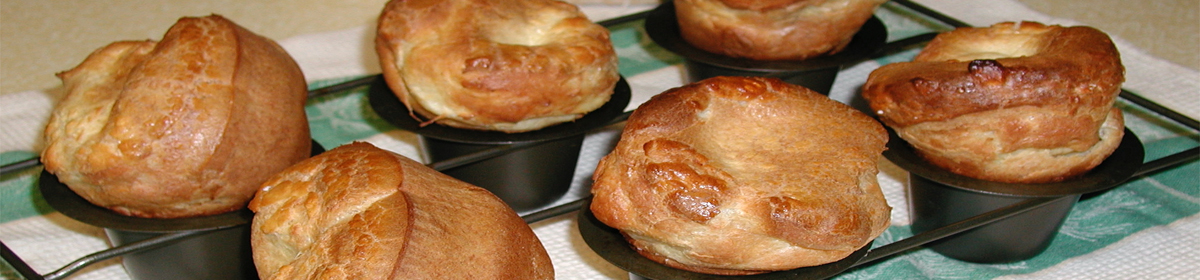
Pork Chops and Bell Peppers

When I was growing up, our family ate lots of pork. Though we never raised pigs, Mom and Dad watched for bargains at the butcher shops and grocery stores and sometimes bought half a hog from a farmer in the late fall. Dad would use his meat saw and butcher knife to cut the side into meal-sized portions and Mom would wrap them in heavy butcher paper.

If the weather was below freezing, we could store the packages in the red shed in the meat chest Dad had made. If it was still warm, he would rent space in the locker plant for a month or two until winter arrived. After Mom and Dad got a chest freezer, they could stock up on meat the way we do now, but for many years, our family lived by the seasons.

Jerri and I gave up on chest freezers after finding a turkey that had somehow escaped our notice for several years in the bottom layer of our freezer. There wasn’t a date on the tag, but the price was twenty-nine cents a pound, so I suspect we were looking at a turkey that was at least five years old when we found it.

I thawed it at the cabin, removed the wire clip that held the legs in place and carried the carcass across the brook. When I checked next day, all sixteen pounds of yellowed turkey had disappeared. Some animal had carried it off to devour at leisure, more evidence that nothing is wasted in nature.

Today Jerri and I have a smaller upright freezer sized for two senior citizens who like to cook and eat. When we find a good price on meat, we buy an extra package or two, and Jerri notes the addition to the larder on her handwritten freezer inventory. Her system works pretty well, and today very little food in our freezer ends up getting taken to the cabin and out into the woods to feed the animals.

At times, of course, her freezer inventory does lead to conflict. Reading the weekly ad from our local supermarket, I may say, “They have a really good price on boneless pork chops. I’ll pick some up and cook pork chops for dinner.”

One might think that Jerri would be grateful that I am offering to cook her a meal. One (whoever that might be) might also be wrong. Grabbing her freezer inventory, she will proceed to inform me that I had bought three packages of pork steak two months ago, two of which still needed my attention.

When this situation arises, it’s nice to have a recipe that works equally well with pork chops or steaks. This recipe serves four, but you can cut it in half if you wish. It tastes fine as a leftover a day or two later, but it doesn’t look as nice warmed up as it does in the photo.

INGREDIENTS:

2 lbs. pork chops or steak
1/3 tsp. dried rosemary
1/4 tsp. freshly ground black pepper
Dash of cayenne pepper
1/2 tsp. salt
2 T butter
1/3 cup all-purpose flour
1 medium green bell pepper
1 medium red bell pepper
1 onion about 3 1/2 inches in diameter
2 large cloves garlic
1 cup water
1 tsp. instant chicken bouillon
1/2 cup dry white wine 
Dash or two of Worcestershire sauce

PROCEDURE:

Start by preparing the vegetables. Wash the peppers, remove the stems, and cut the peppers into halves or quarters. Remove the seeds and white membranes and slice the peppers into quarter inch strips about an inch and a half long. Set them aside in a mixing bowl.

Trim the stem and root ends from the onion and remove the dry outer skin. Do the same with the garlic. Cut the onion in half lengthwise, then cut each half crosswise into thin slices. Mince the garlic. Put the onion in the bowl with the peppers. Set the garlic aside in a small bowl or saucer.

Blend the rosemary, black pepper, cayenne pepper and salt with a mortar and pestle. Stir the spices into the flour on a plate.

Trim the excess fat from the meat and cut it into serving-size pieces. Melt the butter in a large skillet over medium heat. 

Roll the pieces of meat in the flour mixture and and put them into the pan. Brown them about three minutes per side. Turn the pieces to make sure that they are golden brown on both sides.

While the meat is browning, dissolve a teaspoon of instant chicken bouillon in a cup of water. Remove the meat from the skillet to a plate and set it aside. 

Put the peppers and onions into the skillet and sauté them about two minutes. Stir in the minced garlic and sauté another minute or so. Do not overcook the vegetables.

Spoon the vegetables out of the skillet and return the meat to the pan. Add the cup of chicken bouillon, a half cup of dry white wine and the Worcestershire sauce. 

Bring the mixture up to a boil, reduce the heat, cover the skillet and simmer for thirty to forty-five minutes or until the meat is fork tender and the sauce is reduced to about half its original volume. Check occasionally to make sure that the sauce has not boiled away. Add equal amounts of water and wine if necessary.

About three minutes before serving, spoon the vegetables over the meat and cover the pan to finish cooking the peppers and onions. This main dish goes especially well with farfalle (bowtie pasta) and a simple green salad accompanied by a glass of the wine you used to braise the pork.

To serve, spoon a little sauce over the meat, vegetables and pasta on each plate.

NOTES: If you are starting with pork steak or bone-in pork chops, you might want to cut the meat from the bones before breading the pieces. You can cook the smaller trimmings in this dish, or you can freeze them for use in a soup or stir fry at a later time.

Instead of the bouillon, feel free to substitute a cup of chicken broth if you have some in the fridge or freezer. Sauvignon blanc, Chardonnay and vermouth all work well in this recipe, though they do add somewhat different flavors to the final dish. You might want to experiment to find the one you like best.

If you don’t have a mortar and pestle, crush the rosemary with a spoon as best you can before stirring the spices and salt into the flour.
Baby Sitting And Jazzed Up Pizza

Everything was wonderful until 8:30 PM. Jerri and I jazzed up a frozen pizza, played with our baby grandson, changed a couple of wet diapers and all three of us had lots of fun. Our grandson started crawling ten days ago, and his progress has been remarkable. He can already climb the step up from the sunken living room (his daytime play area), which gives him access to the kitchen, library and the main hallway.

He learned this the old fashioned way. He tried, fell, bumped his head on the floor, cried a bit, got up and tried again when his parents were momentarily distracted until he mastered the procedure. His technique for going down the step is still a work in progress, as his grandmother discovered. It consists of getting close to the edge, turning sideways to it and rolling off, bumping his head and squawking for a moment until he rights himself and heads off to see if the pillows blocking access to the floor lamps have been removed.

Like other eight-month-old babies, he is is busy learning about the new world opening up to him. He enjoys feeling the different textures of fabrics, walls, cabinets, plastics and people. Beards, ears, noses and hair attract equal attention when he is being held, and he seems intrigued by the fact that he can make things happen—lamps to sway back and forth, toys and books that fall on the floor and wooden spoons that make lots of noise when pounded on the table or on the tray of his new high chair.

He is already becoming crafty in a small sort of way. A few days earlier he had discovered a night light in the hallway that plugs into an outlet just the right height to attract a small person. Though I did not witness the event, he must have eluded his mother or father long enough to discover that if he pulled on the light, it could be moved. Now he is determined to see if he can pull it free so he can study it more closely.

Over the course of an hour he made repeated attempts to achieve this end. I would pick him up, carry him to the play area or into the kitchen where I was chopping vegetables for the pizza. He would bide his time, then begin the long crawl back to the light. Once he neared it, he would stop, look at me over his shoulder as if he were considering the odds of success and then make a four-limbed, two-foot long dash for the glowing target.

Forestalled in achieving the goal of removing the light, he began picking at the edge of the plastic cover blocking the receptacle below it. Once he learns that those covers are removable, I don’t know what will stop him from disabling an important child safety system. Jerri thinks that it just shows he will probably grow up to be an electrical engineer.

Shortly after learning that he could make lots of noise by pounding on a popcorn can, he once more headed for the hallway. This time, however, he ignored the light and crawled all the way to the door, sat up and looked at me without the smile that I expected. Next he crawled past the darkened library and down the hall to the living room. No mother or father anywhere. It was 8:30 P.M.

We can confirm that our grandson’s lungs are in good shape. Ever the optimist, Jerri thought that he might be hungry, but he twisted away when she tried to give him his bottle. “Maybe he’ll take it from you,” said Jerri, and I really did my best. At least I didn’t drop him as he stiffened his legs, pushed the bottle away with both hands, took a deep breath and increased the volume.

“Maybe he’s wet,” I volunteered. “Probably,” replied Jerri, but a dry diaper did not produce the contented baby one sees on the packages.

I carried him up to the bedroom he shares with his mother and father and put him in his crib. Jerri sang softly as she lay on the bed to let him know he was not alone. By this time the cries had changed from expressions of loss and unhappiness to screams of pure anger. I could almost understand his frustration. “Wahh!!” which translated means, “Stop trying to distract me. Stop that singing. Just get my mom and dad here. Now! Now!!”

Jerri laid him on the bed next to her, thinking that might comfort him. Wrong. He just shook his little fists and upped the volume some more. She put him back in his crib and waited for the half hour it took him to tire and fall asleep. Like any sensible grandfather, I took the pizza from the oven, removed my hearing aids, donned headphones and proceeded to watch a movie while I began my nightly exercises. Jerri appeared shortly after the noise subsided.

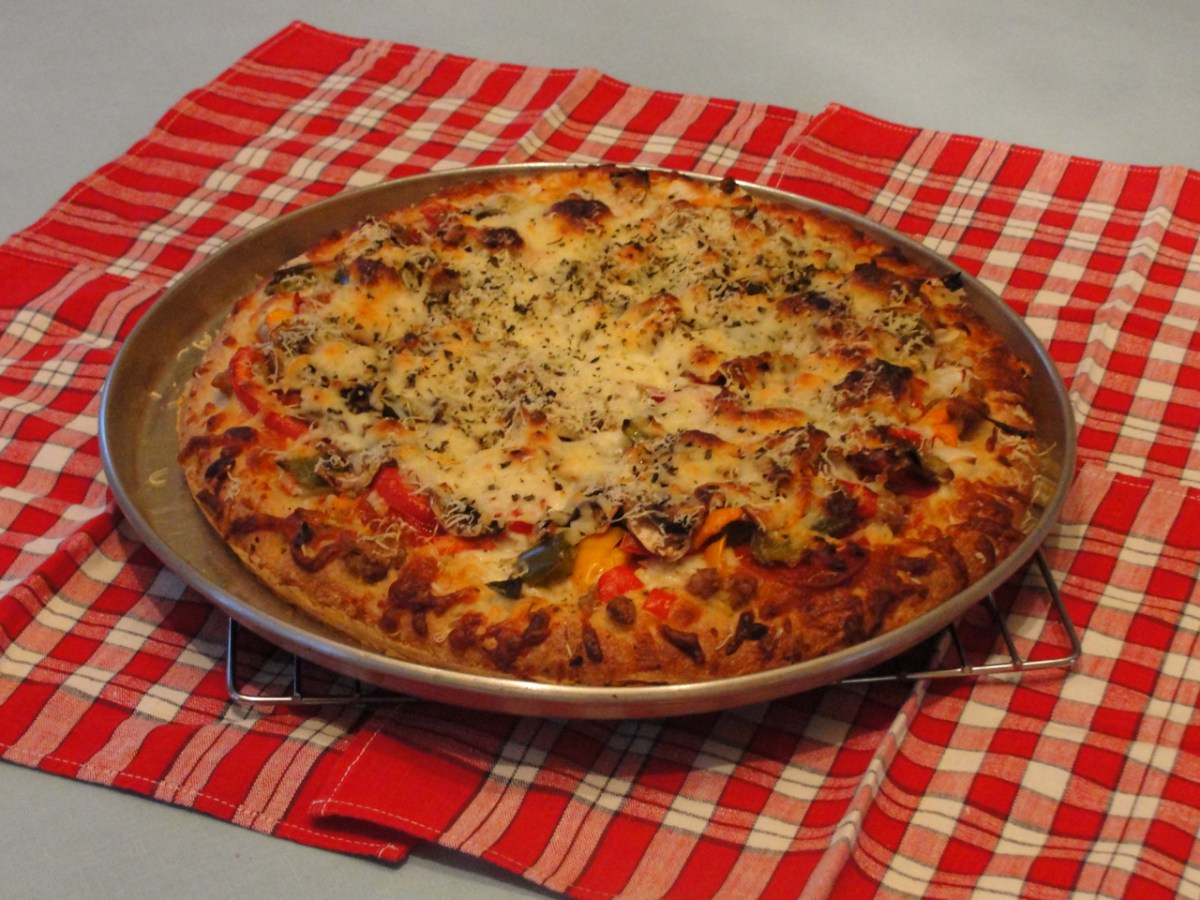
It was a frozen pizza, but I had jazzed it up with fresh vegetables that turned it into the kind of pizza that we really enjoy. I guess that liking frozen pizza makes me a “heat and eat” cook, but adding some ingredients lets me think that I can perfect a recipe that needs some tweaking.

Here is what I usually do to jazz up our frozen pizzas. We like lots of vegetables and extra cheese on our pizzas. Your tastes and approach may be different, but if you want to make something resembling a Chicago Deep Dish Pizza, give this combination a try or customize the ingredients as you wish.

INGREDIENTS:

1 12-inch rising crust pizza
1/4 cup chopped green bell pepper
1/4 cup chopped red bell pepper
1/4 cup chopped sweet onion
4-5 fresh mushrooms
2 Roma tomatoes
1/4 tsp. fennel
1/4 tsp. basil plus a little to sprinkle on top.
1/8 tsp. oregano
Dash of cayenne
Dash of salt
1/2 cup shredded mozzarella cheese
1/4 cup grated Parmesan cheese.

PROCEDURE:

Preheat the oven as instructed on the pizza package.

Prepare the pizza while the oven is heating. Clean and chop the peppers and onion into a quarter-inch dice. Clean and thinly slice the mushrooms and tomatoes.

Put the herbs and spices into a mortar or cup along with the salt and crush them as best you can. If necessary, shred and grate the cheese. For the best flavor, shred and grate good quality cheeses, but the commercial varieties are okay.

Put the frozen pizza on a pan. Arrange the sliced tomatoes on the pizza and distribute the peppers and onion evenly over the tomatoes. Sprinkle the spices over these vegetables. Arrange the mushrooms on the pizza, then distribute the mozzarella over the mushrooms. Sprinkle the Parmesan cheese on top and finish with a little dried basil.

Bake for twenty-eight to thirty minutes until the cheeses begin to brown. Remove the pizza from the oven, allow it to cool for two or three minutes, then cut it into eighths and serve. Pass crushed chile peppers for people who like a little extra bite to their pizza.

NOTES: Remember that pizzas need to be cooked thoroughly and that you need to bake jazzed up pizzas longer than the time specified on the package. How much longer depends on what and how much stuff you add. Adding fresh vegetables also adds liquid, so the extra cooking time helps with that too.

There are hundreds of different kinds of pizza, and I like most of them. I don’t like pizzas made with fake cheese, but if I am hungry enough or the guest of someone who likes such things, I even eat those.

I like pizzas with extra thin crusts, thin crusts, regular crusts and thick crusts. I like cheese pizzas, pepperoni pizzas, sausage pizzas and with just about any kind of vegetable or fruit added. Even anchovy and goat cheese pizzas are OK.

But I really like the taste of our jazzed up pizzas, and while the extra vegetables don’t transform a rising crust pizza into a health food, they are good for you. If you are like me, you may even feel a little virtuous as you bite into a slice of pizza loaded with those crunchy extras.