Once upon a time Jerri and I lived like slaves. That’s what we told our friends, but we were young, in love and newly married and we had found an apartment that we could afford. It was the basement level of a brick house built a few years before the Civil War near the courthouse in Charlottesville, Virginia. Our landlady called it a garden apartment, and in fact she let me grow a few tomato plants on a tiny patch of soil that we called our garden behind the back door.
The hillside had been excavated around the building when it was built, so we had windows on three sides and a narrow paved walkway all around between the retaining walls and our home. This lowest level of a stately antebellum house had been designed for the house slaves, so it was not as fancy as the upper floors, but it had big rooms, lovely solid plank floors, thick walls of plastered brick and, best of all, a wood burning fireplace. The building had been modernized sometime in the past, so we had central heat, electricity, a bathroom and a one person kitchen measuring about six by ten feet. Needless to say, we were the envy of friends paying more for smaller apartments lacking even a gas fireplace. We loved the place.
Our landlady, Mrs. G., had introduced herself to me as “the wife of the seventh GG in Virginia.” I had explained that I was a graduate student in the Department of English at the University of Virginia. She was not impressed by the grandson of a German runaway who had arrived in Mapleton, Iowa with twenty-five cents in his pocket, but I had enough money for the deposit, so my new wife and I would have a roof over our heads and a floor under our feet anytime after August 1, 1967.
Mrs. G. paid us a visit the day after we arrived with Jerri’s 1966 Chevrolet Impala stuffed with our belongings. By that time we had already unloaded the back seat of the car and piled the stuff on the floor or leaned it against the walls in the apartment. We didn’t put anything on the table, because we didn’t have a table. After introducing my new wife and explaining that she would be teaching English at the high school, I left Mrs. G. and Jerri to tour the apartment while I began hauling boxes from the car trunk.
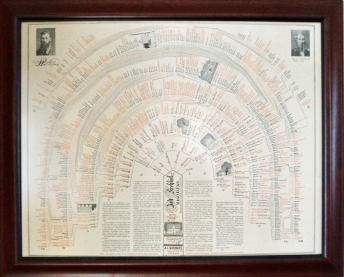 In a few minutes I saw that Jerri and Mrs. G. were getting along well. Mrs. G. had spotted the framed family tree that Jerri’s grandfather had made. Jerri’s family was Mennonite, a Christian denomination that valued family history and kept good records. John Jacob Krehbiel had traced their genealogy through those records and family Bibles back into the seventeenth century. The family tree was evidence that Jerri was a respectable person and since she had married me, I had acquired a pedigree as well.
One of the first suggestions that Mrs. G. gave us was to hire a maid to help with the housework. A young wife should not have to teach school, cook, take care of a new husband and do all the housecleaning and laundry. Mrs. G. told us that two girls worked for her a couple of days a week. They were sisters, so if one were ill or otherwise unable to show up as scheduled, the other usually could fill in. She told us that they weren’t the best of workers, “like all colored folk,” but they were reliable and as far as she knew, honest, and worked for seventy-five cents an hour. When we said that we thought we could afford a girl for one day a week, Mrs. G. told us she would tell one of them to stop in.
A few days later, a petite black lady with gray hair knocked on our back door and introduced herself as Mary. She and her sister Martha worked for Mrs. G. and Mary said she could help us five hours a week and more occasionally if we let her know ahead of time. Jerri and I had decided to pay a dollar an hour (which was the minimum wage), so we had maid service one day a week for a five dollar bill.
Mary was a treasure. When I got up a few minutes before 7 AM on the first day Mary was scheduled to show up, I walked into the kitchen to start the coffee and realized that she was sitting on a box next to the back door. After running back to the bedroom for some pants I let her in and offered her a seat on a dining table chair we had purchased at a used furniture store. Fortunately, Jerri had already cleaned the whole place the night before, so there was no rushing around.
Mary apologized for showing up before her scheduled time, and explained that she and Martha got up at sunrise and walked into town to work so she didn’t mind resting a few minutes when she got to our place. I told her that if we were not up when she arrived she should walk around the building and pound on the bedroom window. She looked a little scandalized at the suggestion but later became comfortable waking us when we overslept.
Her sister Martha was also a charming person. I was home one day when Martha came to fill in for her sister. Jerri and I had done the laundry the night before and Jerri asked Martha to iron some of her blouses and slacks and my shirts after she had finished the other chores.
She had nearly finished everything an hour early when I put down the book I was reading and said, “Martha, I don’t know if I should say this, but Mrs. G. told us to pay you and Mary only seventy-five cents an hour because you weren’t the fastest workers around, but I think you guys are really fast.”
She looked at me, and I shall never forget her smile. She had been ironing my shirts at about three minutes each, but she slowed to an exaggerated back and forth arm motion and said with a music hall drawl, “When we’s working for you and Miz Jerri we works at a dollar an hour speed. For Miz G. we does it a little slower.” In a moment we were both laughing at how they managed to deal with Mrs. G.
Mary and Martha were both the most efficient workers I have ever known. Mary would start doing dishes, I would read a page or two, and the dishes would be washed, wiped and put away. It seemed like magic. One day she mentioned that the plank floors could use waxing. When I asked, she said she could do it, that all she needed was some rags and Johnson Paste Wax. I offered to help and we arranged for her to plan on a full day’s work.
When Mary had finished the regular chores, she and I rolled up the rug ($5 at a graduate student garage sale) in front of the fireplace, moved our living room chair and rocker next to the convert-a-bed that was our sofa and got on our knees with old T-shirts and cans of wax. As I recall, the room was sixteen feet wide and twenty-four or twenty-six feet long. Mary showed me how to get a nice even coat of wax on the rag and how to rub it into the wood with a circular motion. Then she left me behind. She met me coming back on her second pass while I was barely over halfway to the end of my first swath. I was amazed.
As I mastered the technique, I got faster, but Mary did at least three-fourths of the floors. I did help her move the dining table and the bed and even helped with the final swaths in the bedroom and dining room.
I was even more impressed when she told me that Martha would be filling in for her next week as she was going to Boston. “Do you have relatives in Boston?” I asked.
“Well, yes,” she answered, “my son is graduating with his PhD from Harvard.”
“That’s wonderful!” I replied and asked whether we could help in any way.
“Thank you kindly,” she said, “but Martha is covering my families and we told Miz G. that she would have to do without me next week.” She paused. “You know what she told me? She told me that I shouldn’t put myself forward and embarrass my son.”
Her eyes glowed. “As if he would be embarrassed by the mother who helped him with his schooling after his daddy died. He wants me to come and meet some of his friends.”
And then another longer pause, and then quietly, “And Miz G.’s boy was kicked out of UVA for cheating. He’s a lawyer now, she tells me, but I don’t know how.”
I wished her well and hope that my memory is right that I gave her a few extra dollars to help her on the long bus trip to Boston and back.
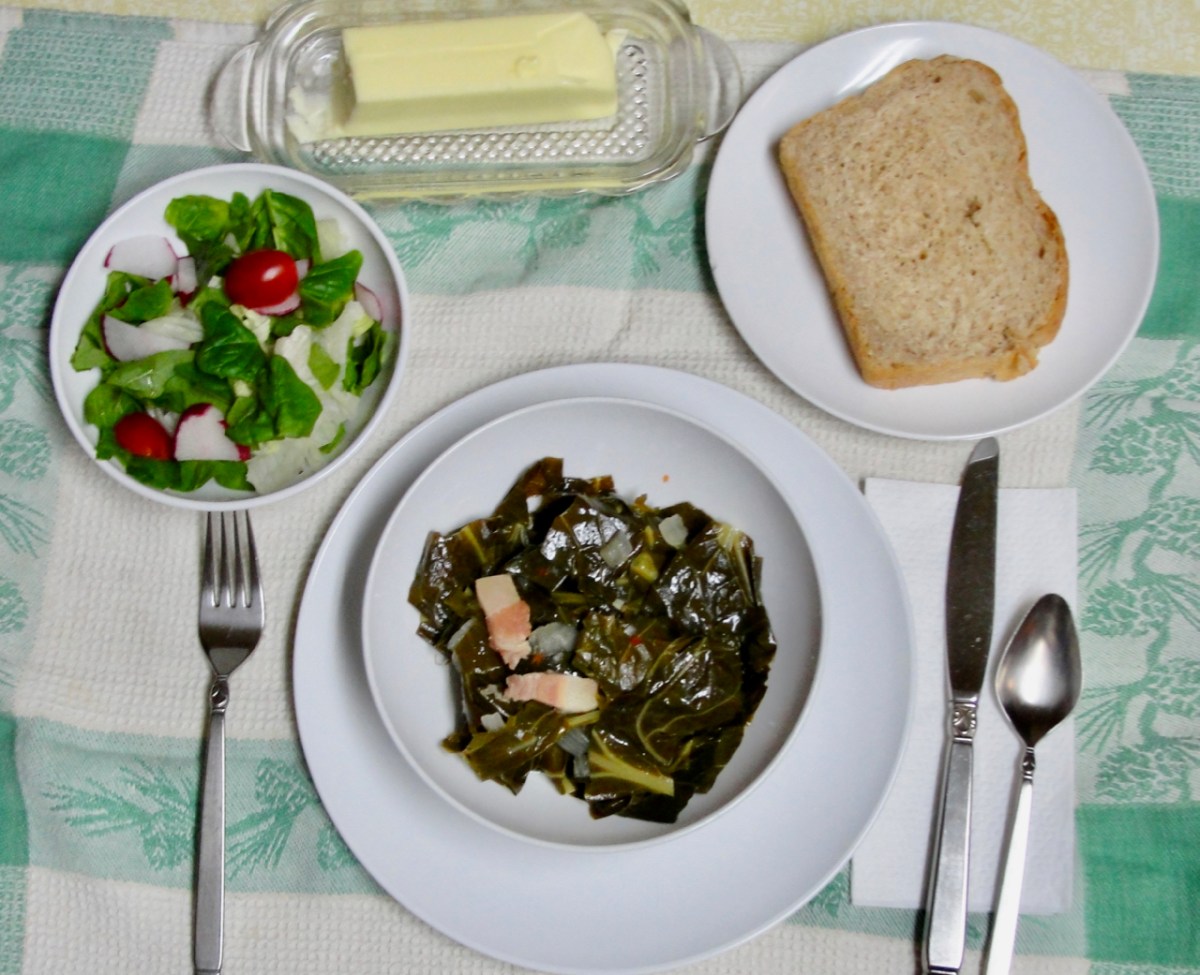
It wouldn’t have been a lot, because Jerri and I had to economize on just about everything. We often bought hog jowl bacon because it was usually cheaper than regular bacon, and Mary and Martha might have done the same and probably used it to make this traditional southern dish. I first had it shortly after I moved into my graduate dormitory at the university. Made properly, hog jowl and collards is a mild, tasty dish that you should start making about an hour and a half before you plan to eat.
INGREDIENTS:
1/2 lb. smoked hog jowl bacon
1/2 – 2/3 cup diced onion
1 large clove minced garlic
1 bunch (about a half pound) collard greens
2 cups chicken broth
1 cup water
1/2 tsp. sugar
1/4 tsp. freshly ground black pepper
1/2 tsp. cider vinegar
Dash of chili pepper flakes
PROCEDURE:
Smoked hog jowl is bacon made from the cheeks of pigs. If it is not sliced already, slice it like bacon, removing the skin if it is still on the jowl. Cut the slices into half inch pieces and put them into a three quart saucepan over moderate heat. Stir occasionally as you prepare the collard leaves.
Wash the leaves thoroughly and remove the central rib up to where it is about a third of an inch in diameter. 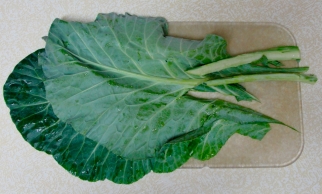 Discard those ribs. Roll the leaves into bundles and cut the bundles into one-inch pieces. Clean and chop the onion into a half inch dice. Clean and mince the garlic.
When the meat has begun to brown a little, add the onion and garlic and stir often until the onion becomes translucent. Stir in the broth, water, sugar, pepper, vinegar and red pepper flakes and bring the broth to a simmer. Add the collard greens, bring the pan back to a boil, reduce the heat and simmer the greens for forty-five minutes, stirring occasionally.
Unlike other green-leaved vegetables, like spinach, collard greens require a lot of cooking. Test for tenderness at forty-five minutes and continue cooking for another fifteen minutes or longer if necessary. When they are done, collard greens don’t have the bright green of lightly cooked spinach. They end up as forest green, unpretentious but elegant.
To serve, remove the greens, meat and onion to a serving dish with a slotted spoon. Spoon some broth over the greens as it is also delicious. Offer vinegar as a condiment.
NOTES: Hog jowl and collard greens are usually served as a side dish accompanying meat today, but slaves often had only jowls and greens for dinner. Collard greens are low in calories and carbohydrates and are loaded with vitamins and minerals. With the jowl bacon added, they give you the strength to “lift that bale.” Plus, they taste really good!
 Courage in the Kitchen