Although pork is the most widely eaten meat in the world, many people do not know how that happened. Archeologists have proved that pigs were first domesticated nearly simultaneously about 10,000 years ago in eastern Turkey and 4,000 miles away in central China. More recently, genetic research has revealed how various breeds of hogs developed and the complex relationship between domestic pigs and wild boars.
Historians have documented that pigs were first brought to the New World by Christopher Columbus on his voyage to Cuba in 1493. Queen Isabella of Spain suggested that he take a few pigs along in case his crew needed emergency food on the voyage. If they had any left after the trip, they could leave them on the island where, as pigs do, they could multiply to supply meat for later visitors.
Pigs are prolific. When Hernando DeSoto landed at Tampa Bay, Florida, in 1539, he offloaded a herd of thirteen pigs. By the time of his death along the Mississippi River three years later, that original herd had increased to seven hundred porkers, despite the fact that Spanish explorers often enjoyed roast pork after a good day’s travel searching for gold.
Roast pork is one of my favorite dishes. I like my mother’s version of Pork Pot Roast on cold winter evenings, and my Boneless Pork Roast with its crispy crust and aromatic perfume that might well have been inspired by an essay I first read in Charles Lamb’s Essays of Elia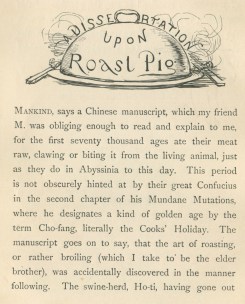 when I was ten or eleven years old. “A Dissertation Upon Roast Pig” is now nearly two hundred years old, but it still tickles my fancy. In it, he explains how roast pig was invented long ago in China.
As the story goes, Ho-ti the swineherd left his son Bo-bo to take care of their hovel. Bo-bo started a fire which not only burned down the house but also burned a litter of young pigs to death. Bo-bo accidentally discovered how wonderful they tasted and persuaded his father to taste a piece of roast pig. Ho-ti then swears his son to silence and begins helping him burn down the house for a meal of roast pig whenever their sow farrowed another litter.
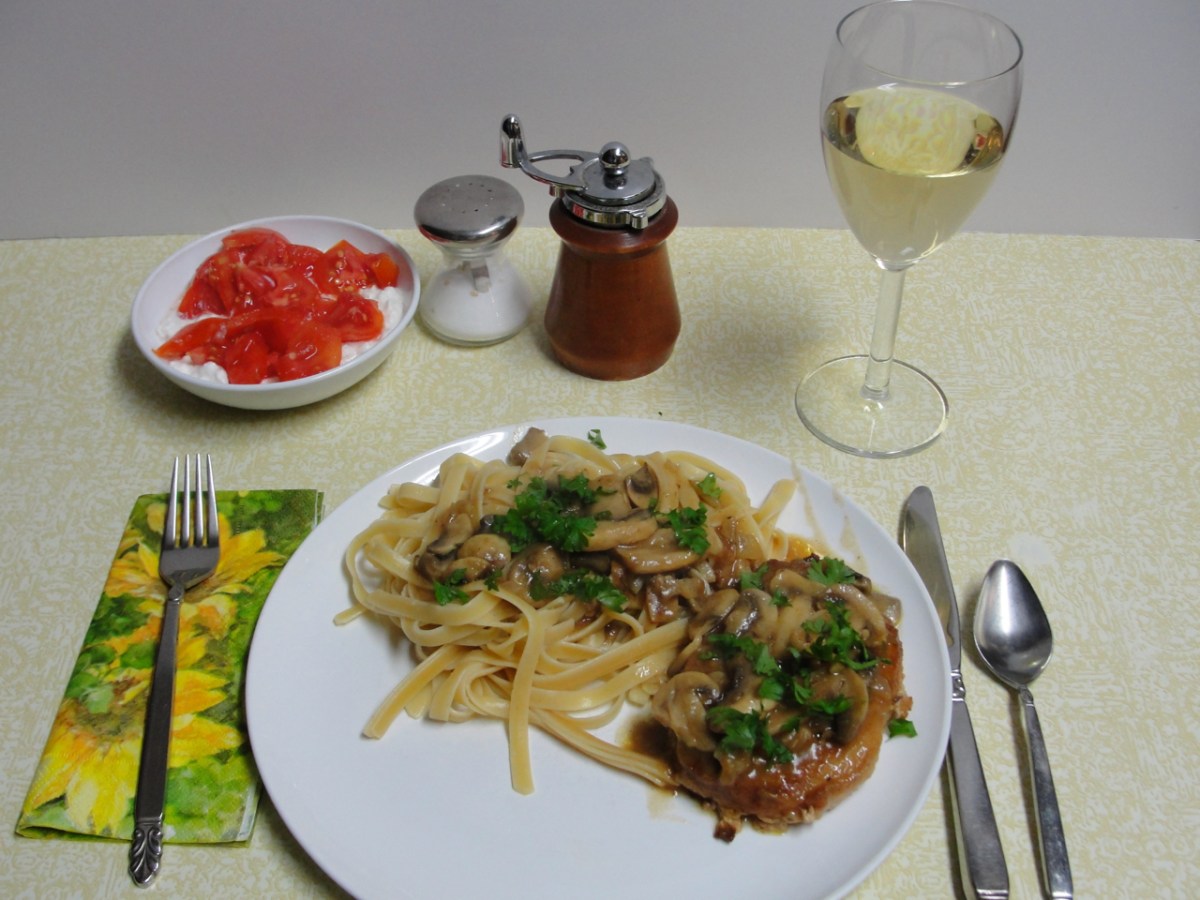
The neighbors began to suspect something and turned the father and son in to the authorities. Complications ensue, but the story ends happily, except, of course, for the pigs. You really should read the essay. My copy of Essays of Elia was published in 1886, but you can find “A Dissertation Upon Roast Pig” on line, and it is very much worth the quarter hour it takes to read it. It might inspire you to try another great recipe like Pork Chops Marsala.
INGREDIENTS:
8 oz. mushrooms
3 T chopped onion
1 T minced garlic
4 T all-purpose flour
1/4 tsp. salt
1/4 tsp. black pepper
1/4 tsp. rosemary
1/8 tsp. paprika
Dash of cayenne
2 T olive oil
2 T butter
4 medium pork chops (5 – 6 ounces each)
1 cup water
1 tsp. instant chicken bouillon
1/4 cup Dry Marsala
Pasta of your choice
PROCEDURE:
Clean the mushrooms, onion and garlic. Cut the mushrooms into moderately thick slices, Chop the onion into a quarter-inch dice and mince the garlic. Set these vegetables aside in a medium-sized bowl. Start heating the water for the pasta.
Blend the salt, pepper, rosemary, paprika and cayenne into the flour in a pie plate.
Heat the oil and butter in a skillet. Raise the heat under the water. Cook the pasta according to directions on the package.
Flour the pork chops and cook them over moderate heat until they are lightly browned on both sides, about three minutes per side. Remove them from the pan and set them aside. Reserve the leftover flour.
If you do not have four tablespoons of oil in the pan, add equal amounts of oil and butter as needed. Blend the flour left over from breading the chops into the oil. Add the mushrooms, onion and garlic and cook them over moderate heat for about four minutes, stirring often and being careful not to burn the mixture. Return the pork chops to the pan along with a cup of water, the instant bouillon and Marsala.
Simmer for six or seven minutes and serve with the pasta. Stir the sauce and turn the chops two or three times.
NOTES: You can substitute rice for the pasta. Fettuccine is my usual choice of pasta for this dish.
 Courage in the Kitchen