Mary’s Broiled Salmon With Marmalade

I have often thought of myself as being basically conservative. For instance, I believe that Christ was right when he said that the second great commandment was, “Thou shalt love thy neighbour as thyself….” He said it 2,000 years ago, but it’s still a good idea. As you can see, I like reading it in the King James translation, which is a bit over 400 years old. Old ideas, old words, old spellings.

I like comfortable old shoes, well-patched work pants and books written long enough ago to prove that they are worth remembering. I enjoy trout fishing and books about the sport. One of my favorites is The Treatise of Fishing with an Angle. The book is over 500 years old and was probably written by a woman, Dame Juliana Berners. It is the oldest known book about fishing published in English and still has some good tips for a trout fisherman. More evidence of my conservative bent.

I am also a conservative when it comes to barbers. Phyllis Jackelen cut my hair for over twenty years. We became friends, exchanged Christmas gifts and enjoyed our time together every month. After Phyllis died I had to find a replacement. It has been only ten months, but I think that Sue Johnson will be Phyllis’ permanent replacement. She does a good job with my thinning hair and likes to cook.

When I asked if she had any favorite recipes that she might consider sharing, she told me about one she got from a friend who lives in Woodbury, Minnesota. Mary Stromen gave it to her nearly ten years ago. A ten-year-old recipe is one that a conservative can use without feeling too liberal, and since Mary is the sister of Karen Pape, our neighbor of more than forty years, the recipe has an even more respectable pedigree.

Dame Juliana has some advice for salmon fishing if you want to catch your own fish, but you can buy some nice skinless filets quite reasonably and turn out a delicious and nutritious entrée in just a few minutes by following the recipe that Sue shared with me. Here is what you do.

INGREDIENTS:

1/2 cup orange marmalade           
1 T Dijon mustard   
1/2 tsp. garlic powder
1/2 tsp. salt
1/4 tsp. freshly ground black pepper 
1/8 tsp. ground ginger  
4 (6 oz.) skinless salmon filets      

PROCEDURE:

For best results, remove the filets from the refrigerator fifteen or twenty minutes before cooking them. If you are in a hurry and don’t have time to let the filets come to room temperature, just add an extra minute to the cooking times and be sure to check that the fish is done.

Preheat the broiler and arrange the top rack in the oven about six inches below the broiler. Line a jelly roll pan with aluminum foil and coat it with cooking spray.

Stir the spices into the marmalade in a small bowl. Make sure that the spices are thoroughly mixed with the marmalade.

Place the filets in the pan and brush half of the marmalade mixture over the fish. Broil for about six minutes, turn the filets and brush them with the remaining marmalade mixture. Broil for another two minutes or until the fish flakes easily when tested with a fork.    

Serve with rice and a green vegetable or salad.
                                                                       

Jane’s Turkey Hash

If, like us, you roast a turkey for your family’s Thanksgiving or Christmas dinner, you may already follow our after dinner tradition of simmering the turkey carcass to create a delicious broth and salvage some tender meat. While Jerri offers suggestions, I carve the last few pieces of meat from the bones and break the carcass into pieces. Then our roles are reversed, and I suggest how much meat should be included in each package that we will freeze for sandwiches or to make turkey a la king.

Eventually the turkey bones end up in the roaster with some water. We bring it to a boil, turn down the heat and simmer them for a couple of hours. When the broth has cooled to a warm room temperature, we remove the last bits of meat from the carcass and strain the broth.

The result is a quart or so of really flavorful broth and two or three cups of turkey meat. Since the meat has already given up some of its flavor to the broth, it is not the best meat from the turkey, but it works just fine for making turkey hash, particularly if you have some sliced turkey left over from the roast.

This recipe is another one from Jane Marsh Dieckmann’s Use it All: The Leftovers Cook Book, which Jerri’s niece Susie loaned to us. Turkey hash is easy to make, tastes good and helps make room in the freezer for other leftovers.

INGREDIENTS:

1 1/2 cups diced turkey or leftover turkey salvaged from the carcass
1 cup cooked diced potatoes
1/2 cup cooked chopped celery
1 T minced parsley
1 T finely chopped chives or a scallion
1 cup gravy or sauce
1/4 tsp. salt
1/4 tsp. freshly ground black pepper
3 T butter or olive oil

PROCEDURE:

If you don’t have any leftover boiled potatoes, peel and chop one or two raw potatoes into a half-inch dice. Spread them in a pie plate, cover it with waxed paper and microwave on high until the potatoes are soft enough to pierce with a fork, about four or five minutes.

Clean and chop the celery into a quarter to half-inch dice and microwave it in a covered bowl until it is starting to soften, two or three minutes.

Clean and finely chop the parsley and chives or scallion and if necessary warm the gravy so it is liquid enough to mix with the other ingredients when you assemble the hash.

Make sure that the turkey is cut into pieces no larger than a half-inch dice and put it into a mixing bowl. Add the potatoes and celery along with the parsley, chives or scallion. Blend everything together, then stir in the gravy, salt and pepper.

Set a skillet or frying pan over moderate heat and coat it with the butter or oil. Transfer the hash to the skillet or frying pan. Stir to prevent burning, but allow the hash to crisp a little as it heats.

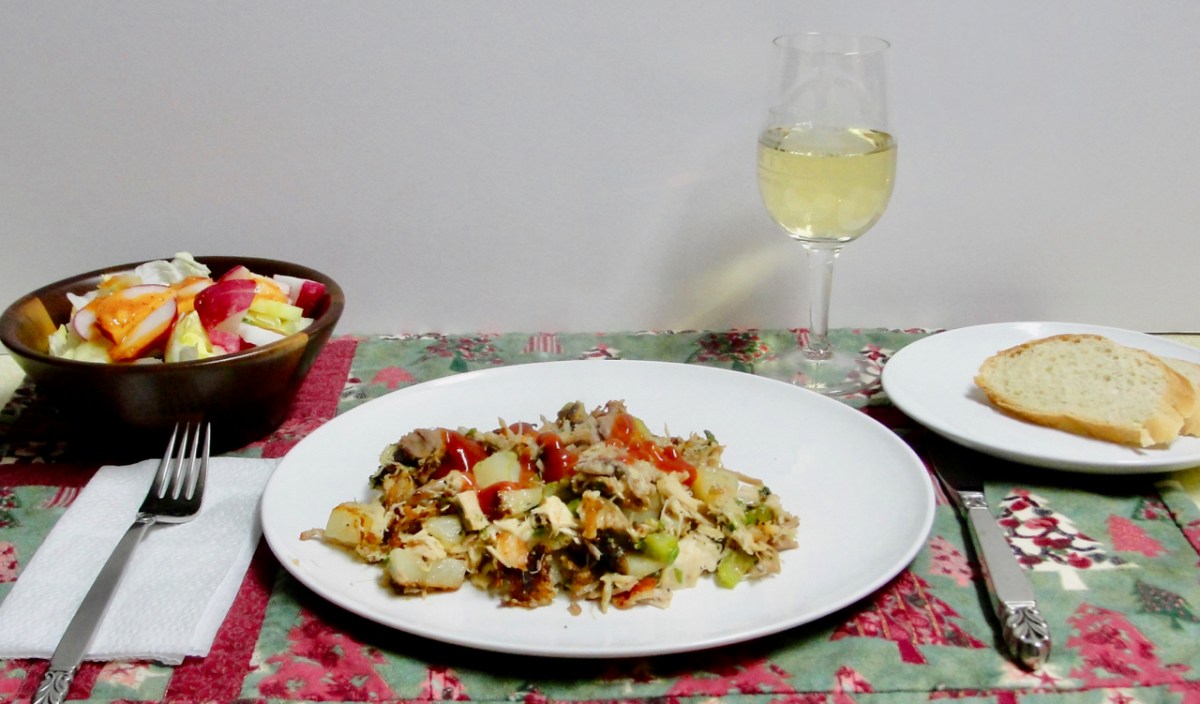
Serve hot and pass the ketchup.

NOTES: The first time I made this recipe, I used all the leftover gravy from our Christmas dinner. Nearly two cups of gravy produced a kind of stew. It wasn’t really hash, but it tasted fine and used up another leftover.

Since we don’t always have leftover gravy in the refrigerator or freezer, I make a satisfactory substitute with chicken bouillon. Dissolve a chicken bouillon cube in three quarters cup of hot water, season with dashes of sage and thyme and thicken with a tablespoon of corn starch dissolved in a quarter cup of cold water.