Mom’s Split Pea Soup and Winter Memories

I remember that it was a Friday night.

It was snowing hard and after eight o’clock and Dad was not home yet. Mom was worried. Heavy snow and blowing wind had been forecast on WCCO that morning, so she had given Dad a list of groceries to bring home. Our family usually went shopping in Hayward on Friday nights, but my parents agreed that this Friday we would stay home in the snug house Dad had built in a grove of jack pine trees along Phipps Road.

In the early 1950’s Dad’s workday ended at six. Allowing a half hour for shopping and fifteen or twenty minutes to drive the four miles to our house, she figured he would be home before seven. By 7:15 she told us that Dad had probably stopped for a glass of beer at the Twin Gables before heading home. By 7:30 she was joining us kids looking out the windows in the front room.

In the daytime you could see the snowbanks along Highway 63 across the field in front of the house, but they blocked the headlights of any cars on the road at night. Highway 63 had not been upgraded with wide shoulders and ditches, so the snowbanks got higher and higher at the plows pushed the snow off the roadway. This year the snowbanks were so high you could barely see the snowplows on the highway and in places you could almost reach the telephone wires when you stood on top of the banks. Mom warned us not to touch the wires while we waited for the school bus.

When we heard sounds at the back door, we ran to see who was there. In came Dad. His hat and coat were covered with snow and the gunny sack he dropped in front of us looked like the snow-covered packs in pictures of Santa Claus on some Christmas cards. He took off his coat, hat and rubbers and high top work shoes, warmed his feet in front of the stove and put on dry socks.

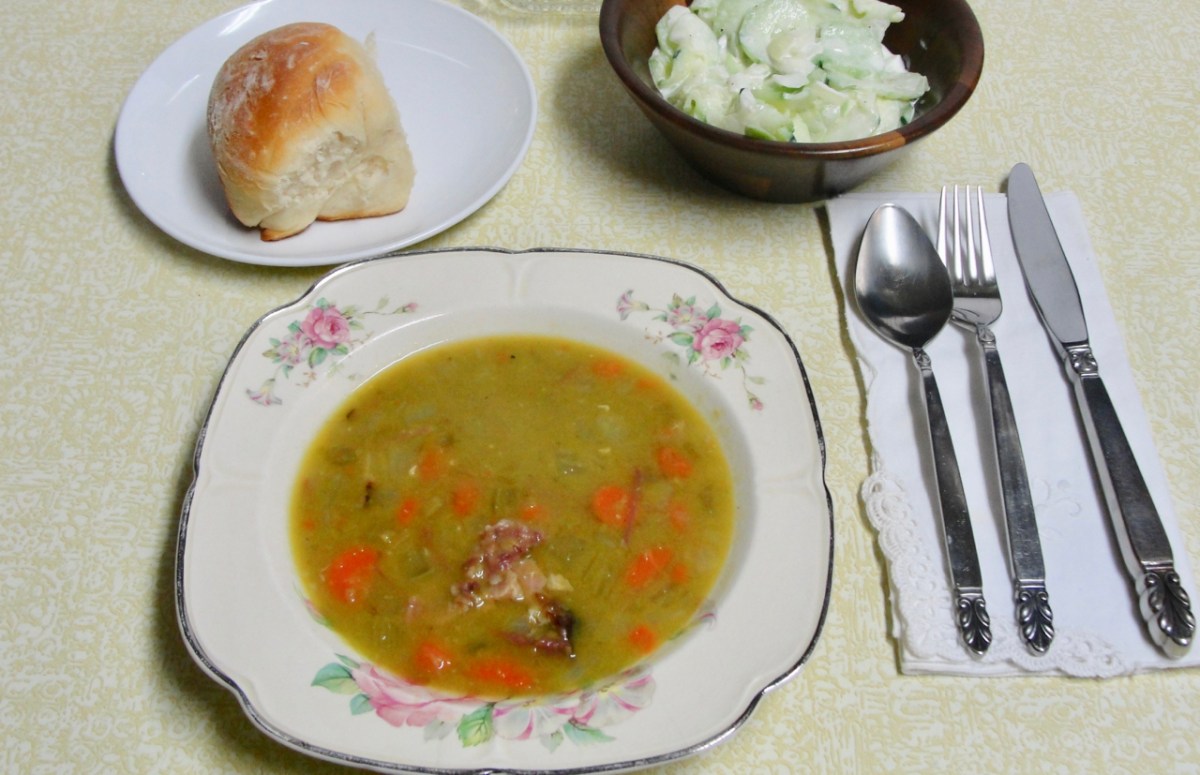
As we sat down to soup and fresh bread, Dad told us how he managed to get home in the middle of the blizzard by following a snowplow. When he got to Phipps Road, he found that the plows had piled a four-foot-high bank across the road and that the road itself was drifted even with the snowbanks on either side as far as he could see in the dark.

He drove north to his uncle Richard’s home which was just a block off the highway. He had been married to “Aunt Trace,” Dad’s youngest aunt. She had died the year before we moved into our new house along Phipps Road. At her funeral I learned that her name was really Theresa. I remember her as being stout and friendly.

Dad shoveled through the snowbank in his uncle’s driveway to get the car off the road, borrowed a pair of snowshoes and a gunny sack and set out cross country. It was more than half a mile, but the wind was mostly at his back. He knew his way through the woods and finally crossed the field north of our house and found the road from the garden to the house.

Next morning Dad snowshoed back to his uncle’s and drove to work. Mom and I shoveled the driveway and the big pile of snow left by the town plow when it opened Phipps Road so Dad could drive all the way home.

I don’t remember what kind of soup we had that Friday night, but it could have been Mom’s Split Pea Soup. I’m sure that we had fresh bread or dinner rolls, because Mom always baked bread and rolls when she made soup. My sisters both reminded me how much we all loved the smell of freshly baked bread, so that may have explained Dad’s good humor after his adventure.

Here is how to put smiles on the faces of everyone around the dinner table with an absolutely delicious pea soup. For the perfect meal, serve it with some Homestyle White Bread.

INGREDIENTS:

1 1/2 – 2 lb. smoked pork hock
Water
2 medium onions (2 1/2 – 3 inches in diameter)
1 medium potato
3 ribs celery
2 large or 3 medium carrots
1 lb. dried green split peas
1 large bay leaf
3 or 4 whole cloves
1/2 tsp. freshly ground black pepper
Salt to taste

PROCEDURE:

Put the pork hock in a soup pot or Dutch oven and cover it with cold water.  Bring the pot to a boil, reduce the heat and simmer the hock for about four hours.   Check occasionally, turn the hock and make sure that it is still mostly covered by water.  Add a little water if necessary.  The long slow simmer extracts gelatin from the bones and skin along with the flavor.

Prepare the vegetables about half an hour before you remove the hock from the broth.  Sort the dried peas into a colander by small handfuls to make sure there are no stones or other debris in them and rinse the peas under cold water and let them drain.  After the hock has simmered for the four hours, carefully remove it from the water with tongs and let it cool on a plate.  Add the peas to the broth before you chop the vegetables.

Cut the stem and root ends off of the onions and remove the dry outer layers and peel the potato.  Scrub the celery ribs and cut off a little of the top to freshen the cut end.  Wash and keep the celery leaves to chop with the ribs.  You can peel or thoroughly scrub the carrots and cut off the stem and root tips.  Chop the onions into a quarter-inch dice.  Chop the carrots into quarter-inch-thick rounds or half rounds.  Chop the celery and potato into a half-inch dice.

Stir the vegetables and spices into the broth.  Do not add any salt at this time.  

Bring the soup to a boil, reduce the heat and let it simmer while you remove the meat from the hock.  Use a sharp paring knife to remove the skin and separate the fat from the meat.  Cut or shred the meat into small pieces and add them to the soup.  Continue cooking the soup until the vegetables are tender. 

Taste and adjust the seasoning if necessary.

Serve with salad, good bread and a beverage of your choice.

Hamburgers With Blue Cheese Dressing

It was the first day of school after Christmas vacation in Mrs. Johnson’s third grade class.

Two little boys, one black and the other white, came running into the room wearing identical blue plaid shirts and big smiles.

“Look, Mrs. Johnson,” said James, “We got the same shirt for Christmas!”

“How are you going to tell us apart?” asked Jacob.

“I’ll just have to look real close,” said Mrs. Johnson.

We love the story, which is a true one, though I have changed the names. It happened to the daughter of a good friend of ours who teaches in the Twin Cities.

I have had conversations with friends who grew up in the Old South that confirm a similar colorblindness. “We all played together and ate cookies and drank Koolaid at each other’s houses. We didn’t think about being different. But about the time we turned eight or nine, we stopped doing that. Our mothers and fathers told us that we shouldn’t be too close with people who weren’t like us. We were taught to behave like white kids and black kids were taught to mind their place.”

There is a song in South Pacific that Rogers and Hammerstein had to fight to keep in the musical. “You’ve Got to Be Carefully Taught” is sung by Lieutenant Cable. He introduces it by saying that racism is “not born in you! It happens after you’re born…”

When South Pacific opened in 1949, people from north and south objected to Cable’s song and the theme of racial prejudice, but the play was an immediate hit on Broadway and won ten Tony Awards. When the film version was released in 1958, it was the highest earning film of the year.

I do believe that there is less racial prejudice in our country now than there was when South Pacific first hit broadway in 1949 and came to towns as small as Hayward where I saw it at the Park Theatre in 1959 or 60. The Civil Rights Act of 1964, the Voting Rights Act of 1965 and the U.S. Supreme Court decision ruling anti-miscegenation laws unconstitutional helped dismantle official racism, but as we see almost every day, there are still people in our country who are clearly racists.

Nearly all of us probably share some racist attitudes that we learned as we grew up, but I also think that there are lots of good people who try to overcome those prejudices. Maybe it would be a good idea for all of us to think about the lesson that Rogers and Hammerstein express in that short song, “You’ve Got to Be Carefully Taught.” It’s a concise reminder of how people are taught to be bigots.

The song ends with the words,

“You’ve got to be taught before it’s too late,
Before you are six or seven or eight,
To hate all the people your relatives hate,
You’ve got to be carefully taught!”

which bring us back to James and Jacob, who clearly thought that new shirts were more important than skin color.

Like the two boys, we pay attention to the things that are important to us and forget about matters that don’t seem important. When it comes to food, most of us think more about how something tastes than what the ingredients are or where a dish originated. If you think you are different than most, please answer the following question honestly.

Have you eaten any foods containing monosodium glutamate recently? Many if not most of us would probably answer “I don’t know.” We don’t pay much attention to the actual ingredients of that bowl of ramen we had for lunch, the chicken nuggets from our favorite fast food restaurant or the jello salad on the buffet table at the church potluck. They all use monosodium glutamate as a flavor enhancer, but if the food tastes good we don’t think about the ingredients.

We also usually don’t care where some dish comes from or else have a mistaken idea of its origin. We say, “As American as apple pie.” However, the apple pie was invented in England more than a century before Columbus ran into North America on his way to China. The cooks of King Richard the Second published a cookbook with a recipe for one in 1390. Apple pie is not American, but it tastes good and that’s what counts.

Many people think hamburgers were invented in Hamburg, Germany, and there is a connection to that city. However, as is true of many different foods, the history of the hamburger is complicated. The Romans cooked chopped meat mixed with various ingredients into something resembling a hamburger patty at least 1,700 years ago and the ancestors of modern Germans were undoubtedly eating “gehacktes rindfleisch” (chopped beef) long before Columbus set sail. Restaurants in Hamburg were selling fried chopped beef steaks to German emigrants on their way to America.

When those German immigrants arrived in the United States, they asked for a familiar food, and restaurants in New York City and other port cities began offering “Hamburg steak” to satisfy the demand. Thus, that part of the hamburger clearly originated in the Old World. However, the idea of putting the meat between slices of bread and later, into a bun, almost certainly originated in the United States.

Places claiming the invention of the hamburger range from Texas to Ohio, but I am partial to the claim made by Charlie Nagreen of Seymour, Wisconsin, who explained that as a fifteen-year-old boy selling Hamburg steaks at the Outagamie County Fair in 1885, he discovered that business was not very good. People did not want to eat the meat at the stand. In desperation he flattened the steaks and put them between two slices of bread so people could walk around while eating the meat. Success! His creation was sold at the fair until “Hamburger Charlie” died in 1951. Seymour celebrates his invention every summer with a Burger Fest.

I like a good hamburger, but like James and Jacob who think their new shirts are what’s important, for me the important thing is that my hamburger be accompanied by French fries and, if possible, baked beans. I am not really concerned about the history of the hamburger, as fascinating as it is.

To turn your hamburger into a gourmet treat, add some blue cheese dressing. Long ago I learned that blue cheese goes very well with chopped beef, and I have shared a recipe for https://courageinthekitchen.blog/2012/05/24/sour-cream-blue-cheese-dressing/. Blue cheese dressing is a great sauce for a hamburger. If you don’t have any on hand, follow this link to learn how to make https://courageinthekitchen.blog/2012/05/24/sour-cream-blue-cheese-dressing/.

Here is what I do to make a simple and delicious dinner for two.

INGREDIENTS:

1 lb. lean hamburger
Steak seasoning
Frozen French fries
Baked beans (canned or homemade)
Lettuce
Sour Cream Blue Cheese Dressing
2 buns

PROCEDURE:

Divide the meat in half and make two patties about five inches in diameter. Sprinkle both sides lightly with steak seasoning and let the meat come to room temperature while you cook the French fries and warm the beans.

Preheat the oven and cook two servings of French fries per instructions on the package. Begin heating the beans once the potatoes are in the oven.

Put a skillet over high heat about fifteen minutes before the French fries will be done. If you wish, spray the pan lightly with non-stick spray. Put the hamburger patties in the skillet when it is hot. Reduce the heat to medium and cook the patties about five minutes on each side or until they are done as you prefer them.

Rinse and dry some lettuce leaves while the meat is cooking.

Place a patty on each bun, top it with dressing and finish with some lettuce. Serve with French fries, baked beans and the beverage of your choice.

NOTES: You can make three or four patties if you want smaller servings. Use whatever kind of dry steak seasoning you like. We often have homemade baked beans in the freezer, but when we don’t I use a good variety of Boston-style baked beans. Again, the choice is yours. You can substitute Kaiser rolls for regular hamburger buns if you like.

My sister Patsy deserves credit for suggesting how the story of James and Jacob can make us think about food in a different way. Thanks, sis!