Perfect Popovers

In a certain sense, making popovers is a test of faith: You put the batter-filled pan in the oven and pray that the popovers will do their thing in the next 40 minutes.    I have been making these scrumptious muffins since I was a teenager.

Sometimes they were wonderful–standing tall and proud.  More often they looked liked something trying with only limited success to look like popovers.  On some memorable occasions (usually when we had friends over for breakfast) my popovers were rubbery little sponges hunkering down in the pan.

Months without popovers would pass after such failures, but as the poet said, “Hope springs eternal in the human breast”, and after enjoying a particularly delicious popover at a restaurant or fair I would tell myself that my memory was wrong:  No one could screw up a recipe that had only five ingredients.  And so I would try again and sometimes succeed.

I remember making two batches in a row that were beautiful.  But when my mother came to visit and I announced that we would have an afternoon snack of popovers with butter and jam, the jinx returned.  “Oh Chuckie, they taste just fine,” said Mom, but one of the kids remarked that they didn’t look like popovers.  To make matters worse, motivated by my two successes, I had just bought a popover pan.

I finally tackled the problem systematically, and for the last twenty years I have never had a popover failure.  Since it took me 30 years to figure out the secret to the perfect popover, I feel relieved, not proud.

There are two parts to the secret:  First, the eggs and milk must be at WARM room temperature;  70 degrees is too cool.   Second, don’t beat the batter too long.  I know that many expert chefs say to beat the batter for 20 or 30 seconds.  It must work for them and it may work for you, but don’t blame me if you get sponge cake instead of popovers.

This recipe makes enough batter for a six-cup popover pan.

INGREDIENTS:

1 cup plus 1 T flour
1/2 tsp. salt
1 cup plus 1 T milk
2 tsp. vegetable oil
3 large eggs

PROCEDURE:

Make sure that the baking rack in your oven is in or slightly below the center position.  Preheat the oven to 450 degrees.  Grease the popover pan lightly and place it in the oven to heat.

While the oven is heating, put the eggs in a small bowl and cover them with very warm water from the tap.  Let them sit for at least 5 minutes.  Warm the milk on the range or in the microwave until it feels slightly warm to the touch.

Stir the flour and salt together in a lipped 1 quart measuring cup or bowl.  Add the warm milk, oil and eggs and beat the batter with an electric mixer for 11 seconds (NO MORE) on high.  Stop and stir slowly with a fork to mix in any remaining large dry clumps.  Small lumps are OK.

Take the hot pan from the oven and fill the cups evenly; they should be 1/2 to 2/3 full.  Put the pan into the hot oven, turn the heat down to 425 degrees and bake 20 minutes, then 20 minutes at 350 degrees.  DO NOT OPEN THE OVEN DURING BAKING.  PERIOD.

Remove the pan from the oven, let it cool for 15 or 20 seconds, remove the popovers from the pan and serve them while still hot.  Give each popover a gentle twist to loosen it.  A table knife works to loosen stubborn popovers.  If you want, cut a small slit in the side of each popover to release the steam.

NOTES:  The eggs and milk must be warm.  The oven door must remain closed during the entire baking period.  Have faith.  They will pop.  You can make popovers in an ordinary muffin pan, but they don’t pop as high.

Besides eating popovers with butter and honey, jam or jelly, we also like to fill them with scrambled eggs.

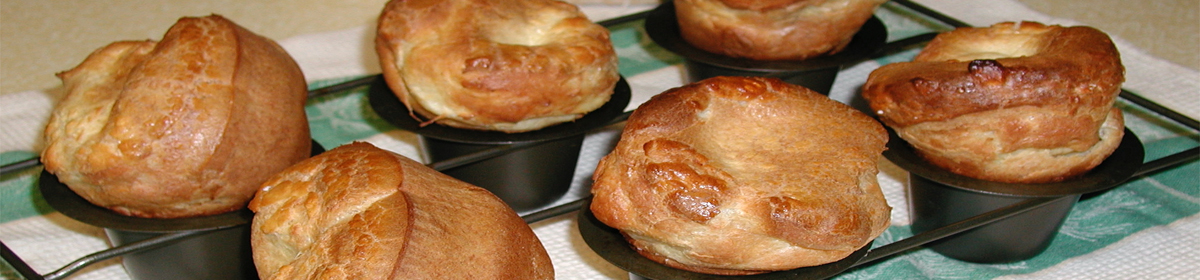
A batch of popovers fresh from the oven

Garlic Toast

My mother and father grew up in the Great Depression.  From it they learned not to waste anything.  Dad reused lumber and other building materials, repaired tools and saved everything he thought he might be able to use sometime.  Mom turned ham and turkey bones into soup stock, saved old bread for bread pudding, made sandwiches with leftover roast and served warmed over vegetables if we had not eaten them the day before.

She also darned socks and patched our clothes, which then became “work” or “play” clothes.  However, there were exceptions to this rule.  I recall a painful incident involving a brand new pair of khaki pants that I thought made me look a little bit like a soldier.

I was 12 or 13, and I had worn the pants once or twice the first week of school.  As the school bus rolled over the Phipps Bridge I could see trout rising in the still water upstream.  I got off the bus, ran inside, told Mom that the trout were rising and I was going fishing before supper.

“Change your clothes,” she said as I headed for the door.

“I’m just going for a little while,” I answered.

I don’t remember if I caught any trout, but I do remember very clearly the vicious strand of barbed wire that put a three-cornered tear in my pants just below the knee.  I also remember the lecture and the fact that I had to wear patched pants to school.

Jerri has a similar memory involving a new wool skirt and a three-cornered tear that occurred when she was playing in an old farm wagon with a friend after school.  She  was seven or eight at the time but still recalls her mother’s exact words when she saw the tear:  “That’s the worst kind.”

Lesson learned.  She has used the line with me a few times when I have come home after an encounter with a fence or protruding nail.

When it comes to leftover foods, sometimes it just makes sense to throw out that last spoon of sauce or three green beans with the trash or compost, but it is difficult for people like us brought up to save bent nails and worn out towels.  Once in a while Jerri follows her grandmother’s approach:  “I just put it in the refrigerator until it spoils. Then it’s easier to throw it out.”

Have you ever hidden leftover hot dog or hamburger buns in the freezer until the only thing to do was to feed them to the birds?  I still do it at times, but here is a delicious and easy way to solve the problem of what to do with those extra buns.

INGREDIENTS:

Leftover hot dog or hamburger buns
Olive oil
Some garlic cloves
Dried crushed basil and oregano
Parmesan cheese
Salt and pepper to taste

PROCEDURE:

Preheat the oven to 475 degrees.

The amount of olive oil and number of garlic cloves will depend on how many buns you have left over.  For 8 buns you will need four to five tablespoons olive oil and four or five garlic cloves.   Peel and mince the garlic cloves. Cover the garlic with the olive oil in a microwavable dish.  Add 1 teaspoon each of basil and oregano along with 1/4 teaspoon salt and some freshly ground pepper.  Mix well and microwave until steaming.

Slice the hot dog buns into rounds about 1/2 inch thick.  If you have hamburger buns, cut each half into six equal pieces.  Brush each piece with the seasoned olive oil on one side and put in a single layer on a baking sheet.  Sprinkle with Parmesan cheese and bake until lightly browned, about 8 or 10 minutes.  Cool and serve with a soft spreadable cheese as an appetizer.

NOTES:  Leftover French bread works well too.  You can store these toasts for at least two weeks if you dry them overnight before sealing them in a storage bag.  They have never lasted longer than two week in our home, so I can’t report on long term storage.  If you need extra olive oil, you can warm more with the garlic and spices.